Artwork
Saint Andrew
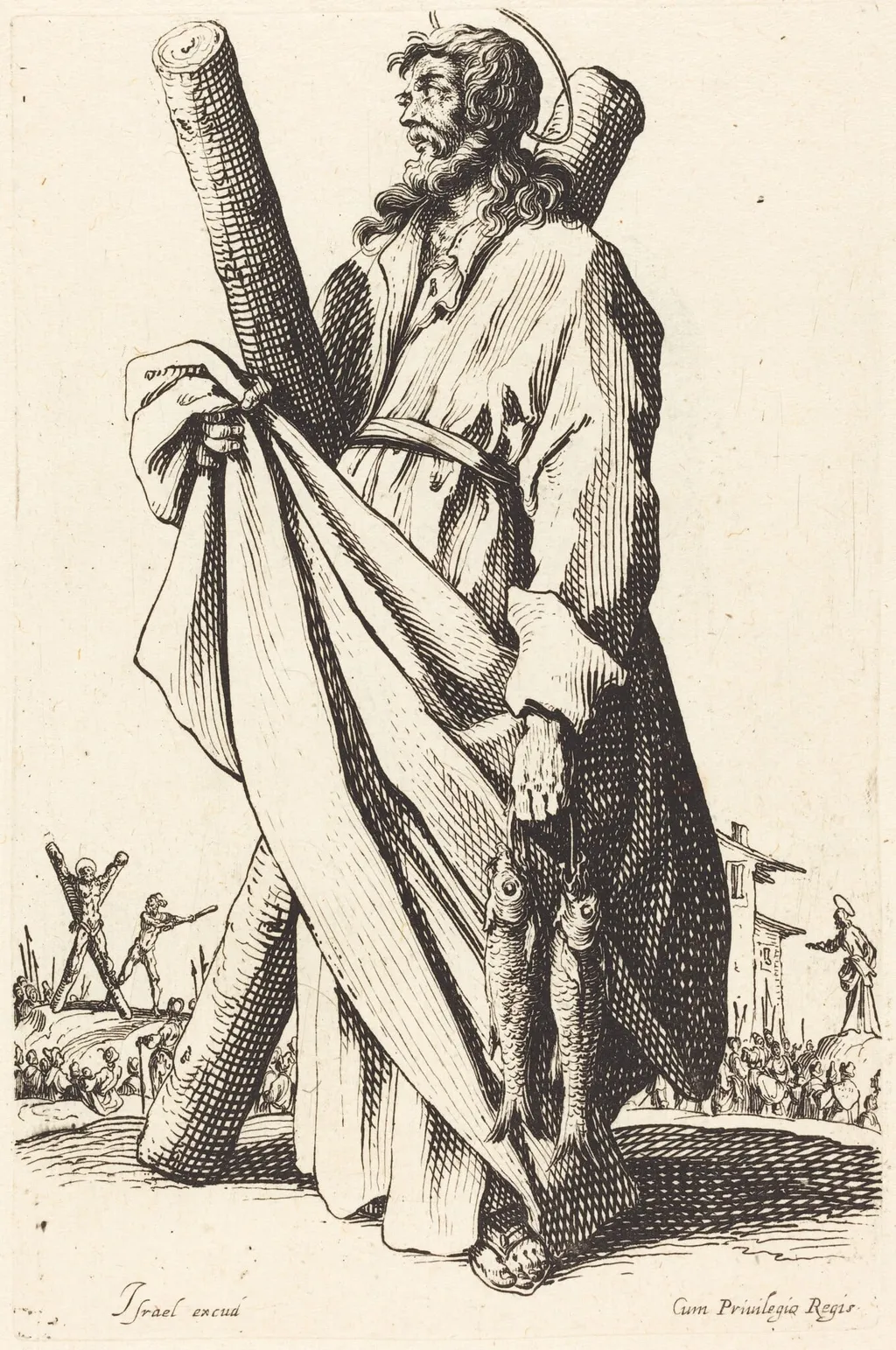
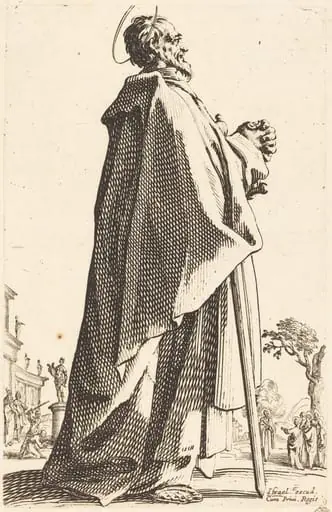
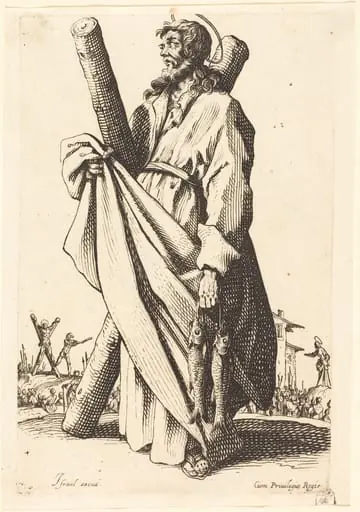
Saint Andrew is an ink print by the Baroque artist Jacques Callot. It dates from 1631 and is held in the collection of the National Gallery of Art.
About this work
Overview
Saint Andrew is a 1631 etching on laid paper by Jacques Callot, a prolific French Baroque printmaker from Lorraine. This work exemplifies his ability to blend detailed religious figures with expansive, nuanced backgrounds.
Subject & Meaning
The etching depicts a bearded Saint Andrew, solemn-faced, carrying a large cross towards a gathered crowd. The scene conveys drama through the contrast between the saint's prominent, textured robe and cross, and the smaller, varied reactions of the onlookers.
Technique & Style
Callot utilized sharp etching lines to achieve detailed textures, evident in the saint's robe and the cross's rough wood. His composition balances a central figure with a lively, depth-implying background, characteristic of his style.
History & Provenance
Created in 1631, Saint Andrew is part of Callot's vast oeuvre of over 1,400 etchings, which broadly documented 17th-century life, including religious and military themes.
Context
This work reflects Callot's practice of incorporating detailed landscapes into religious imagery, a hallmark of his contribution to Baroque printmaking.
Legacy
As part of Callot's extensive body of work, Saint Andrew contributes to the artist's lasting influence on old master prints, highlighting his technical skill and thematic range.
Artist & collection
Artist
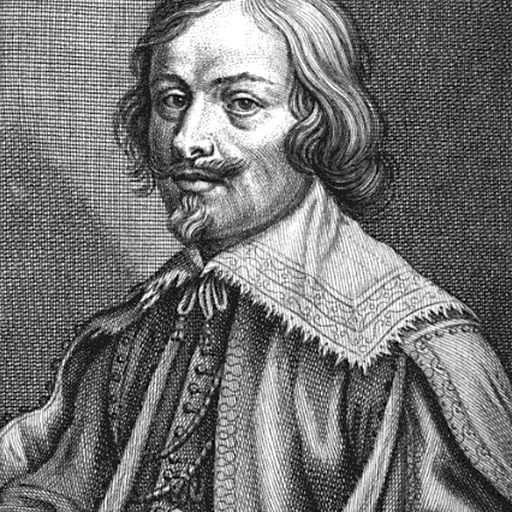
Jacques Callot was a baroque printmaker and draftsman from the Duchy of Lorraine.

 Holy Family at supper
 Restoration of the Aqueduct at Pisa
 Restoration of the Aqueduct at Pisa
 Square in Paris with Many Figures
 Square in Paris with Many Figures
 Horsemen Attacked by Robbers
 HOW WILL A COVERED PART BE CORRECTED?HOW WIKA A COVERED HEART DEED CORRECTED?
![Christ Walking on the Water [second plate], by Jacques Callot](https://artifactworldgallery.com/img/jacques-callot--christ-walking-on-the-water-second-plate--2069f3bfe4cb2126-w320.webp) Christ Walking on the Water [second plate]
Christ Walking on the Water [second plate]