Artwork
Battle of Nude Men
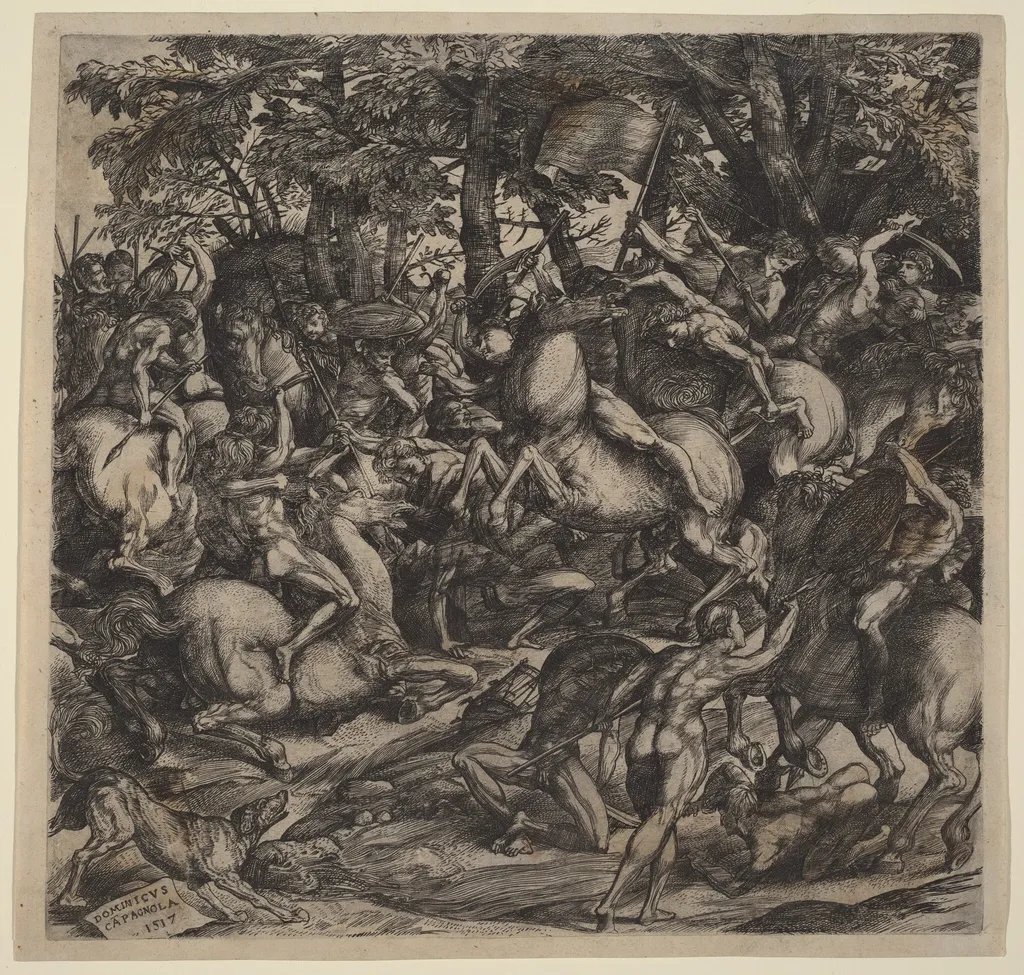
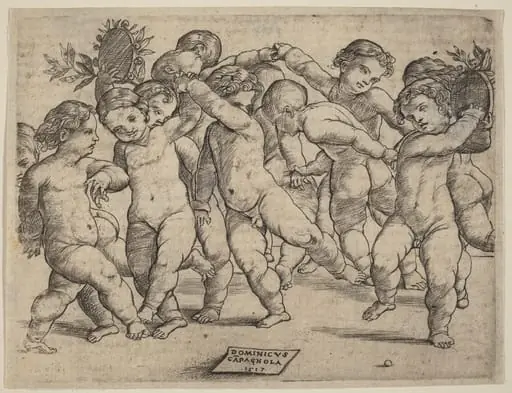
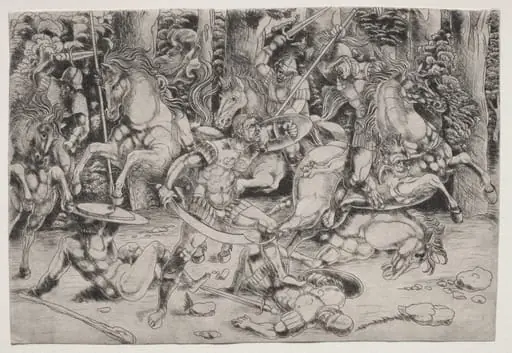
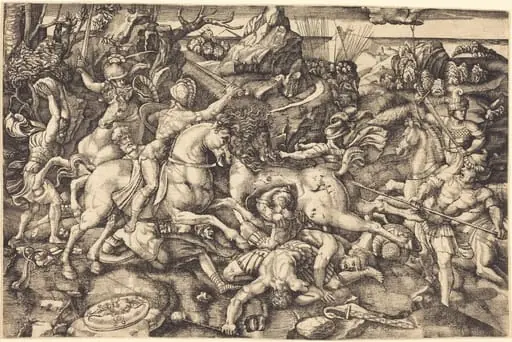
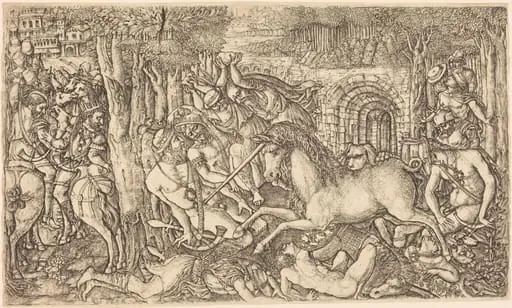
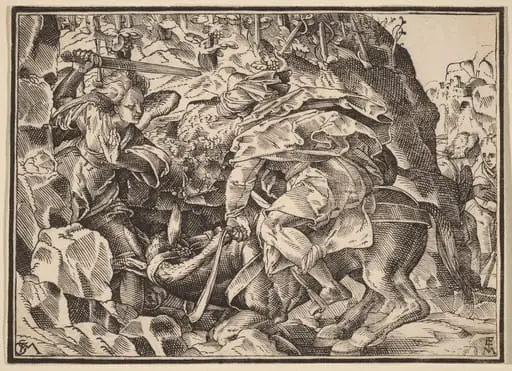
Battle of Nude Men is an ink print by the Renaissance artist Domenico Campagnola. It dates from 1517 and is held in the collection of the National Gallery of Art.
About this work
Overview
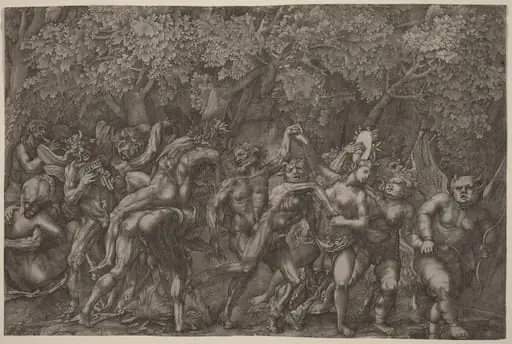
Domenico Campagnola’s engraving titled *Battle of Nude Men* dates from 1517. Executed as a black‑and‑white print, the work presents a densely populated scene of unclothed combatants locked in vigorous struggle. The composition is dominated by a mass of twisting bodies, set against a backdrop of trees and rocky outcrops that recede into the distance.
Subject & Meaning
The print depicts an anonymous melee of nude male figures, each caught in a moment of conflict. Their contorted poses and overlapping gestures convey a sense of chaotic violence, while the absence of narrative detail leaves the episode open to interpretation as an allegorical or mythological confrontation.
Technique & Style
Campagnola employs fine, intersecting lines to model musculature and generate subtle gradations of shadow, giving the figures a near‑three‑dimensional presence. The intricate hatching and cross‑hatching typical of early Renaissance engraving create a dense visual texture that heightens the sense of movement and tension throughout the scene.
History & Provenance
Created in the early sixteenth century, the engraving reflects the period’s growing interest in printmaking as a means of disseminating complex compositions. While specific ownership records are scarce, the work is associated with Campagnola’s broader output of detailed engravings that circulated among collectors and artists of the Venetian Renaissance.
Context
During the 1510s, Venetian artists were expanding the technical possibilities of engraving, using the medium to explore anatomical precision and dynamic composition. Campagnola’s *Battle of Nude Men* exemplifies this trend, showcasing both the artist’s skill in line work and the era’s fascination with the human form in action.
Artist & collection