Artwork
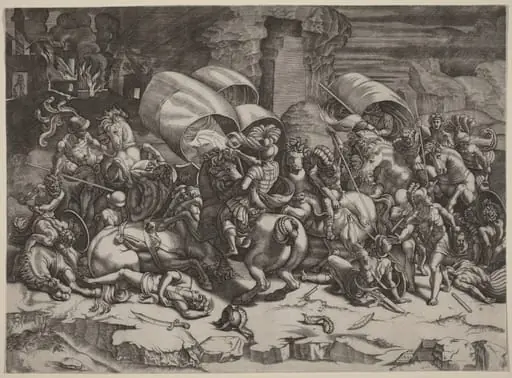
Combat between Horsemen and Foot Soldiers
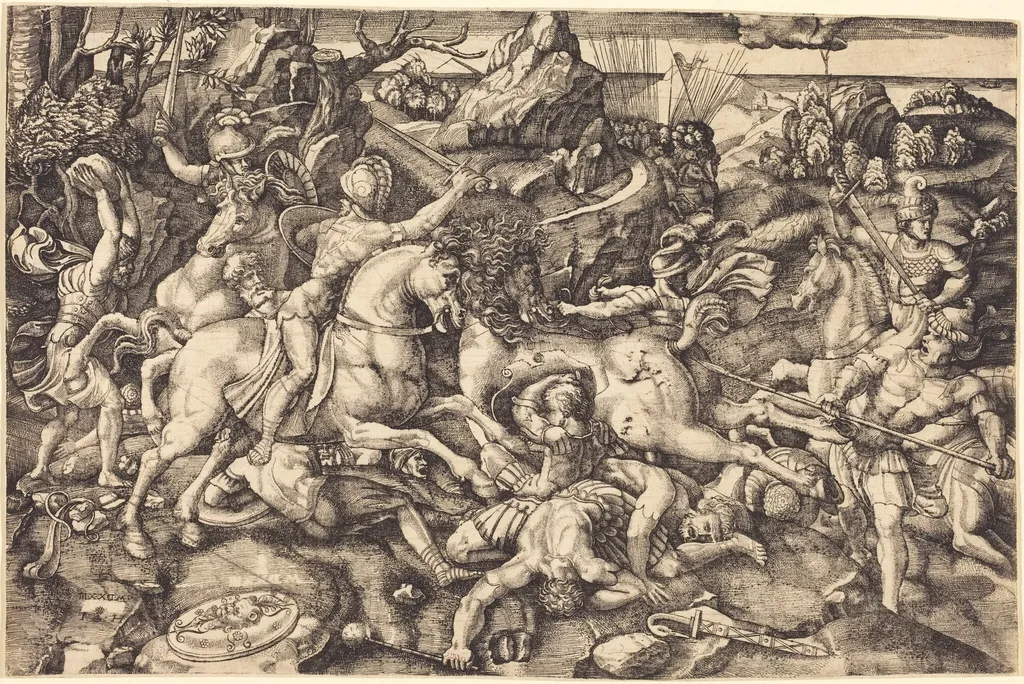
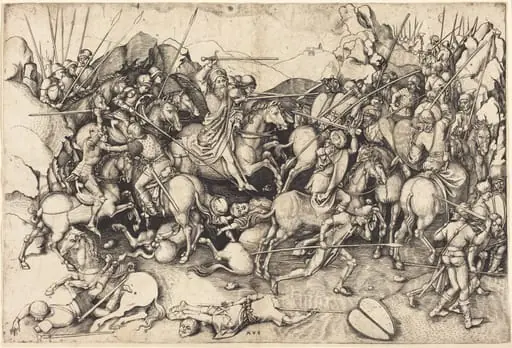
Combat between Horsemen and Foot Soldiers is an ink print by the Renaissance artist Hieronymus Hopfer. It dates from 1525 and is held in the collection of the National Gallery of Art.
About this work
Overview
The scene unfolds in a confined space, where bodies and horses interlock in motion, suggesting chaos without explicit order.
Created in 1525 by Hieronymus Hopfer, this etching depicts a violent clash between mounted and foot soldiers. Rendered in black ink on paper, the composition captures a dense, dynamic melee with no clear narrative center. The scene unfolds in a confined space, where bodies and horses interlock in motion, suggesting chaos without explicit order. The work belongs to a tradition of martial prints that emphasized action over storytelling.
Subject & Meaning
The print portrays a generic battle, not tied to a specific historical event. It presents combat as a visceral, physical struggle—soldiers grapple, horses rear, and limbs twist in exertion. The absence of identifiable leaders or flags suggests a focus on the raw experience of warfare rather than its political or heroic dimensions. The imagery may reflect contemporary anxieties about violence in the wake of peasant uprisings and regional conflicts.
Technique & Style
Hopfer employed fine, controlled etching lines to render movement and tension. The precision of the incised marks gives the impression of carved detail, despite being drawn on metal. He used dense, overlapping contours to suggest depth and mass without shading, relying on line weight and density to convey form. The composition is tightly packed, yet each figure remains legible, demonstrating mastery in spatial compression.
History & Provenance
The print was produced in Augsburg, a center for printmaking and metalwork in early 16th-century Germany. Hopfer, part of a family of engravers, specialized in etchings of military and mythological scenes. This work likely circulated as a standalone print or as part of a series, appealing to collectors interested in martial imagery. Its survival in multiple institutional collections indicates early and sustained interest.
Context
In the decades surrounding 1525, Germany experienced widespread social unrest, including the Peasants' War. Military imagery in prints became more prevalent, reflecting both public fascination and unease with violence. Hopfer’s work aligns with a broader trend of secular, action-oriented prints that catered to urban audiences, distinct from religious or allegorical subjects dominant in earlier decades.
Legacy
Hopfer’s etching exemplifies the technical refinement possible in early printmaking, influencing later artists who sought to capture motion through line. While not widely known today, his approach to dense, energetic compositions contributed to the development of battle scenes in Northern European print culture. The work remains a reference for studying how artists conveyed chaos within strict formal constraints.
Artist & collection


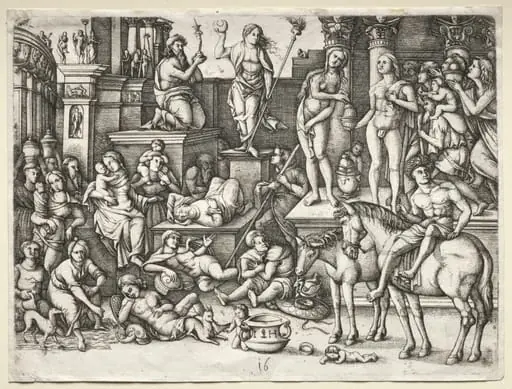
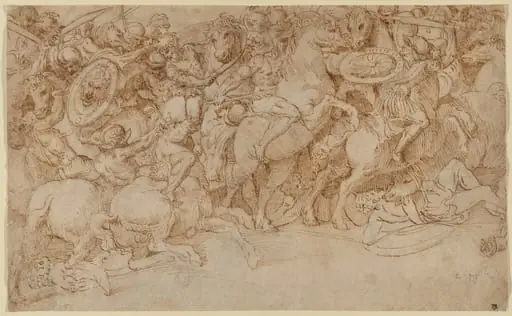 A Battle on Horseback
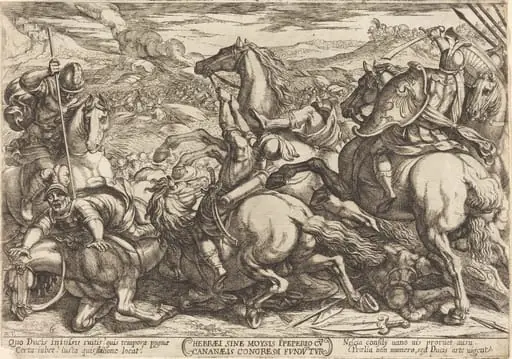 The Hebrews defeat the Canaans
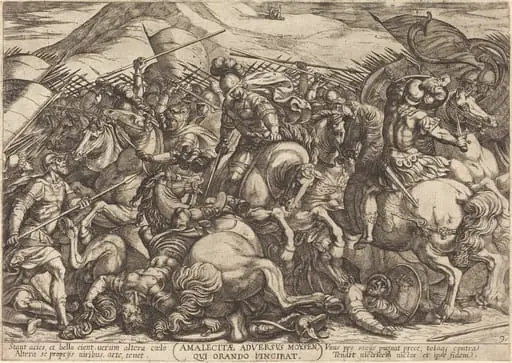 The Defeat of the Amalikits by the Hebrews
 The Battle with the Cutlass
 Christ Tells His Disciples of the Last Judgment
 The Trojans Repulsing the Greeks
 La bataille au coutelas
 The Fall of Troy and the Escape of Aeneas
 Conversion of St. Paul
 The Battle of Saint James at Clavijo