Artwork
Italian Girl with Mandolin on the Coast of the Gulf of Naples
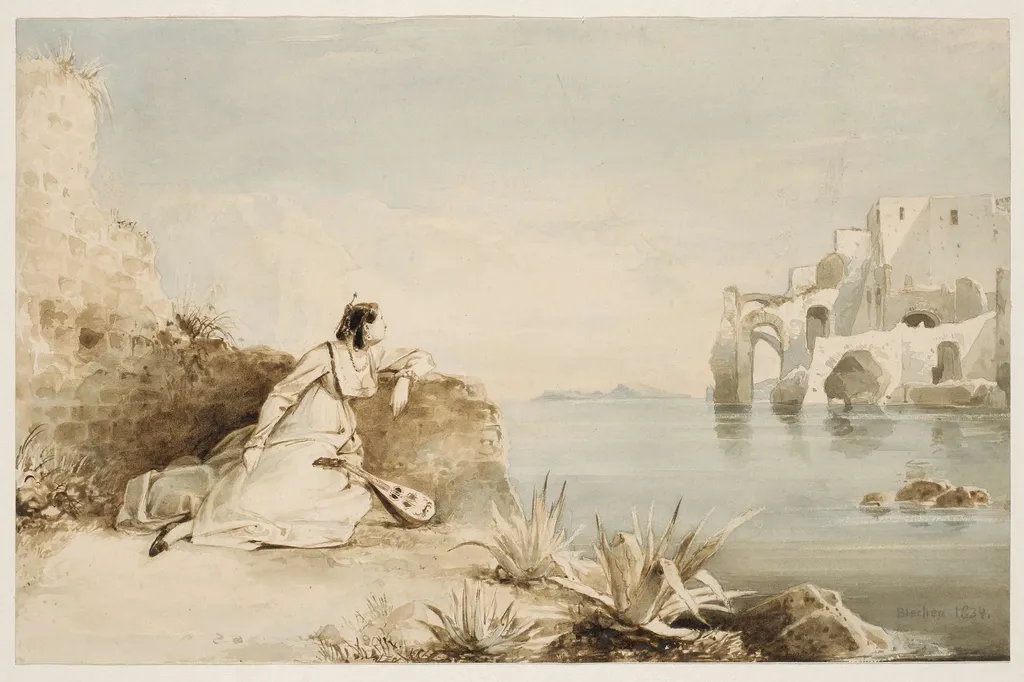
Italian Girl with Mandolin on the Coast of the Gulf of Naples is an unspecified painting by Carl Blechen. It dates from 1834 and is held in the collection of the National Gallery of Canada.
About this work
Overview
Blechen, known for his atmospheric landscapes and academic role in Berlin, here merges a human presence with a quiet coastal setting.
Painted in 1834 by the German artist Carl Blechen, this work captures a solitary figure on the southern Italian coast. Blechen, known for his atmospheric landscapes and academic role in Berlin, here merges a human presence with a quiet coastal setting. The scene reflects his broader interest in the emotional resonance of nature, framed through the lens of Romantic sensibility rather than topographical precision.
Subject & Meaning
A young woman, dressed in a white gown and dark-haired, sits on a rocky shore, cradling a mandolin. Her posture is still, her gaze distant, suggesting introspection rather than performance. The absence of narrative action shifts focus to mood: the figure becomes an emblem of quiet solitude, harmonizing with the stillness of the sea and sky. The mandolin, a cultural symbol, adds subtle local character without overt storytelling.
Technique & Style
Blechen employs soft tonal transitions to evoke atmospheric depth, with muted blues and grays dominating the sea and sky. The girl’s white dress contrasts gently against the darker rocks, drawing the eye without disrupting the scene’s calm. Brushwork is deliberate but unobtrusive, favoring subtle gradations of light over sharp detail. The composition balances figure and landscape, each element reinforcing the other’s quiet presence.
History & Provenance
Created during Blechen’s travels in Italy, the painting emerged from his engagement with southern landscapes after his return from a study trip. It was likely made in the early 1830s, a period when he increasingly integrated human figures into his natural scenes. The work remained in private collections in Germany until the 20th century, with no major public exhibition history documented prior to its current institutional ownership.
Context
In the 1830s, German artists were drawn to Italy as a site of aesthetic and spiritual renewal. Blechen’s depiction aligns with Romantic ideals that valued emotional response to nature over classical order. Unlike contemporaries who emphasized ruins or grand vistas, he focused on intimate, unheroic moments—here, a girl in repose—reflecting a quieter, more personal strand of Romanticism emerging in Northern Europe.
Legacy
Though not among Blechen’s most widely reproduced works, this painting exemplifies his distinctive synthesis of landscape and human presence. It influenced later German painters who sought emotional nuance in natural settings, steering away from theatricality. Today, it stands as a quiet testament to his ability to convey solitude and serenity through restrained composition and atmospheric tone.
Own this work as a print
Artist & collection

Artist
Carl Eduard Ferdinand Blechen (29 July 1798 – 23 July 1840) was a German landscape painter and a professor at the Academy of Arts, Berlin. His distinctive style was characteristic of the Romantic ideals of natural beauty.




 Coast View near Sorrento, Bay of Naples
 Ecole de Virgile, Baja
 Palais de Tibere a Capri
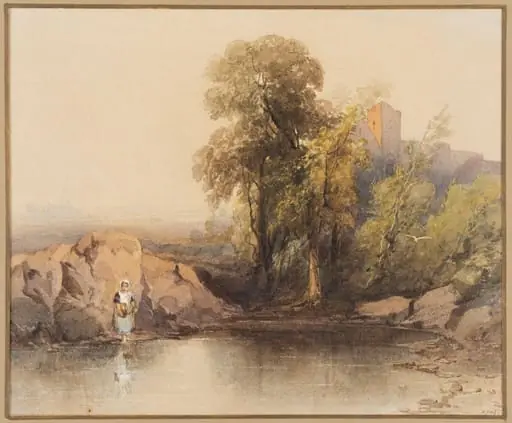 Pond and trees sunset
 Coast near Castiglione
 A Classical Composition
 Oriental Capriccio, with water, boats and buildings
 Gule-Hissa Ovassy in the Northern part of Lycia
 The Castle of Ischia, Bay of Naples
 The Citadel of Sidon
 Pozzuoli
 An Italian Coast Scene