Artwork
Bergeronnette
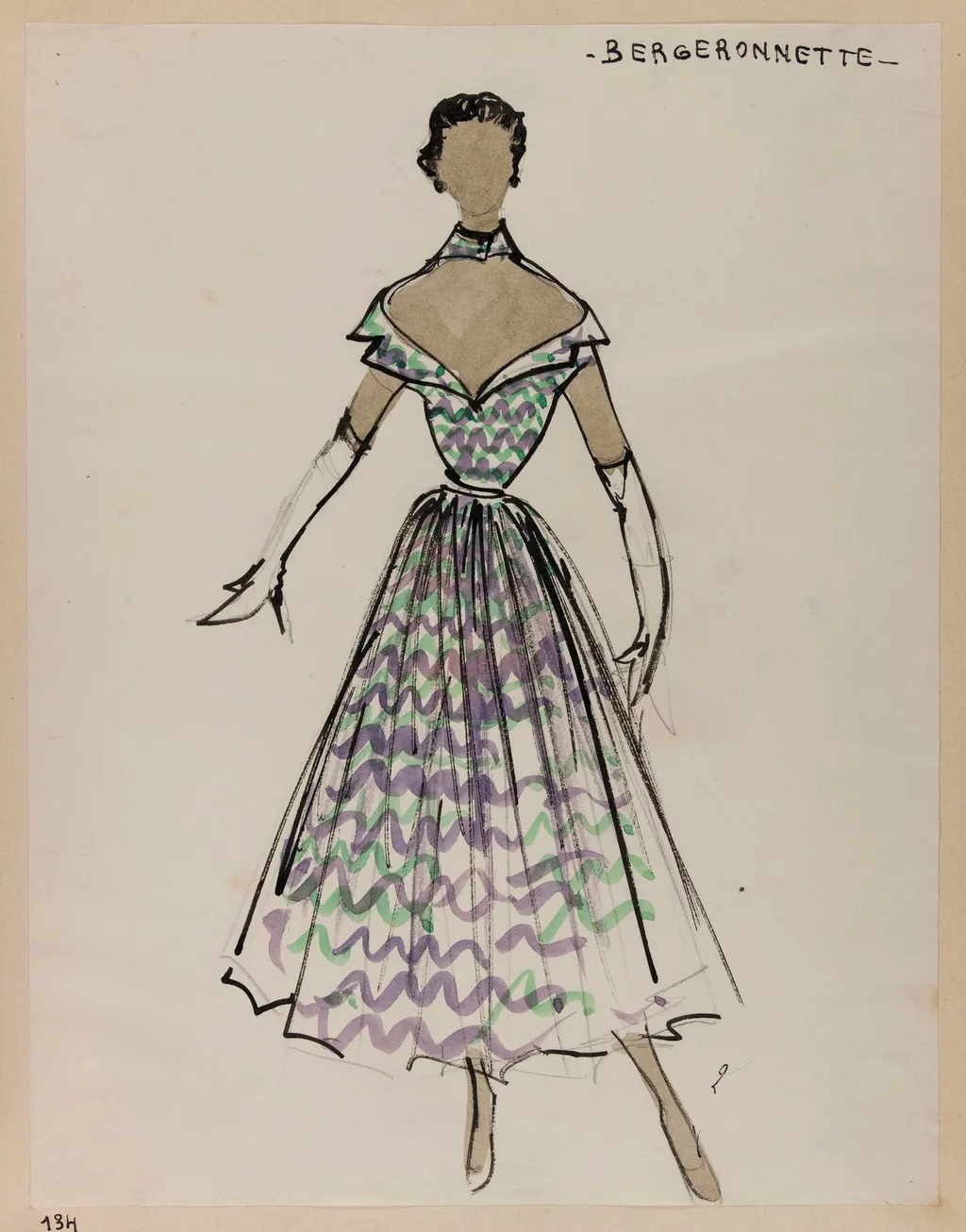
Bergeronnette is a drawing by Carven. It dates from 1952 and is held in the collection of the Palais Galliera - Musée de la Mode de la Ville de Paris.
About this work
Overview
Though labeled as a fashion sketch, its informal quality suggests it was made as a study rather than a finished presentation piece.
Created in 1952 by the designer Carven, Bergeronnette is a pencil drawing that captures a woman in motion. Executed with rapid, expressive lines, the work belongs to the collection of the Museum of Ethnography. Though labeled as a fashion sketch, its informal quality suggests it was made as a study rather than a finished presentation piece. The title and catalog number, '13H,' indicate it was part of a larger series of design experiments.
Subject & Meaning
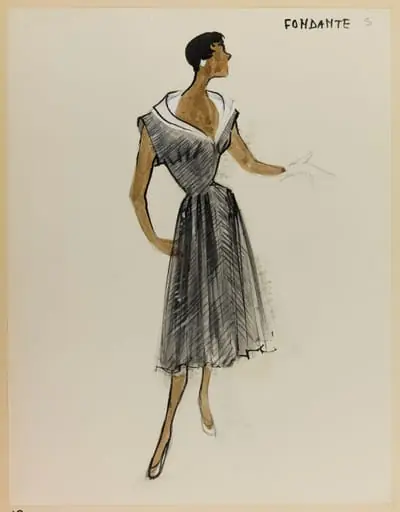
The figure depicts a woman in a tailored yet fluid dress, her posture relaxed but poised—one hand resting on her hip. The attire, with its V-neck and layered skirt, reflects mid-century French femininity, blending elegance with ease. The name 'Bergeronnette,' meaning a type of bird, may allude to lightness or movement, reinforcing the garment’s airy silhouette. The sketch avoids overt symbolism, focusing instead on the rhythm of form and fabric.
Technique & Style
The drawing is rendered in loose, visible pencil strokes that emphasize spontaneity over precision. Contours are suggested rather than defined, and shading is minimal, relying on line weight to imply volume. The swirls on the skirt are drawn with fluid, rhythmic marks, suggesting movement rather than detailed pattern. The unfinished quality reflects a working method typical of fashion designers capturing ideas quickly, prioritizing gesture over polish.
History & Provenance
The drawing entered the Museum of Ethnography’s collection as part of a donation of Carven’s archival materials. Its origin as a design study from 1952 aligns with the designer’s active period in postwar Paris. The presence of the catalog number '13H' suggests it was cataloged systematically, likely during an institutional effort to preserve fashion ephemera. No earlier ownership records are publicly documented.
Context
In early 1950s Paris, fashion houses relied on rapid sketches to explore silhouettes before fabric selection. Carven, known for wearable elegance, used such drawings to refine her signature blend of structure and fluidity. This piece reflects a broader trend among designers to document inspiration informally, valuing immediacy over presentation. The sketch’s ethnographic placement hints at its role as cultural artifact, not merely commercial tool.
Legacy
Bergeronnette exemplifies how fashion design was documented in its formative stages, preserving the artist’s thought process. Its preservation in an ethnographic museum underscores a shift in how fashion is valued—not just as clothing, but as cultural expression. The drawing’s rawness invites comparison with other working sketches of the era, offering insight into the creative rhythm behind couture production.
Artist & collection
Artist
These delicate ink-on-paper drawings capture the quiet poetry of everyday things: pinecones, reeds, apples.
Museum
Palais Galliera - Musée de la Mode de la Ville de Paris
Continue through works from the same source collection.