Artwork
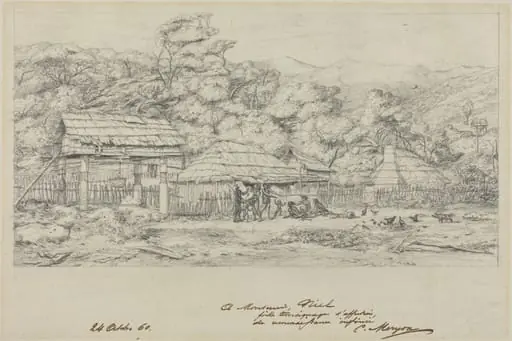
Native Barns and Huts at Akaroa, Banks' Peninsula, 1845
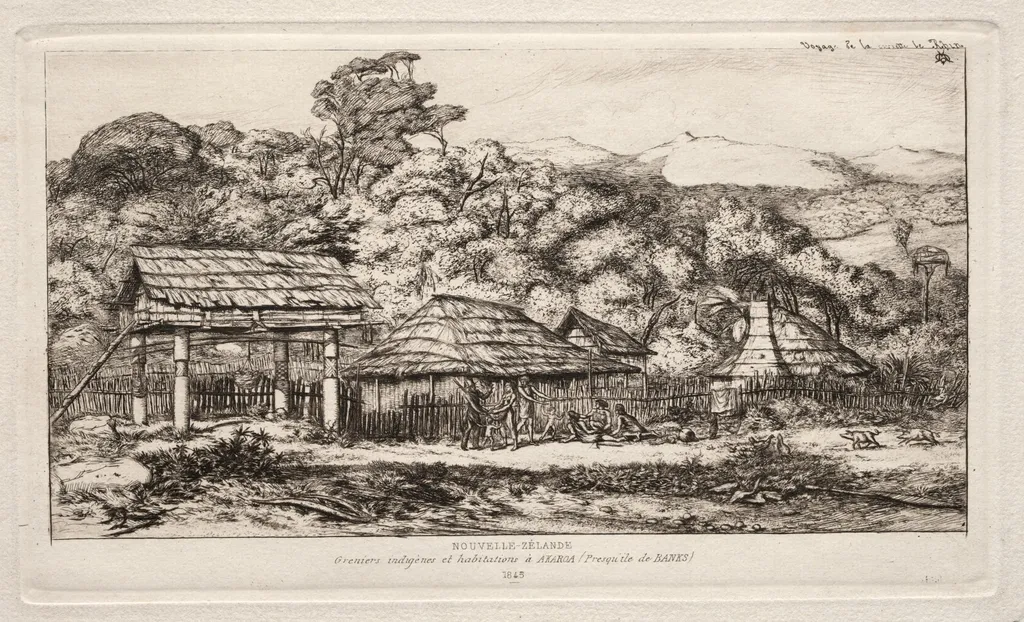
Native Barns and Huts at Akaroa, Banks' Peninsula, 1845 is a print by the Impressionist artist Charles Meryon. It dates from 1865 and is held in the collection of the Cleveland Museum of Art.
About this work
This black-and-white sketch shows a cluster of simple huts with thatched roofs, built close to a forest.
This black-and-white sketch shows a cluster of simple huts with thatched roofs, built close to a forest. A small stream runs in front of them, and the hills in the background are dotted with trees. A few people are visible near the huts, going about their daily tasks.
The title says these huts are in Akaroa, on Banks Peninsula, drawn in 1845. The artist made this sketch decades later, so it’s more of a memory than a live scene.
If you like this style, check out Realism—it focuses on everyday life just like this drawing does.
Overview
Created in 1865, this etching by Charles Meryon captures a scene from Akaroa on Banks Peninsula, New Zealand, originally observed in 1845. Though executed two decades after the visit, the work reflects Meryon’s sustained engagement with architectural forms and rural environments encountered during his travels. The image is rendered in monochrome, emphasizing structure and atmosphere over color, consistent with his broader printmaking practice.
Subject & Meaning
The scene portrays modest Māori or settler-built dwellings with thatched roofs, nestled against a forested slope and adjacent to a narrow stream. Figures are present but unobtrusive, engaged in quiet daily activities. The composition avoids romanticization, instead presenting a restrained record of vernacular architecture and lived space, suggesting an interest in the quiet integration of human habitation within natural terrain.
Technique & Style
Meryon employed fine-line etching to achieve subtle tonal gradations and precise architectural detail. His use of cross-hatching and delicate line work conveys texture in thatch, foliage, and earth without reliance on shading or color. The composition is tightly framed, drawing attention to the relationship between built forms and landscape, a hallmark of his method in depicting structures across diverse geographies.
History & Provenance
Meryon visited New Zealand during a voyage in 1845 as part of a French naval expedition. He made sketches on-site, later transforming them into etchings in his Paris studio. This print was produced in 1865, well after his return to France, during a period when he was refining his earlier travel studies. The work entered institutional collections in the late 19th century, preserved as part of his documented global observations.
Context
Produced during a time of increasing European documentation of Pacific settlements, the etching aligns with 19th-century ethnographic and topographical practices. While not overtly political, it quietly records indigenous and colonial architectural responses to the New Zealand landscape. Meryon’s approach diverged from overt exoticism, favoring observational neutrality over dramatization.
Legacy
Though less known than his Parisian urban scenes, this work contributes to Meryon’s reputation as a meticulous observer of architecture in varied cultural settings. Its inclusion in major print collections underscores its value as a rare visual record of mid-19th-century New Zealand settlements. The etching remains a quiet example of how travel and memory shaped European printmaking beyond its domestic centers.
Artist & collection
Artist
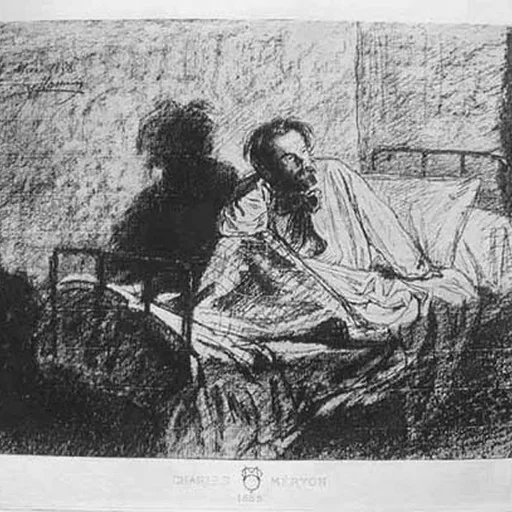
Charles Meryon (sometimes Méryon, 23 November 1821 – 14 February 1868) was a French artist who worked almost entirely in etching, as he had colour blindness.

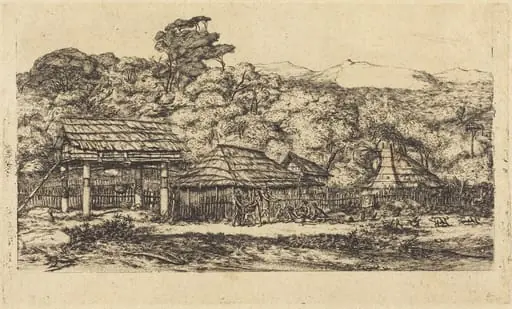 Greniers indigènes et habitations à Akaroa, presqu'Ile de Banks, 1845 (Native Barns and Huts at Akaroa, Banks' Peninsula, 1845)
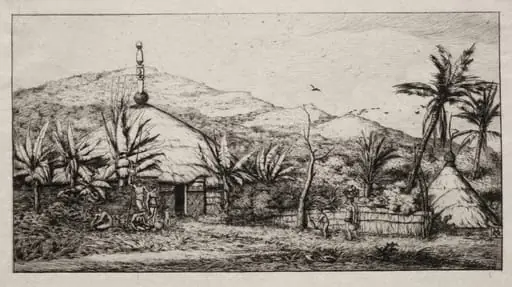 New Caledonia: Large Native Hut on the Road from Balade to Puebo, 1845
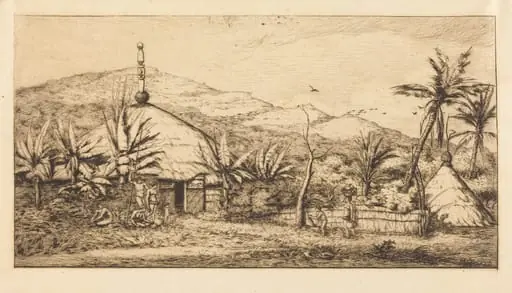 Nouvelle-Calédonie: Grande case indigène sur le chemin de Ballade à Poepo, 1845 (New Caledonia: Large Native Hut on the Road from Balade to Puebo, 1845)
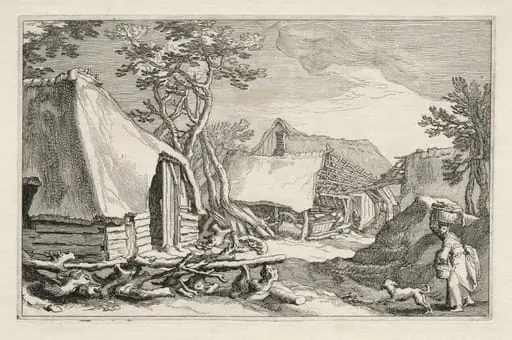 Landscape with Farmhouses
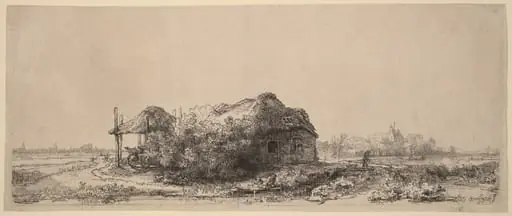 Landscape with a Cottage and Hay Barn: Oblong