Artwork
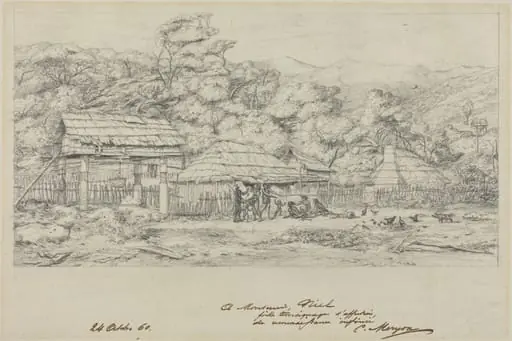
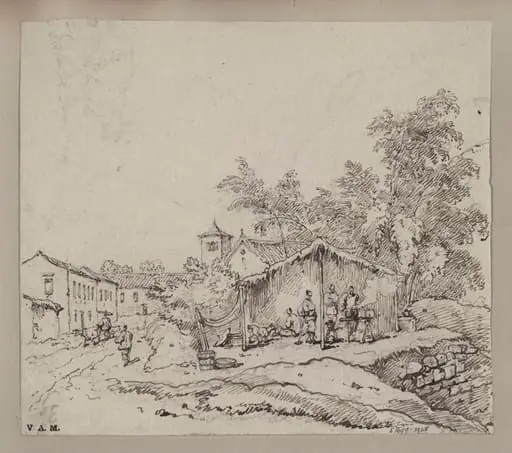
New Caledonia: Large Native Hut on the Road from Balade to Puebo, 1845
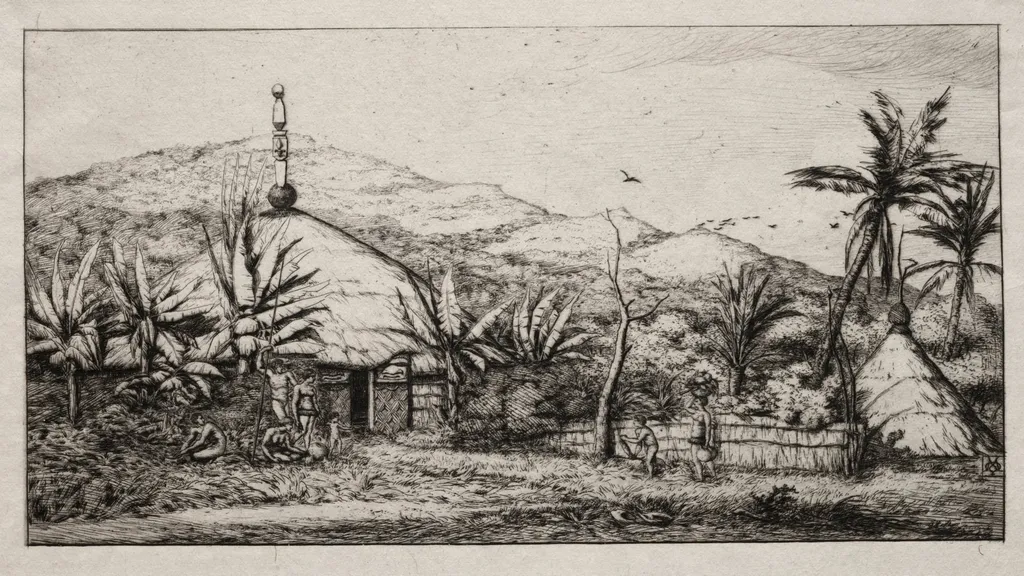
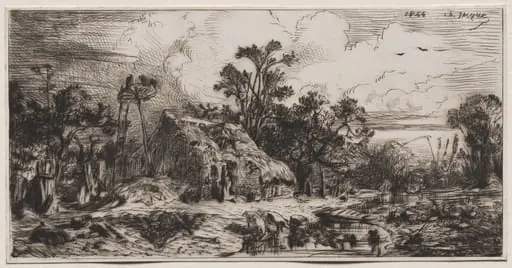
New Caledonia: Large Native Hut on the Road from Balade to Puebo, 1845 is a print by the Impressionist artist Charles Meryon. It dates from 1863 and is held in the collection of the Cleveland Museum of Art.
About this work
Overview
His color blindness led him to focus exclusively on line and tone, shaping a distinctive visual language grounded in precision and restraint.
Created in 1863, this etching by Charles Meryon captures a solitary native structure along a path in New Caledonia. Though best known for his atmospheric depictions of Paris, Meryon produced a series of works during his travels in the Pacific. This piece belongs to that lesser-known body of travel sketches, rendered in his signature monochrome technique. His color blindness led him to focus exclusively on line and tone, shaping a distinctive visual language grounded in precision and restraint.
Subject & Meaning
The scene centers on a large thatched hut, surrounded by palm trees and three figures engaged in quiet, everyday activities. A simple wooden cross atop the structure suggests the presence of missionary influence. The figures—seated, leaning, standing—offer no dramatic narrative, instead conveying a sense of stillness and routine. Meryon’s choice to depict ordinary life, without idealization, aligns with a documentary impulse common among 19th-century travelers recording unfamiliar cultures.
Technique & Style
Executed in fine, controlled etching lines, the work demonstrates Meryon’s mastery of tonal gradation and texture. The thatch roof, foliage, and fabric folds are rendered with delicate cross-hatching, creating depth without color. The background hills recede through lighter, sparser lines, while foreground elements remain sharply defined. This method, typical of topographical sketches of the era, prioritizes clarity and observational accuracy over expressive flourish.
History & Provenance
Meryon produced this etching during a voyage to the South Pacific aboard the French naval vessel La Bonite, which stopped in New Caledonia in 1845. Though the drawing was made then, the etching was completed nearly two decades later in Paris, based on his field sketches. It was likely included in a private collection or institutional archive before entering public circulation, reflecting the 19th-century European fascination with colonial territories and ethnographic documentation.
Context
This work emerged amid a surge of European interest in Pacific islands, driven by naval expeditions and missionary activity. Meryon’s etching contributes to a broader genre of travel illustrations that sought to record indigenous architecture and daily life. Unlike romanticized portrayals common in the period, his approach is restrained, avoiding exoticism in favor of quiet observation—a subtle shift toward the realist tendencies emerging in art at the time.
Legacy
Though overshadowed by his Parisian etchings, this piece exemplifies Meryon’s commitment to documenting the world through meticulous line work. It stands as a rare Pacific record within his oeuvre, offering insight into how French artists engaged with colonial landscapes. The work’s quiet realism influenced later generations interested in ethnographic representation, reinforcing etching’s role as a medium for both artistic and anthropological inquiry.
Artist & collection
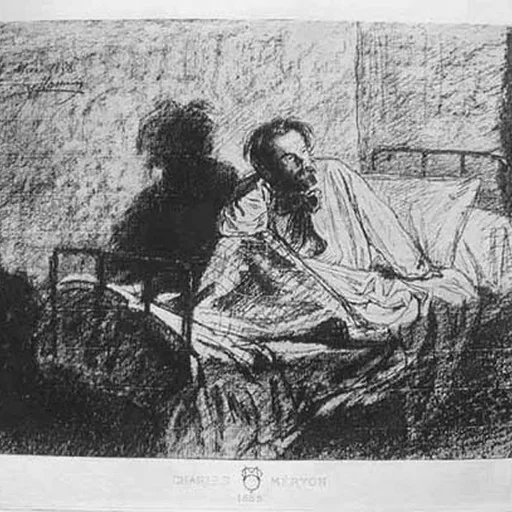
Artist
Charles Meryon (sometimes Méryon, 23 November 1821 – 14 February 1868) was a French artist who worked almost entirely in etching, as he had colour blindness.