Artwork
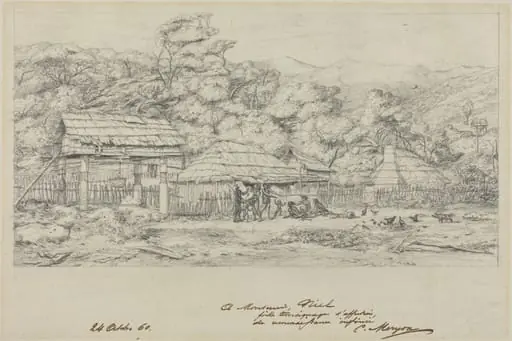
Nouvelle-Calédonie: Grande case indigène sur le chemin de Ballade à Poepo, 1845 (New Caledonia: Large Native Hut on the Road from Balade to Puebo, 1845)
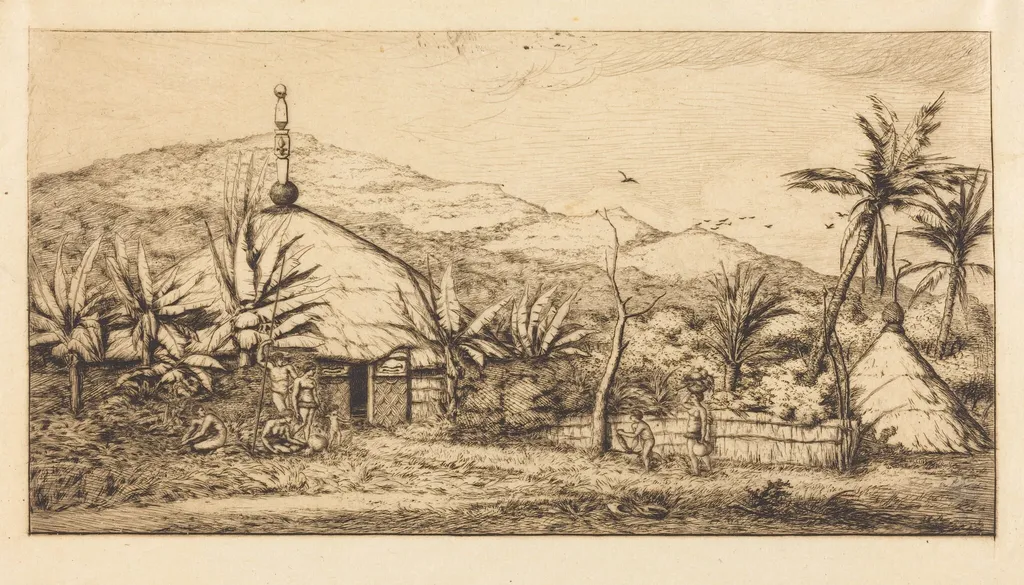
Nouvelle-Calédonie: Grande case indigène sur le chemin de Ballade à Poepo, 1845 (New Caledonia: Large Native Hut on the Road from Balade to Puebo, 1845) is an ink print by the Impressionist artist Charles Meryon. It dates from 1863 and is held in the collection of the National Gallery of Art.
About this work
Overview
Charles Meryon’s etching, executed on laid paper, presents a solitary, thatched hut set against a tropical landscape in New Caledonia. The composition captures a narrow path flanked by palm trees, with a few figures engaged in everyday activity near the structure. Rolling hills rise in the distance, while birds trace arcs across the sky, offering a concise view of colonial-era island life.
Subject & Meaning
The image records a large Indigenous dwelling along the road from Balade to Poebo, emphasizing the modest architecture and communal space of the local population. The presence of seated and moving figures suggests routine social interaction, while the surrounding flora and open sky convey a sense of the region’s natural environment and its integration with human habitation.
Technique & Style
Meryon employed a fine, sharply incised line to render architectural detail and atmospheric depth, characteristic of his etching practice.
Meryon employed a fine, sharply incised line to render architectural detail and atmospheric depth, characteristic of his etching practice. Ink was forced into the metal plate’s grooves and transferred onto the laid paper, producing a clear contrast between the dark outlines of the hut, the delicate foliage, and the lighter sky. The precision of the linework balances documentary observation with a subtle sense of mood.
History & Provenance
Although Meryon is chiefly associated with Parisian cityscapes, this print belongs to a lesser‑known series inspired by his travels beyond France. Created in the mid‑19th century, the work reflects his interest in exotic locales and was likely produced shortly after his return from New Caledonia. It has since entered museum collections as an example of his broader geographic scope.
Context
The etching emerges from a period when European artists frequently documented colonial territories, often blending ethnographic observation with artistic interpretation. Meryon’s focus on a native hut aligns with contemporary curiosity about indigenous architecture, while his technical approach situates the work within the French print tradition that prized meticulous line and tonal variation.
Artist & collection
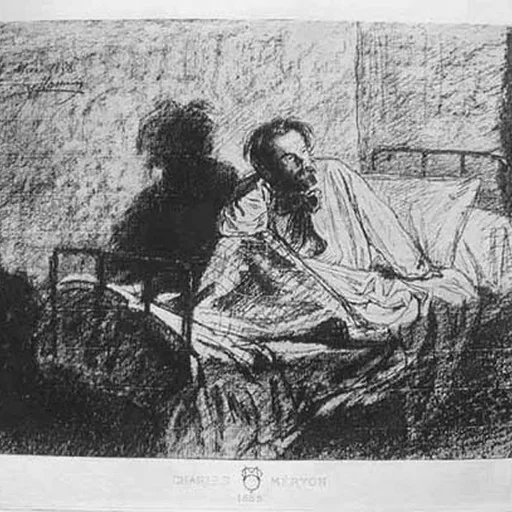
Artist
Charles Meryon (sometimes Méryon, 23 November 1821 – 14 February 1868) was a French artist who worked almost entirely in etching, as he had colour blindness.

 View in Krakatoa Island, near the Straits of Sunda
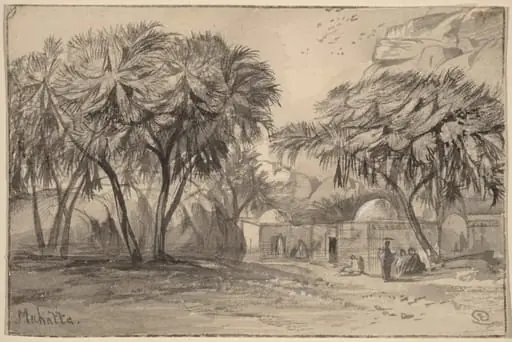 Mahatta
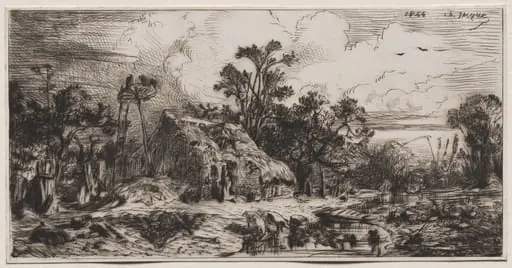 The Cottage
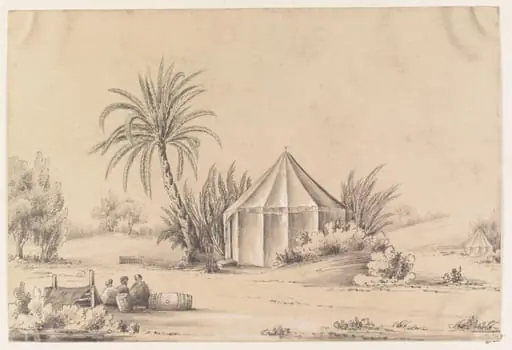 A Scene in the Desert Wady Gharendl
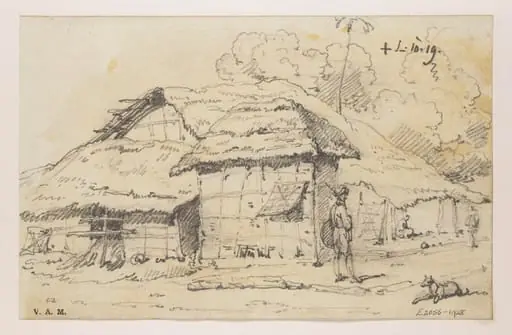 Village huts, Bengal
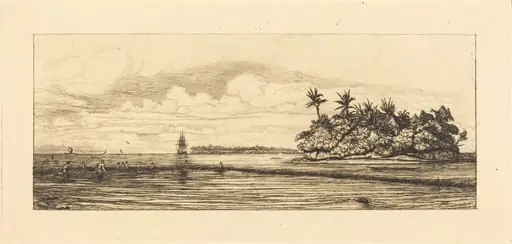 Océanie, ilots à Uvea (Wallis); Peche aux palmes, 1845 (Oceania: Fishing, Near Islands with Palms in the Uea or Wallis Group)
 A Farmyard with a Draw Well
 Road with Barn and Cottages