Artwork
Fishing
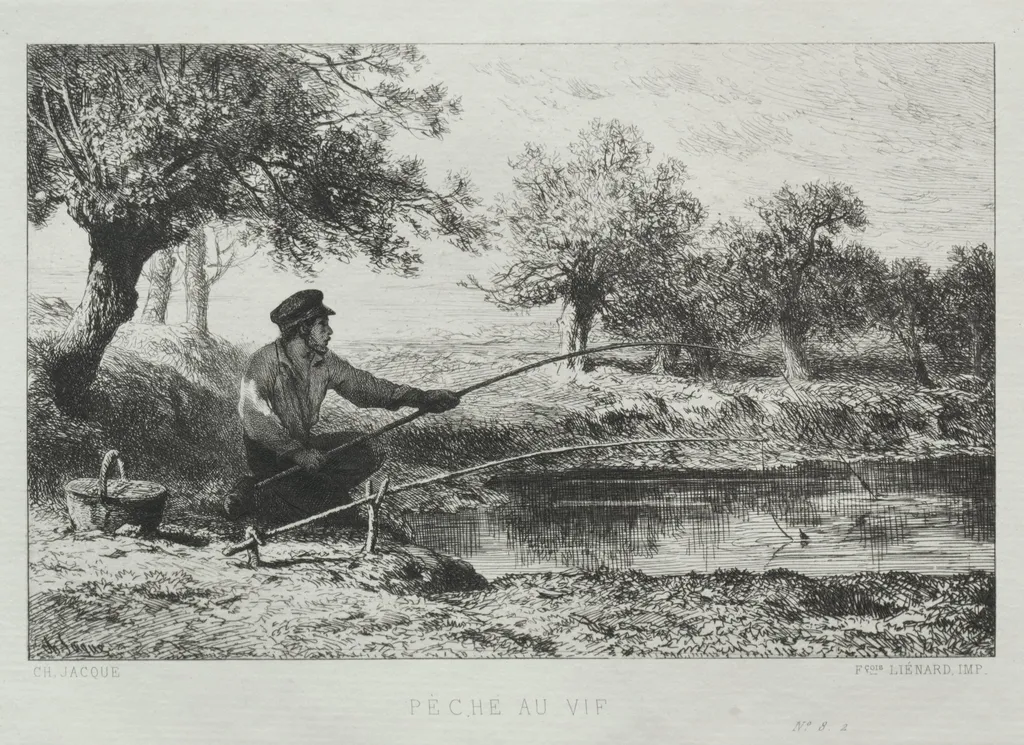
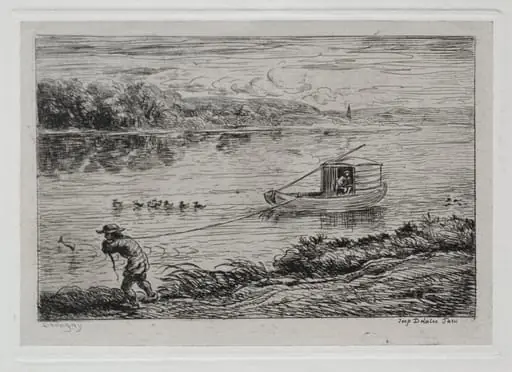
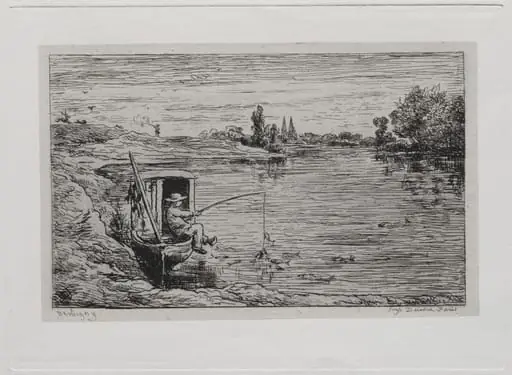
Fishing is a print by the Impressionist artist Charles Jacque. It dates from 1864 and is held in the collection of the Cleveland Museum of Art.
About this work
Overview
The piece is now part of The Cleveland Museum of Art’s collection, reflecting his enduring interest in quiet, unadorned scenes of the countryside.
Charles-Émile Jacque produced the print *Fishing* in 1864, capturing a tranquil moment along a French riverbank. Though trained as a map engraver during military service, he turned to pastoral subjects after leaving the army. His work aligns with the Barbizon School’s dedication to observing rural life without idealization. The piece is now part of The Cleveland Museum of Art’s collection, reflecting his enduring interest in quiet, unadorned scenes of the countryside.
Subject & Meaning
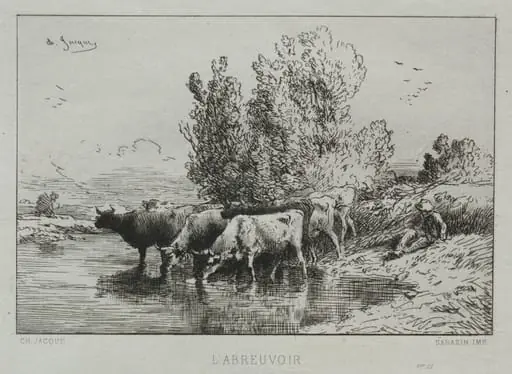
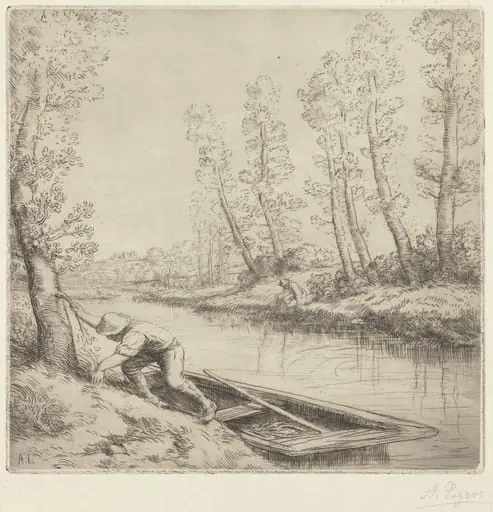
The scene depicts two boats on a still river: one holds two men repairing nets, the other drifts empty. Tools lie scattered along the grassy shore, suggesting a pause in labor rather than a grand event. Jacque avoids drama, instead emphasizing the rhythm of daily work. The composition invites contemplation of solitude, routine, and the quiet dignity of rural labor, central themes in his artistic vision.
Technique & Style
Jacque employed etching and engraving techniques to render fine linear detail and subtle tonal gradations. The soft contours of the riverbank, the delicate texture of the nets, and the muted greens of the landscape reflect his mastery of printmaking. His style avoids theatricality, favoring restrained composition and atmospheric balance. The quiet energy of the scene arises from precise observation, not embellishment.
History & Provenance
Created in 1864, *Fishing* emerged during Jacque’s mature period, when he was deeply engaged with rural subjects after years of military engraving. The work entered The Cleveland Museum of Art’s collection through documented acquisition, likely in the early 20th century. Its preservation reflects sustained interest in Barbizon-associated printmakers and their documentation of 19th-century French rural life.
Context
Jacque’s work belongs to the broader Barbizon movement, which rejected academic idealism in favor of direct observation of nature and peasant life. While contemporaries like Millet focused on labor’s hardship, Jacque often emphasized its quiet continuity. His upbringing near Paris gave him access to rural peripheries, which he rendered with intimacy rather than sentimentality, aligning with the movement’s realist ethos.
Legacy
Jacque’s prints, including *Fishing*, contributed to the recognition of printmaking as a legitimate medium for serious artistic expression. His focus on unheroic rural moments influenced later realist and regionalist artists. Though less widely known than his painting peers, his technical precision and understated narratives remain valued for their sincerity and quiet resonance in 19th-century French art.
Own this work as a print
Artist & collection
Artist
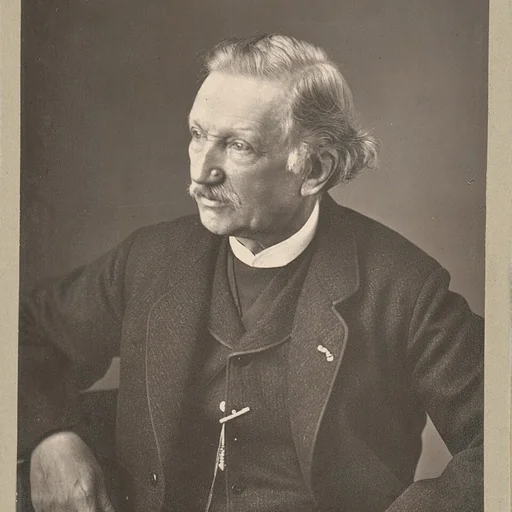
Charles-Émile Jacque (23 May 1813 – 7 May 1894) was a French painter of Pastoralism and engraver who was, with Jean-François Millet, part of the Barbizon School. He first learned to engrave maps when he spent seven years in the French Army.