Artwork
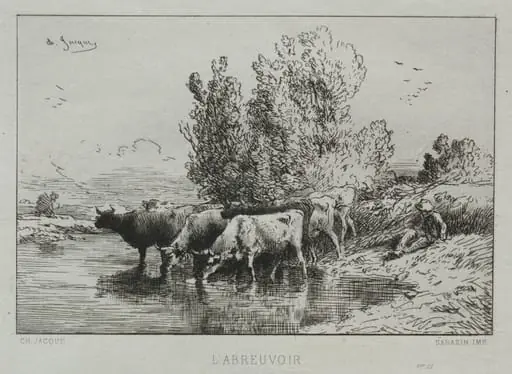
L'Abreuvoir
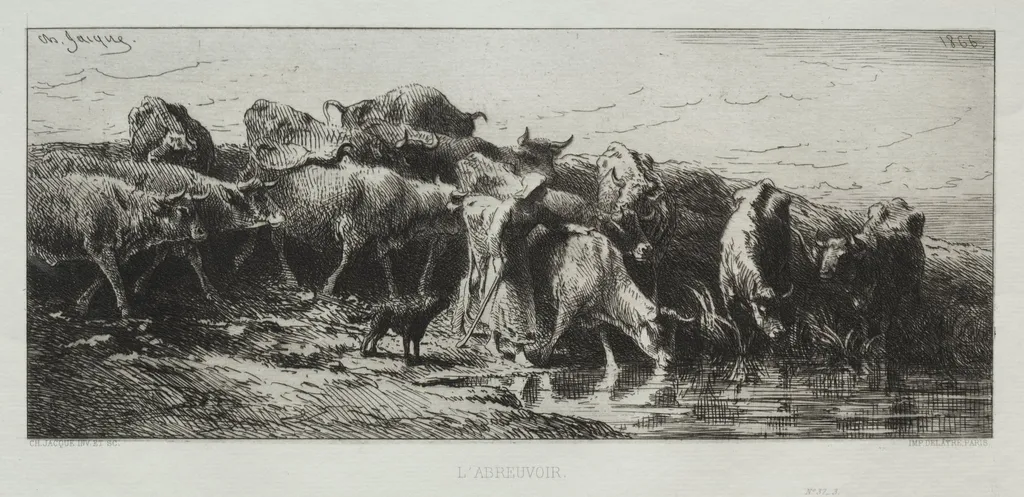
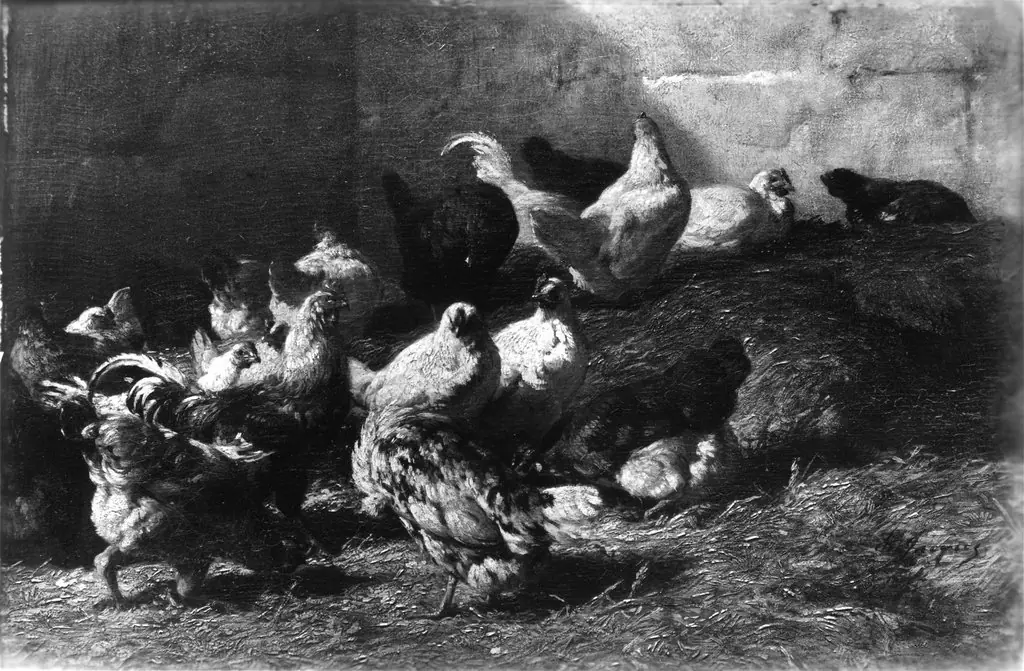
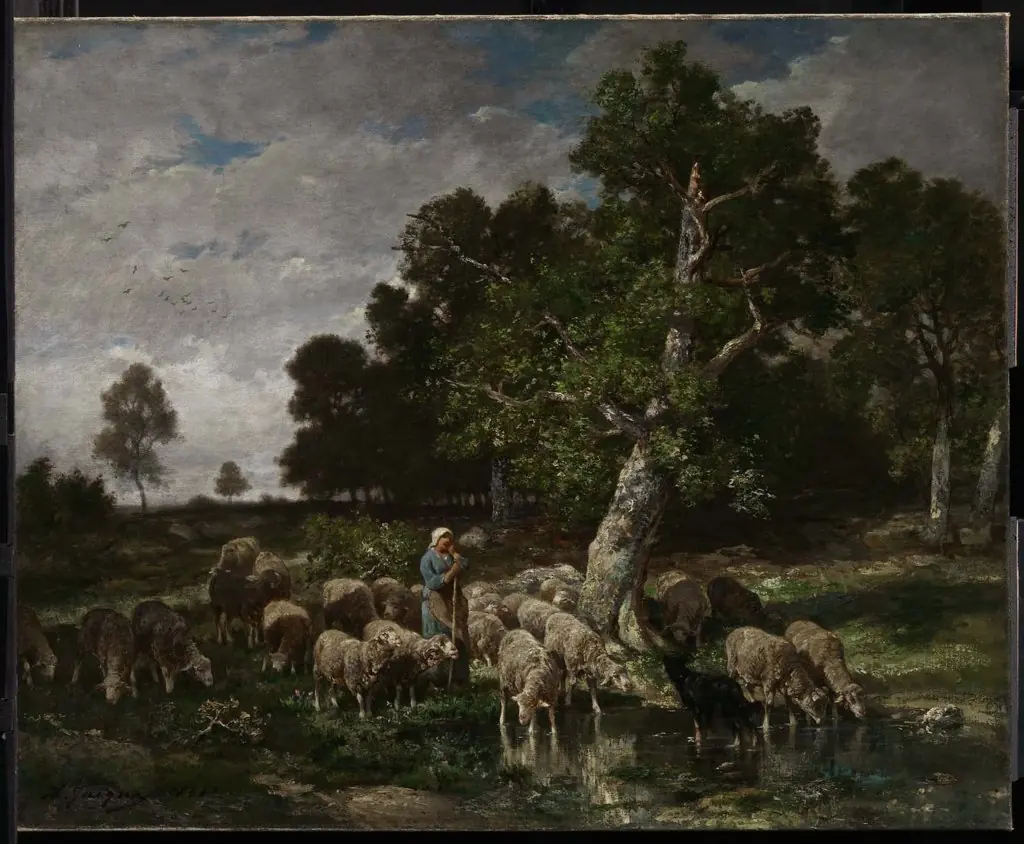
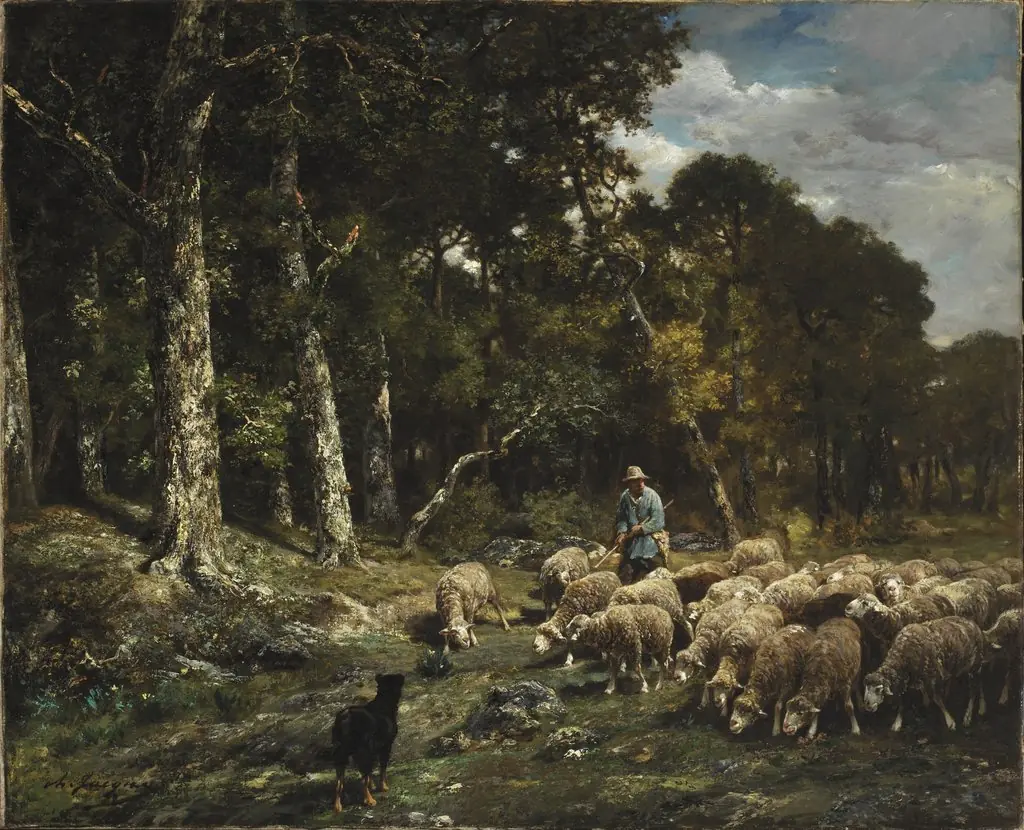
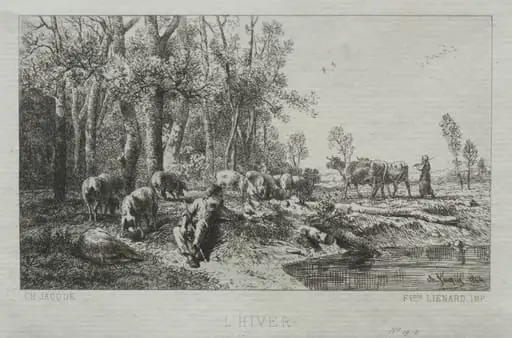
L'Abreuvoir is a print by the Impressionist artist Charles Jacque. It dates from 1866 and is held in the collection of the Cleveland Museum of Art.
About this work
Overview
As a member of the Barbizon School, Jacque turned his attention to rural France, favoring quiet, unidealized moments over grand narratives.
L'Abreuvoir is a pencil sketch by Charles-Émile Jacque, completed in 1866. As a member of the Barbizon School, Jacque turned his attention to rural France, favoring quiet, unidealized moments over grand narratives. This work captures a group of cattle at a natural watering spot, rendered with minimal detail and a sense of immediacy. The medium and composition reflect the artist’s interest in direct observation rather than studio refinement.
Subject & Meaning
The scene depicts livestock gathered at a shallow pool, their heads lowered in the act of drinking. There is no human presence, emphasizing the autonomy of animal life within the landscape. The title, meaning 'the watering hole,' anchors the image in the rhythms of agricultural existence. Jacque’s focus on this mundane ritual underscores a broader interest in the dignity of everyday rural labor and natural cycles.
Technique & Style
Jacque employed rapid, linear strokes to suggest the texture of fur and the subtle motion of the animals. The lines are loose and gestural, conveying urgency without sacrificing clarity. Background elements are reduced to minimal contours—bare earth and indistinct sky—drawing attention to the animals’ forms. This economy of means aligns with the Barbizon ethos of truth to visual experience over decorative finish.
History & Provenance
Created during Jacque’s active years in Barbizon, the sketch likely originated as a preparatory study or independent work from direct observation in the field. It reflects his close association with Jean-François Millet and other artists committed to recording rural life outside academic conventions. The piece remained within private collections until entering public institutional holdings in the 20th century.
Context
In mid-19th century France, artists increasingly turned from mythological and historical subjects to the lives of peasants and animals in the countryside. Jacque’s work emerged alongside the Realist movement, which valued authenticity over idealization. L'Abreuvoir exemplifies this shift, presenting nature and animal behavior without sentimentality or narrative embellishment.
Legacy
Jacque’s sketches like L'Abreuvoir contributed to a broader redefinition of artistic subject matter, influencing later generations interested in naturalism and plein air practice. While less celebrated than his contemporaries, his focus on quiet, unadorned moments helped legitimize the observation of ordinary life as worthy of artistic attention.
Artist & collection
Artist
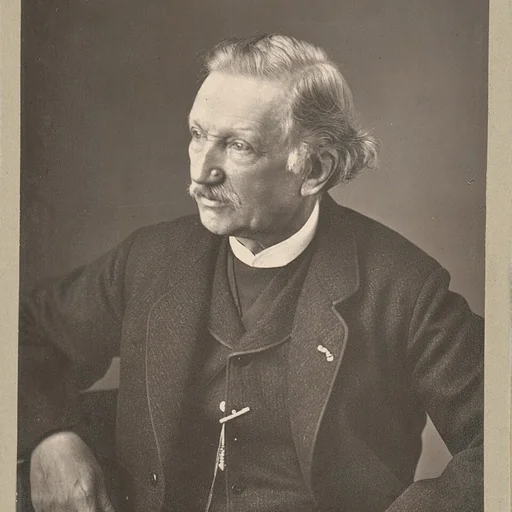
Charles-Émile Jacque (23 May 1813 – 7 May 1894) was a French painter of Pastoralism and engraver who was, with Jean-François Millet, part of the Barbizon School. He first learned to engrave maps when he spent seven years in the French Army.