Artwork
The Voyage to Paris
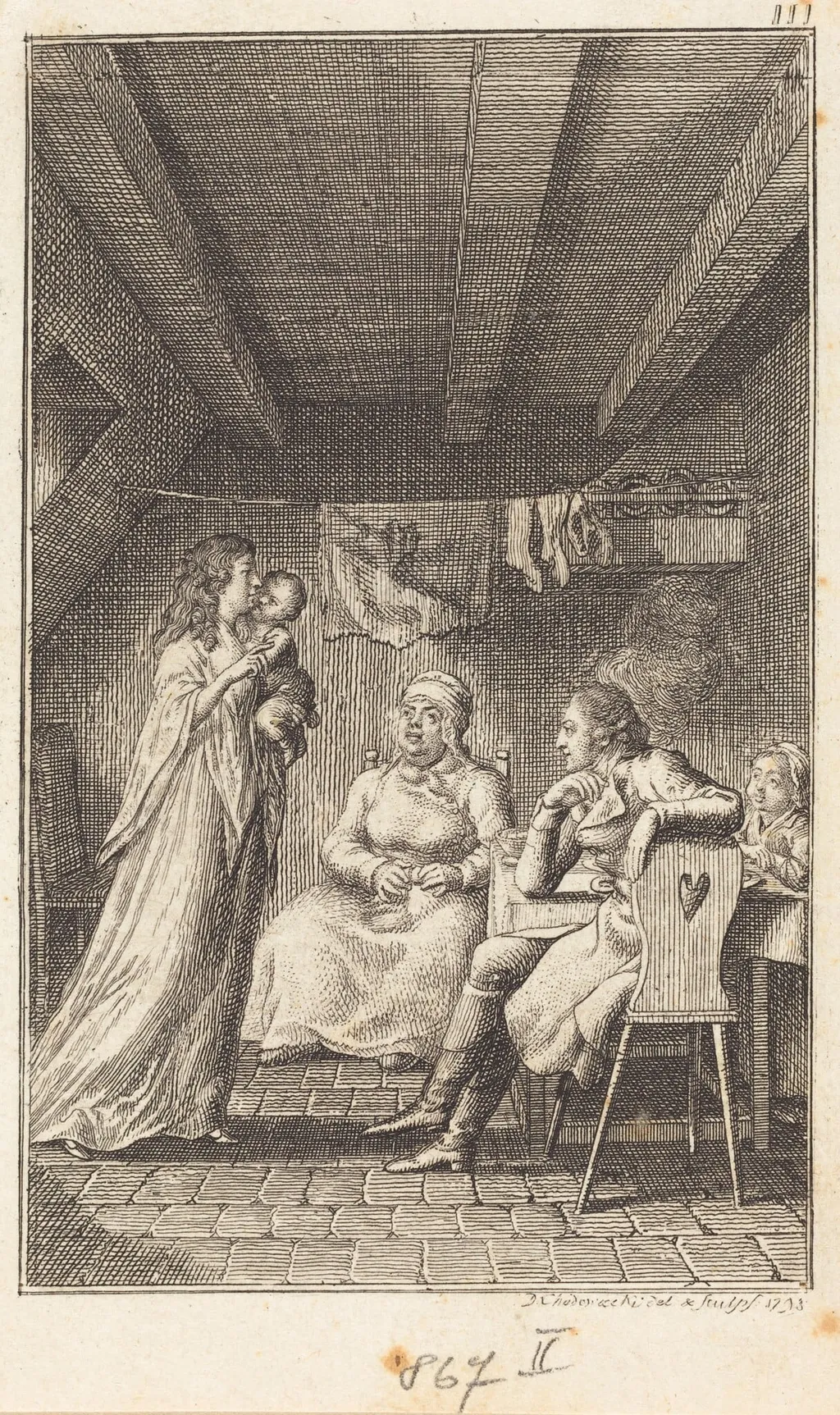
The Voyage to Paris is an ink print by the Romanticist artist Daniel Nikolaus Chodowiecki. It dates from 1798 and is held in the collection of the National Gallery of Art.
About this work
Overview
This work belongs to a body of prints that capture intimate, psychologically charged moments, often drawn from domestic or transitional scenes.
Daniel Nikolaus Chodowiecki, a German printmaker of Huguenot and Polish descent, produced *The Voyage to Paris* in 1798 as an etching. Based in Berlin for most of his career, he was deeply engaged with the visual storytelling of ordinary life. This work belongs to a body of prints that capture intimate, psychologically charged moments, often drawn from domestic or transitional scenes. His role as director of the Berlin Academy of Art underscored his influence in shaping print culture in late 18th-century Germany.
Subject & Meaning
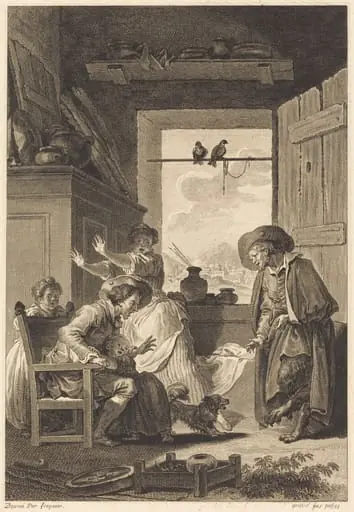
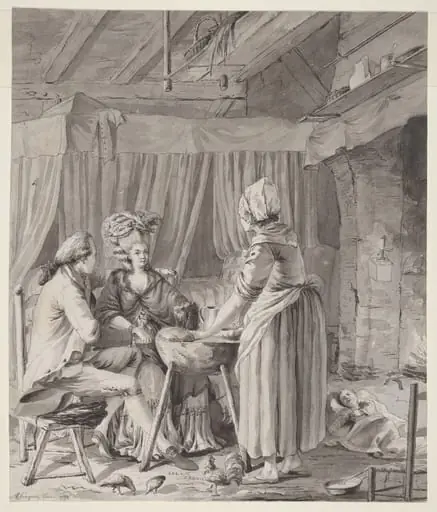
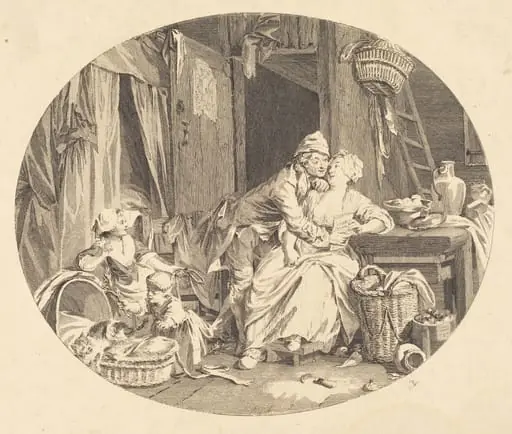
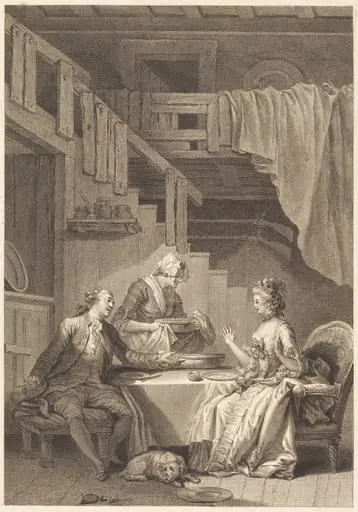
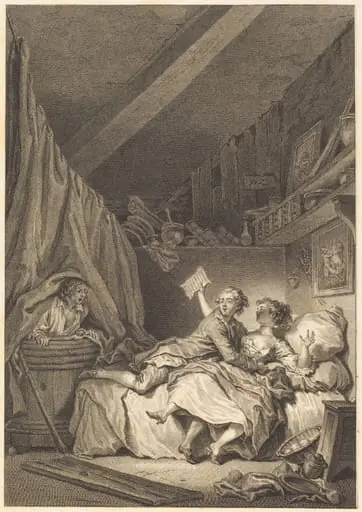
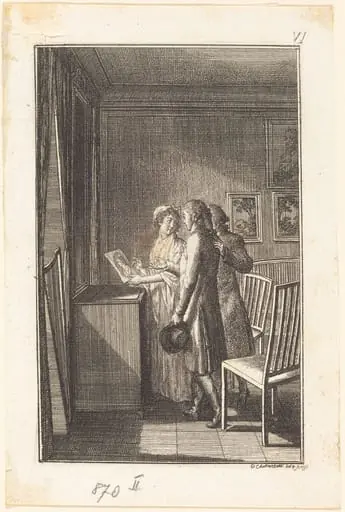
The scene depicts four figures in a sparse interior, centered on a woman holding a child’s hand, her arm extended toward two seated observers. A third figure lingers in shadow behind them. The atmosphere is subdued, charged with quiet anticipation rather than action. The absence of clear narrative cues—no luggage, no destination visible—suggests a moment of pause, perhaps before departure or after arrival. The tension lies in the unspoken exchange between the figures, evoking themes of migration, care, or uncertainty.
Technique & Style
Chodowiecki employed etching to achieve fine, controlled lines and subtle tonal gradations. The dim lighting is rendered through delicate hatching and cross-hatching, concentrating shadow around the figures while leaving the stone floor and walls barely defined. A single candle casts the only light, drawing focus to the woman’s gesture and the faces of the seated individuals. The composition avoids ornamentation, using minimal detail to heighten emotional resonance and spatial depth.
History & Provenance
Created in 1798, the etching emerged during Chodowiecki’s mature period, when he was deeply involved in the Berlin Academy and producing numerous prints for public circulation. While the specific provenance of this work is not documented, it aligns with his broader practice of distributing prints that appealed to middle-class audiences interested in narrative and moral themes. Its survival reflects the popularity of his genre scenes in late 18th-century German print markets.
Context
In the late 1700s, printmaking in Germany was a vital medium for disseminating ideas and scenes of daily life. Chodowiecki’s work responded to Enlightenment interests in human behavior and social observation. *The Voyage to Paris* reflects a broader cultural fascination with movement—whether physical, emotional, or social—amid political upheaval and shifting identities. His focus on quiet, interior moments distinguished his work from grand historical or mythological subjects common elsewhere in Europe.
Legacy
Chodowiecki’s etchings, including this one, helped define a genre of intimate, psychologically nuanced printmaking in Germany. His ability to convey complex emotion through minimal detail influenced later generations of artists working in graphic media. Though less widely known today than his French or Italian contemporaries, his prints remain important for their understated humanity and technical precision, offering a quiet counterpoint to the era’s more dramatic visual narratives.
Artist & collection
Artist
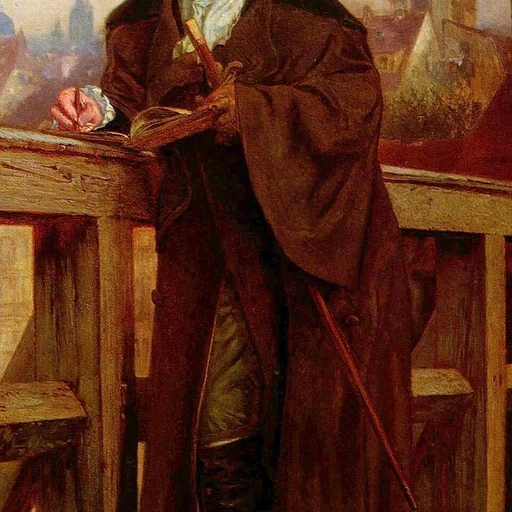
Daniel Niklaus Chodowiecki (16 October 1726 – 7 February 1801) was a German painter and printmaker of Huguenot and Polish ancestry, who is most famous as an etcher.