Artwork
Lyminster Church, near Arundel
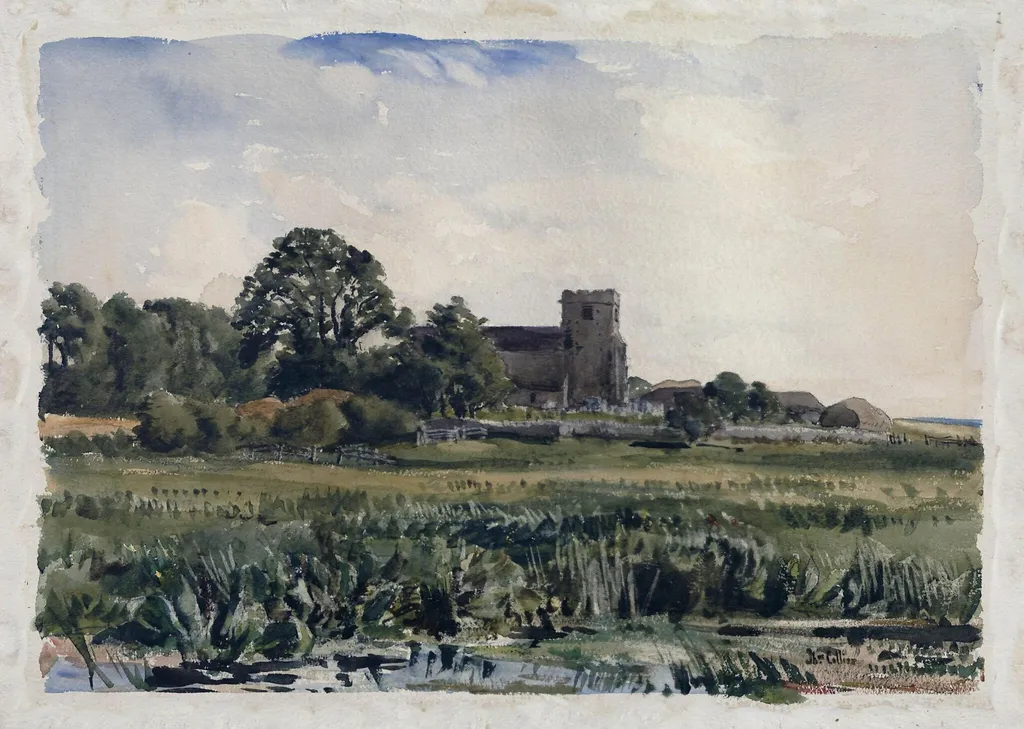
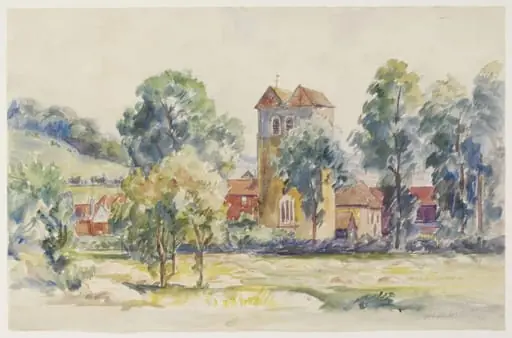
Lyminster Church, near Arundel is a watercolor work on paper by the British Romanticist artist Thomas Collier. It dates from 1860 and is held in the collection of the Victoria and Albert Museum.
About this work
Overview
Rendered with delicate washes, it captures a quiet rural scene with minimal detail, emphasizing atmosphere over architectural precision.
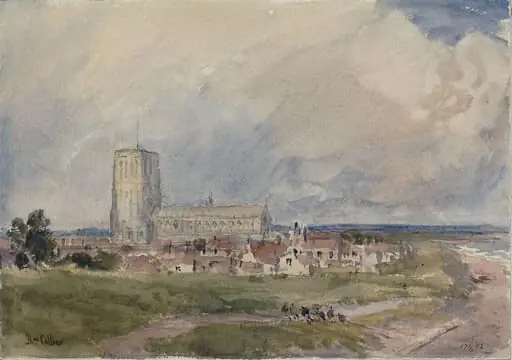
Thomas Collier created this watercolour in 1860, depicting Lyminster Church just outside Arundel. The work is signed by the artist and remains in the collection of the Victoria and Albert Museum. Rendered with delicate washes, it captures a quiet rural scene with minimal detail, emphasizing atmosphere over architectural precision. The composition balances structure and landscape in a restrained, contemplative manner.
Subject & Meaning
The church, positioned on the right, stands as a quiet anchor amid open fields and natural growth. Its modest tower and simple form suggest a local parish church, unadorned and integrated into the surrounding countryside. The stream winding through the foreground and the scattered bushes imply a lived-in, unhurried landscape. The scene conveys stillness rather than grandeur, reflecting a quiet reverence for everyday ecclesiastical life.
Technique & Style
Collier employed transparent watercolour washes to build soft, layered tones. The sky is lightly glazed with pale blue and white, while the foliage and earth are rendered in muted greens and browns. Edges are blurred, avoiding sharp definition, which enhances the sense of atmospheric depth. The technique favors tonal harmony over detail, aligning with 19th-century British watercolour traditions that valued mood over realism.
History & Provenance
Created in 1860, the work entered the Victoria and Albert Museum’s collection, where it remains today. Collier, known for his topographical watercolours of southern England, often documented rural architecture with quiet precision. While little is recorded about the painting’s immediate history, its preservation in a major public collection suggests it was regarded as a representative example of his observational style.
Context
In mid-19th-century Britain, watercolour was widely used for landscape documentation, especially by artists interested in regional architecture and rural life. Collier’s work reflects this trend, aligning with contemporaries who valued the medium for its immediacy and intimacy. Lyminster Church, like many such depictions, served not as a monument but as a record of place — unembellished and grounded in local reality.
Legacy
Collier’s watercolours, including this one, contribute to a broader archive of English rural scenes from the Victorian era. Though not widely exhibited today, his works remain valuable for their unpretentious observation of everyday landscapes. The painting endures as a quiet testament to the aesthetic of understated naturalism that defined much of British watercolour practice in the 19th century.
Artist & collection

Artist
Thomas Collier RI (12 November 1840 – 14 May 1891) was an English landscape painter, mainly in watercolour.