Artwork
The Fall of Man (Der Sündenfall)
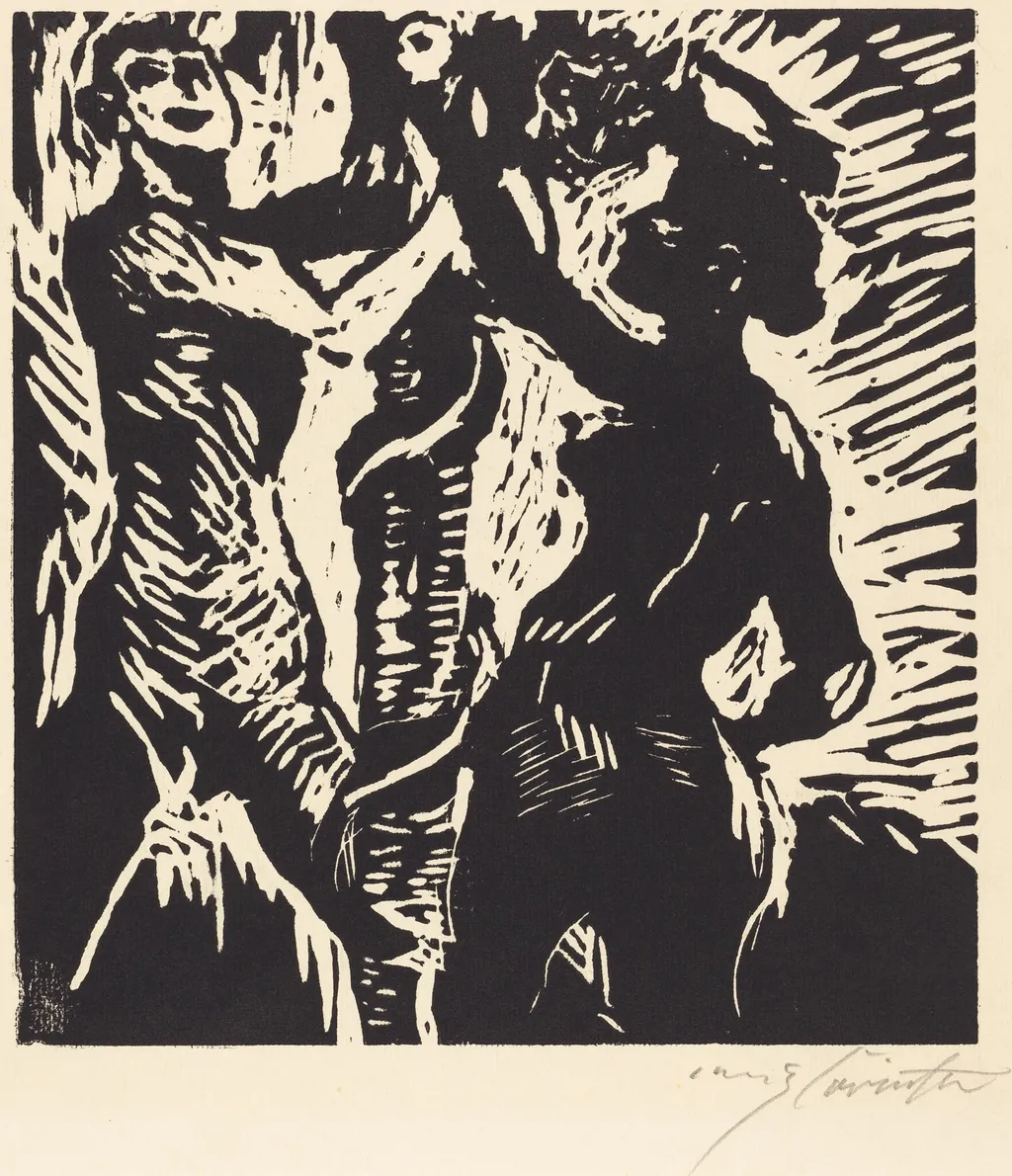
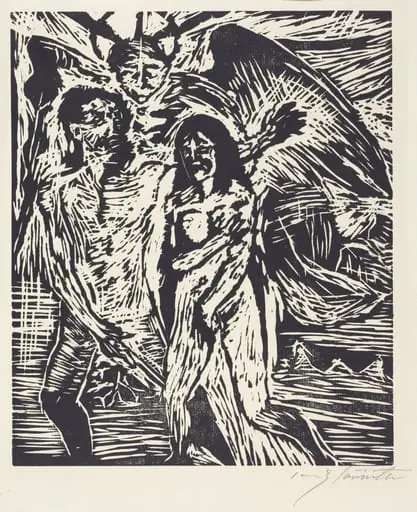
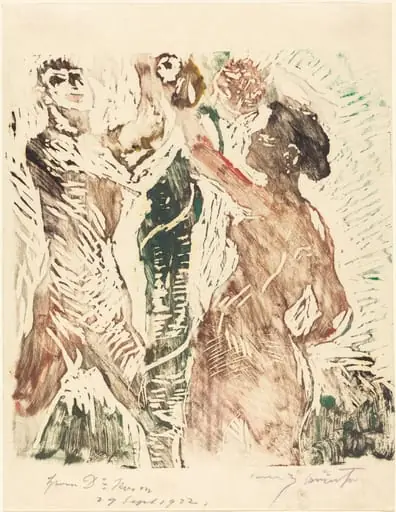
The Fall of Man (Der Sündenfall) is an ink print by Lovis Corinth. It dates from 1919 and is held in the collection of the National Gallery of Art.
About this work
Overview
This print exemplifies his mature style: emotionally charged, formally simplified, and driven by stark contrasts between ink and paper.
Created in 1919, *The Fall of Man* is a woodcut by Lovis Corinth, executed on laid paper. The work emerged during a period of intense personal and artistic transformation following a stroke in 1911. Corinth, who had previously engaged with Impressionist and academic traditions, now embraced a more visceral, expressive mode. This print exemplifies his mature style: emotionally charged, formally simplified, and driven by stark contrasts between ink and paper.
Subject & Meaning
The image depicts Adam and Eve in the moment after their expulsion from Eden, rendered without explicit biblical symbolism. Their back-to-back postures and upward-reaching limbs suggest entrapment rather than transgression. The dense, chaotic forest surrounding them evokes psychological isolation and inner turmoil. Corinth’s focus is less on moral narrative than on the physical and emotional weight of alienation, reflecting post-war existential anxieties.
Technique & Style
Corinth employed the woodcut medium to exploit its inherent brutality: deep, jagged lines carved into the block produce sharp, unyielding forms. The contrast between dense black ink and the untouched paper heightens the sense of claustrophobia. Brushwork is absent; instead, the artist’s hand is evident in the rough, uneven edges of each carved line. This technique amplifies the emotional urgency, transforming the print into a tactile record of struggle.
History & Provenance
The print was made in 1919, during Corinth’s final productive years, after his recovery from a stroke that altered his physical coordination and artistic direction. It belongs to a series of prints from this period in which he revisited mythological and biblical themes through a lens of personal suffering. The work was likely produced for private circulation or small exhibitions, as Corinth increasingly turned away from public acclaim toward introspective expression.
Context
Created in the aftermath of World War I, the print resonates with the broader cultural mood of disillusionment and fragmentation. Corinth’s shift toward Expressionism aligned with a generation of artists rejecting pre-war order in favor of raw emotional truth. While his earlier work reflected academic training and French influences, this print reveals a German Expressionist sensibility—concerned with inner anguish, bodily presence, and the instability of the human condition.
Legacy
Though not widely exhibited during his lifetime, *The Fall of Man* is now recognized as a pivotal work in Corinth’s printmaking oeuvre. It exemplifies how he fused technical mastery of traditional methods with a modern, psychologically charged vision. The print’s influence is seen in later German artists who used woodcut to convey existential themes, cementing Corinth’s role in the evolution of 20th-century printmaking beyond mere illustration.
Artist & collection

Artist
Lovis Corinth was a German artist and writer whose mature work as a painter and printmaker realized a synthesis of impressionism and expressionism.