Artwork
Luther as 'Junker Jorg'
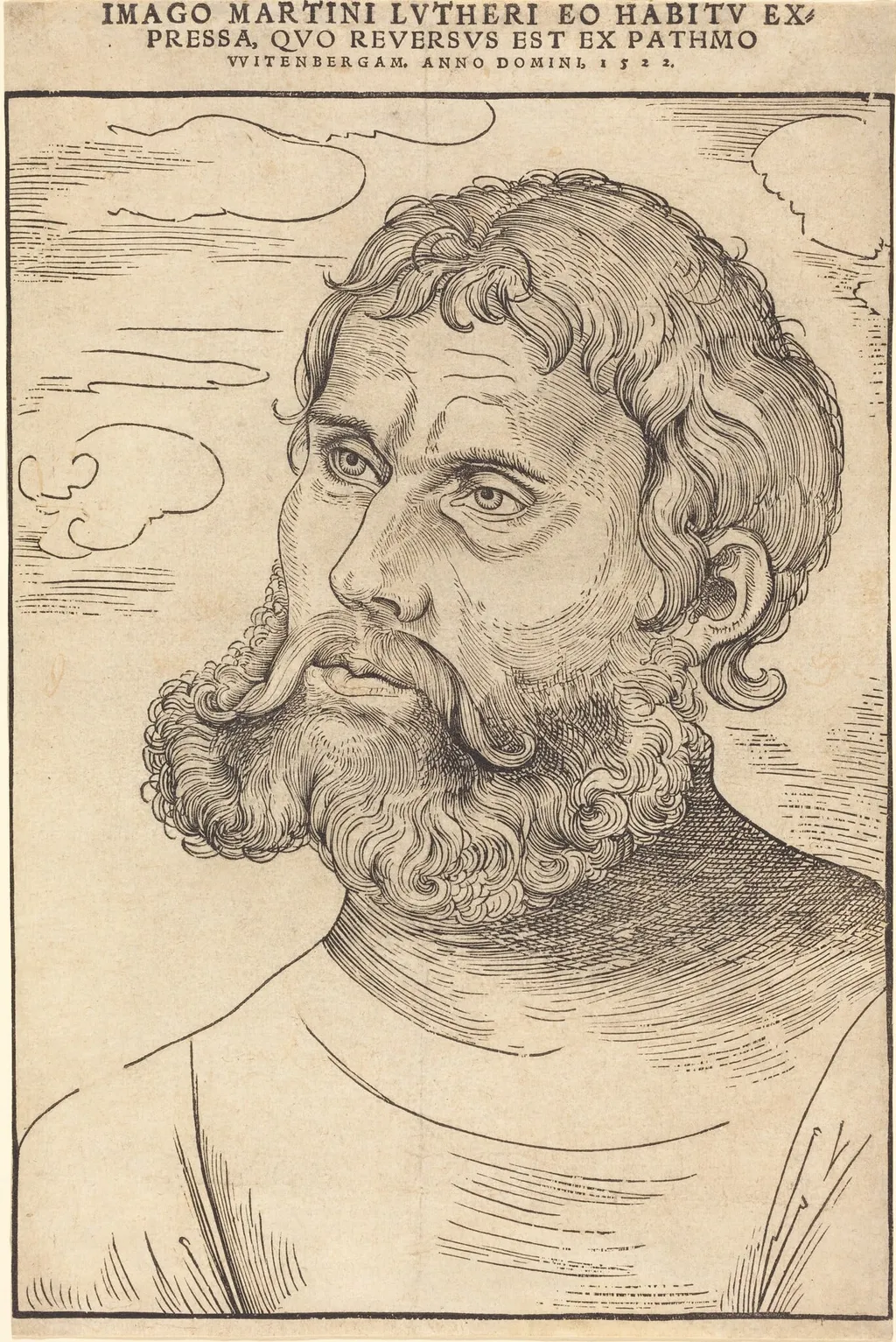
Luther as 'Junker Jorg' is an ink print by the Renaissance artist Lucas Cranach the Elder. It dates from 1522 and is held in the collection of the National Gallery of Art. Created in 1522, this woodcut presents a profile portrait of Martin Luther, rendered in stark black and white.
About this work
His hair and beard are thick, almost curly, and his eyes look straight ahead with a serious expression.
This is a black-and-white drawing of a bearded man’s head and shoulders, turned slightly to the side. His hair and beard are thick, almost curly, and his eyes look straight ahead with a serious expression. The background is simple, with just a few wavy lines that might be clouds or waves.
The text at the top names the person as "Martin Luther" and says this was made in 1522. The artist used a printing method called woodcut, where the image is carved into wood and then inked.
Look up woodcut to see how this printing method works.
Overview
Created in 1522, this woodcut presents a profile portrait of Martin Luther, rendered in stark black and white. The image shows a bearded man turned slightly, his hair and beard rendered with thick, almost curly lines, and a direct, solemn gaze. The simple background consists of a few undulating strokes that suggest clouds or water.
Subject & Meaning
The portrait identifies Luther by name, emphasizing his role as a central figure of the early Reformation. By depicting him in a modest, almost anonymous guise, the work reflects the tensions of the period, when Luther’s teachings were both celebrated and contested across the Holy Roman Empire.
Technique & Style
Executed as a woodcut, the image was carved into a wooden block, inked, and pressed onto paper. Cranach’s handling of line creates a clear contrast between the dense, textured hair and the smoother facial planes, demonstrating his skill in translating complex forms into the binary medium of woodcut.
History & Provenance
The print belongs to a series of portraits produced by Lucas Cranach the Elder, the court painter to the Electors of Saxony, who maintained close connections with reformers. Among the surviving works are eleven depictions of Luther, illustrating Cranach’s transition from Catholic commissions to support for Lutheran ideas.
Context
Cranach’s position at the Saxon court placed him at the intersection of political power and religious change. This portrait, like others in the series, served both as a visual record of reformist leaders and as a subtle instrument of propaganda during a period of intense doctrinal conflict.
Artist & collection
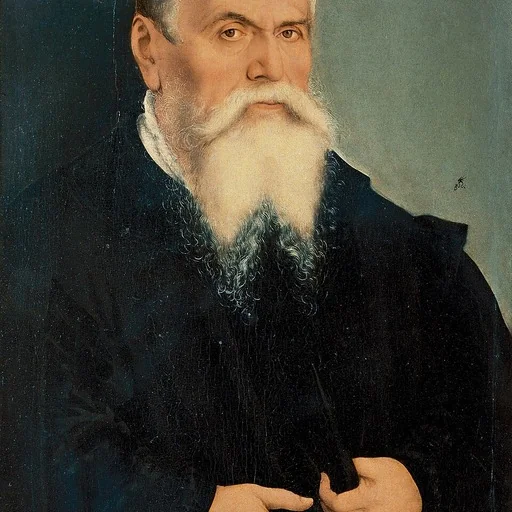
Artist
Lucas Cranach the Elder was a German Renaissance painter and printmaker in woodcut and engraving.