Artwork
Man Flailing
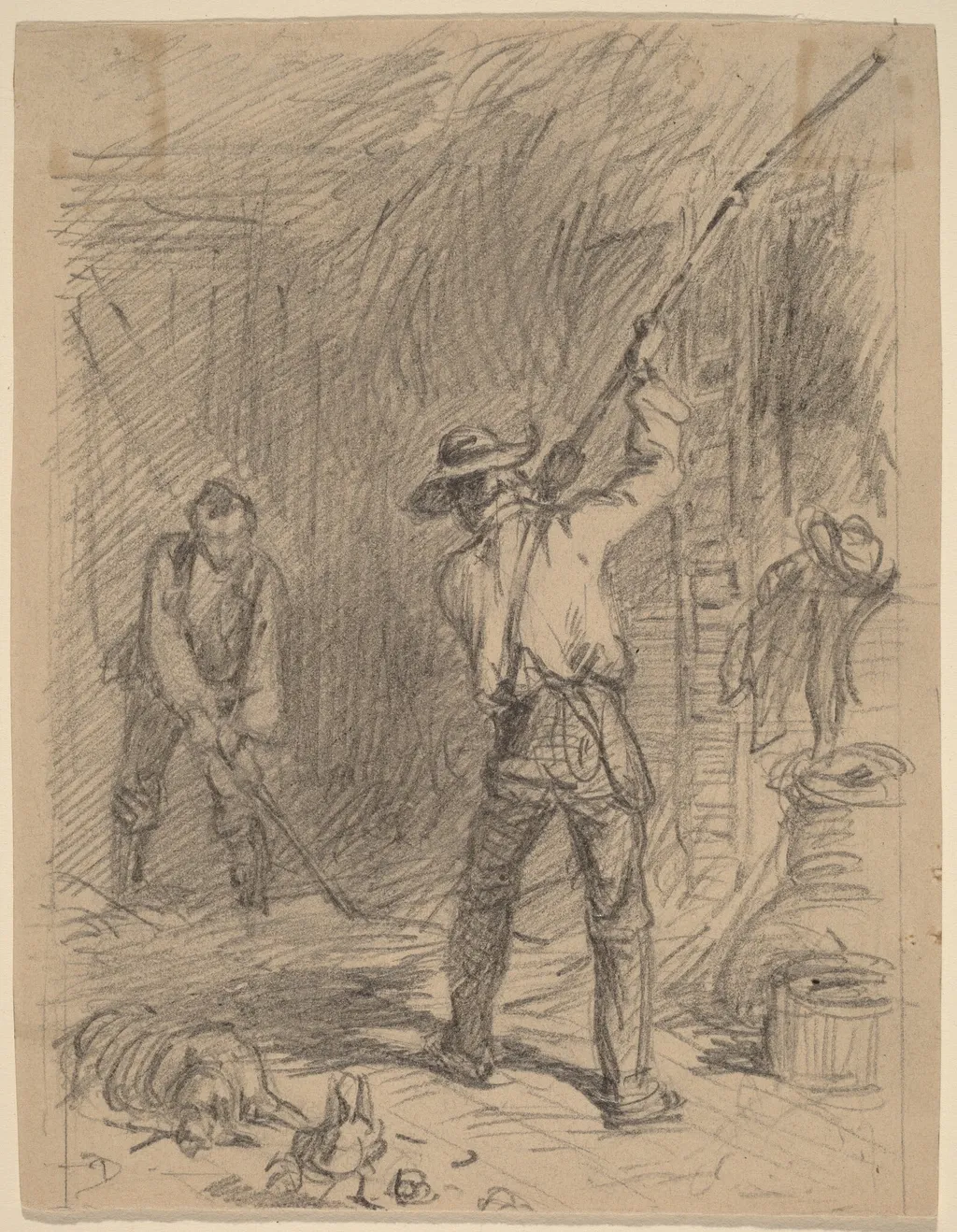
Man Flailing is a graphite drawing by the Impressionist artist Felix Octavius Carr Darley. It dates from 1854 and is held in the collection of the National Gallery of Art.
About this work
Overview
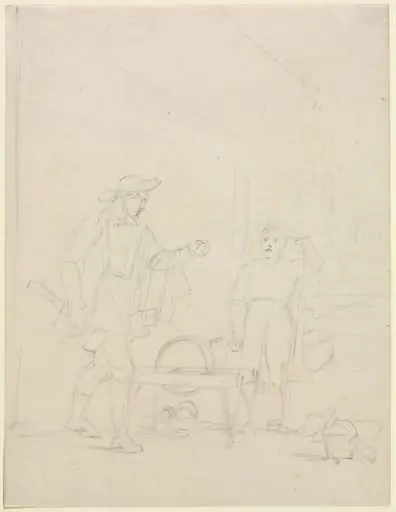
Man Flailing, a graphite drawing on heavy wove paper by Felix Octavius Carr Darley (c. 1854), captures a dynamic, tense moment in a dimly lit, cluttered interior.
Subject & Meaning
The drawing depicts three rough-hewn men in a state of physical and emotional turmoil. The central figure strains to control a long pole, his facial expression conveying intense effort. Two other men react with indifference (one leaning against the wall with arms crossed) and despair (the third slumped on the floor). The scene conveys a sense of raw, unvarnished reality.
Technique & Style
Darley employed quick, expressive, and somewhat messy graphite lines to convey a sense of movement and tension. The hasty execution and weak, shadowy lighting contribute to an overall impression of spontaneity and unfinishedness, akin to a rapid sketch.
History & Provenance
Created around 1854, the drawing's provenance and exhibition history are not detailed here, highlighting the work's existence as part of Darley's body of sketchwork from that period.
Context
Man Flailing reflects Darley's interest in capturing everyday, potentially overlooked scenes of common life, characterized by their immediacy and emotional authenticity.
Legacy
As a representative of Darley's sketching practice, Man Flailing offers insight into his approach to capturing human struggle and everyday drama, though its individual impact on his broader legacy is not specifically defined.
Own this work as a print
Artist & collection

Artist
Felix Octavius Carr Darley (June 23, 1822 – March 27, 1888), often credited as F.

![Chef Tossing Pancakes and Group of Four Men [verso], by Felix Octavius Carr Darley](https://artifactworldgallery.com/img/felix-octavius-carr-darley--chef-tossing-pancakes-and-group-of-four-men-verso--2a1e79eefaebb888-w320.webp)
![Bernini Fountain, Rome [recto], by Felix Octavius Carr Darley](https://artifactworldgallery.com/img/felix-octavius-carr-darley--bernini-fountain-rome-recto--bed0d506722bdbdf-w320.webp)
![Soldier Taking Aim [recto], by Winslow Homer](https://artifactworldgallery.com/img/winslow-homer--soldier-taking-aim-recto--59bbf30d729c412f-w320.webp)
![Farmers Shucking Corn [recto], by Perry, Enoch Wood, Jr.](https://artifactworldgallery.com/img/perry-enoch-wood-jr--farmers-shucking-corn-recto--9473f386e6632807-w320.webp)
![Two Soldiers Resting [verso], by Winslow Homer](https://artifactworldgallery.com/img/winslow-homer--two-soldiers-resting-verso--989d55e6cbbf0806-w320.webp)