Artwork
Je vous arrête, mauvais sujet...
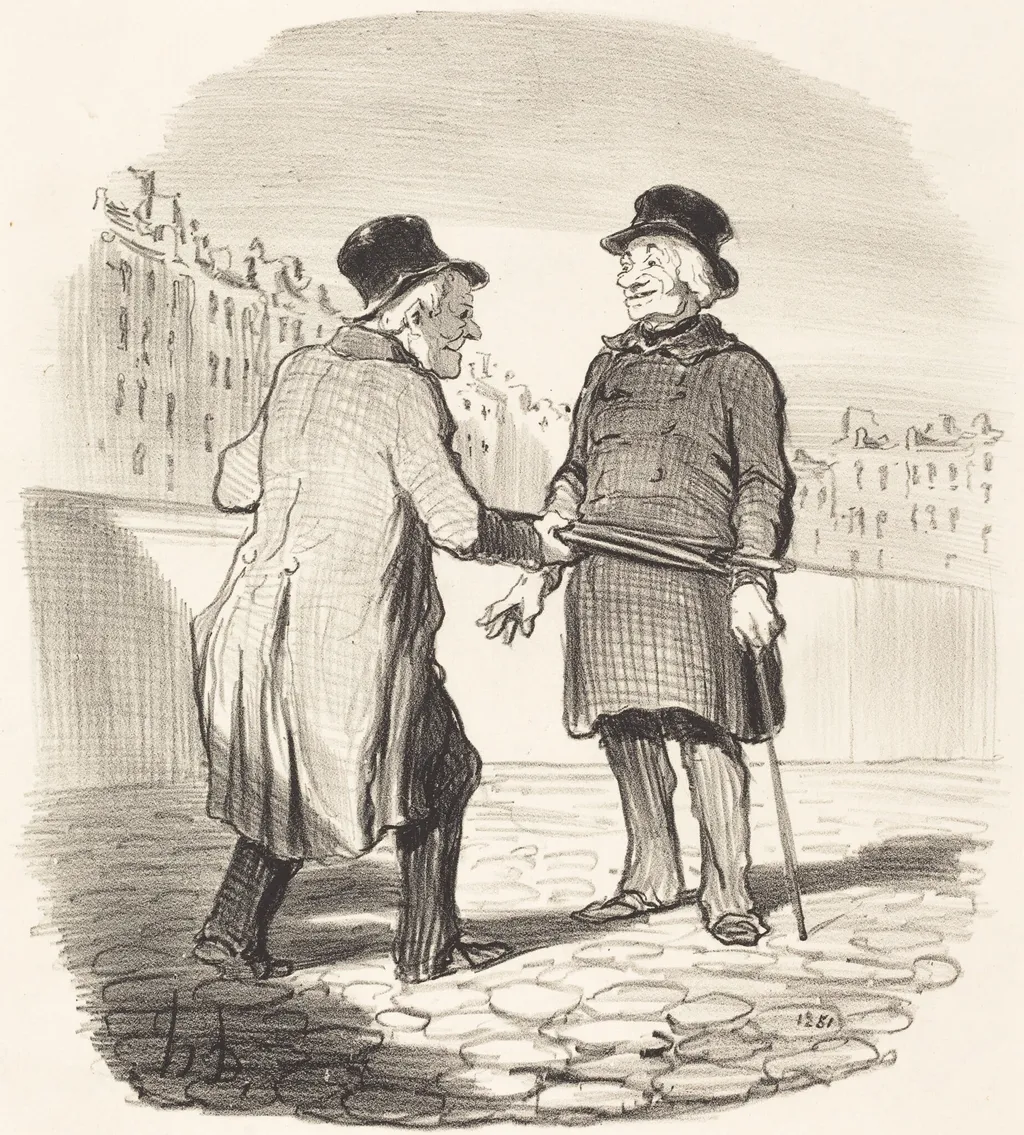
Je vous arrête, mauvais sujet... is an ink print by the Impressionist artist Honoré Daumier. It dates from 1852 and is held in the collection of the National Gallery of Art.
About this work
Overview
His choice of lithography allowed rapid production and wide distribution, making his commentary accessible to the public beyond elite circles.
Created in 1852, this lithograph by Honoré Daumier captures a fleeting urban encounter with quiet irony. Part of a broader series of social satires published in French periodicals, the work reflects Daumier’s commitment to visual critique during a time of political instability. His choice of lithography allowed rapid production and wide distribution, making his commentary accessible to the public beyond elite circles.
Subject & Meaning
Two men, one in a long coat and the other in a top hat, exchange a handshake on a rain-slicked street. Their interaction suggests a transaction or mutual complicity, possibly between a corrupt official and a schemer. The title, translating to 'I arrest you, bad subject,' ironically undercuts the gesture, implying the arrest is performative or hypocritical. Daumier uses ambiguity to expose the moral compromises of the bourgeoisie and petty authority figures.
Technique & Style
Daumier employed rapid, expressive lines typical of his lithographic method, avoiding polished detail in favor of dynamic energy. The wet pavement is suggested by sparse, reflective strokes, and the figures are rendered with loose, almost sketch-like contours. The faint glow of a streetlamp and windows behind them adds atmospheric depth without realism, emphasizing mood over precision. This economy of line heightens the sense of immediacy and urban anonymity.
History & Provenance
The print was produced during the early years of Louis-Napoléon Bonaparte’s rule, following the 1851 coup that ended the Second Republic. Daumier had been imprisoned for earlier satires targeting the monarchy, and by 1852, censorship had tightened. This work, though less overtly political than his earlier pieces, continues his critique through subtle social observation, likely published in *Le Charivari*, where he had been a regular contributor since the 1830s.
Context
In post-1848 France, political repression and the rise of a new bourgeois order reshaped public life. Daumier’s prints responded to the erosion of republican ideals and the normalization of corruption. His focus on ordinary urban scenes—street corners, cafés, legal offices—turned mundane moments into indictments of systemic hypocrisy. Lithography, as a reproducible medium, enabled his voice to reach a broad, literate public despite state surveillance.
Legacy
Daumier’s approach influenced later generations of social realists and cartoonists, particularly in how he merged artistic technique with civic critique. His ability to convey complex social dynamics through minimal means set a precedent for visual journalism. Though less celebrated in his lifetime than in retrospect, his prints remain key documents of 19th-century French society, valued for their unflinching observation and formal innovation.
Artist & collection

Artist
Honoré-Victorin Daumier was a French painter, sculptor, and printmaker, whose many works offer commentary on the social and political life in France, from the Revolution of 1830 to the fall of the Second French Empire in 1870.









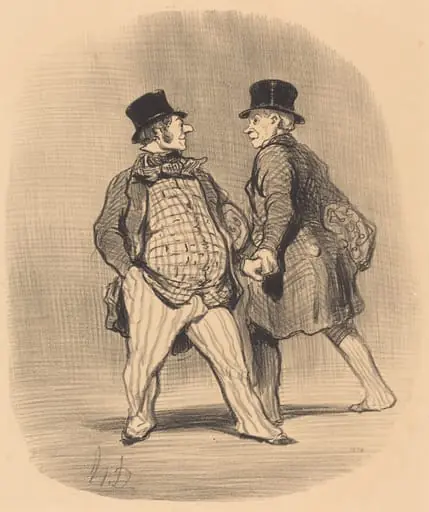 Confrère, méfiez-vous du petit baron...
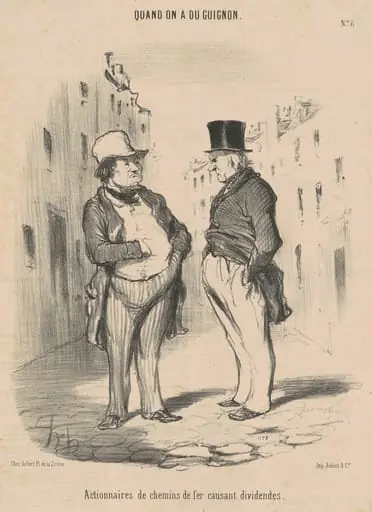 Actionnaires de chemins de fer causant dividendes
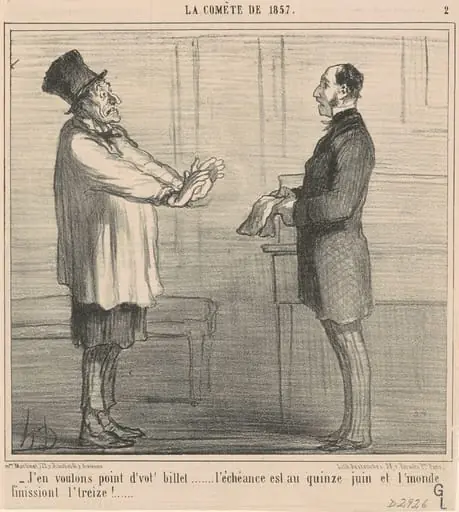 J'en voulons point d'vot' billet ...
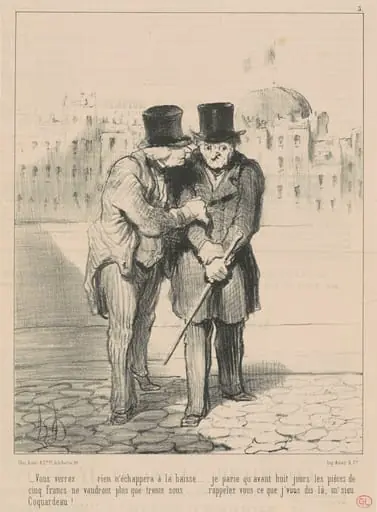 Vous verrez ... rien n'échappera a la baisse ...
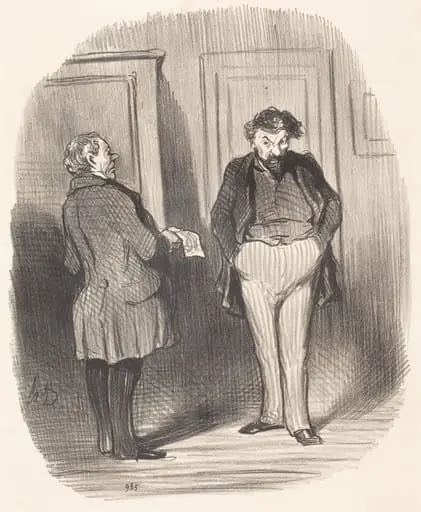 Pourriez-vous me dire...? J'ai la grippe!...
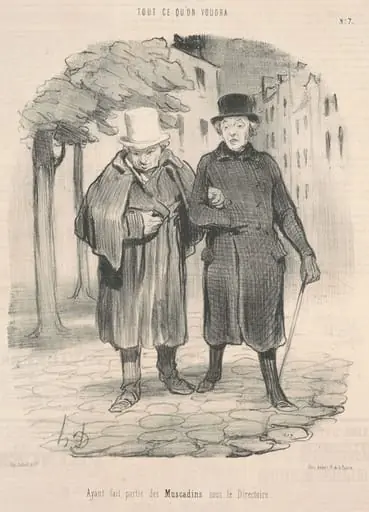 Ayant faitartie des muscadins sous le directoire
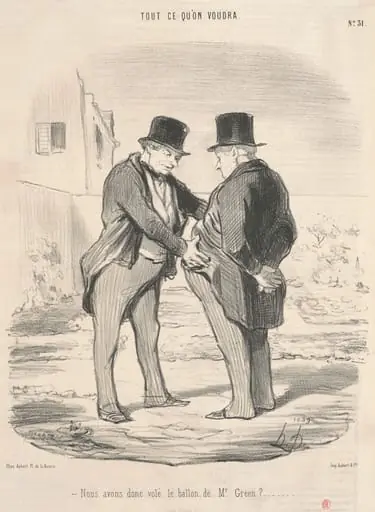 Nous avons donc volé le ballon de Mr. Green?
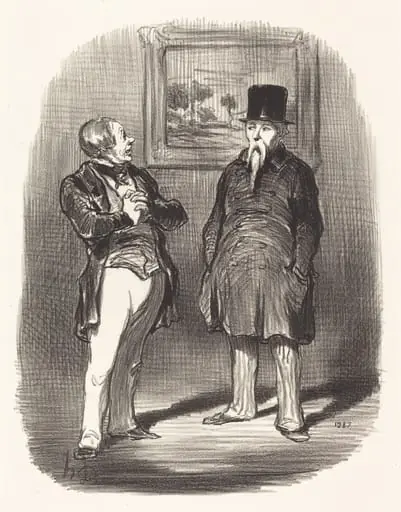 Tiens... je ne te reconnaissais pas...
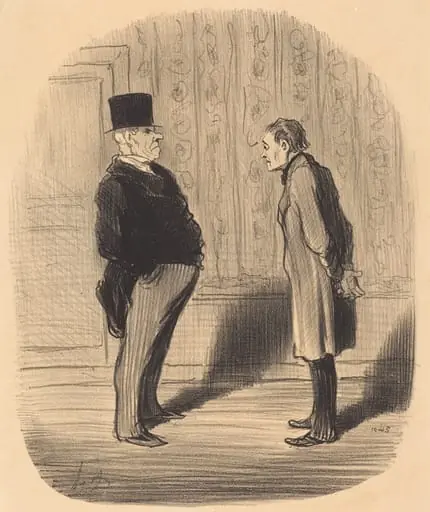 Eh! bien monsieur et mes trois termes...
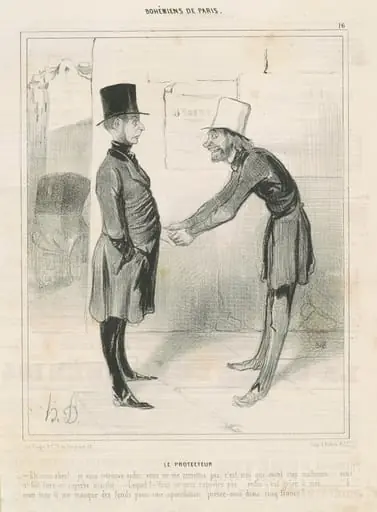 Le Protecteur