Artwork
La malheureuse famille Calas (The Unfortunate Calas Family)
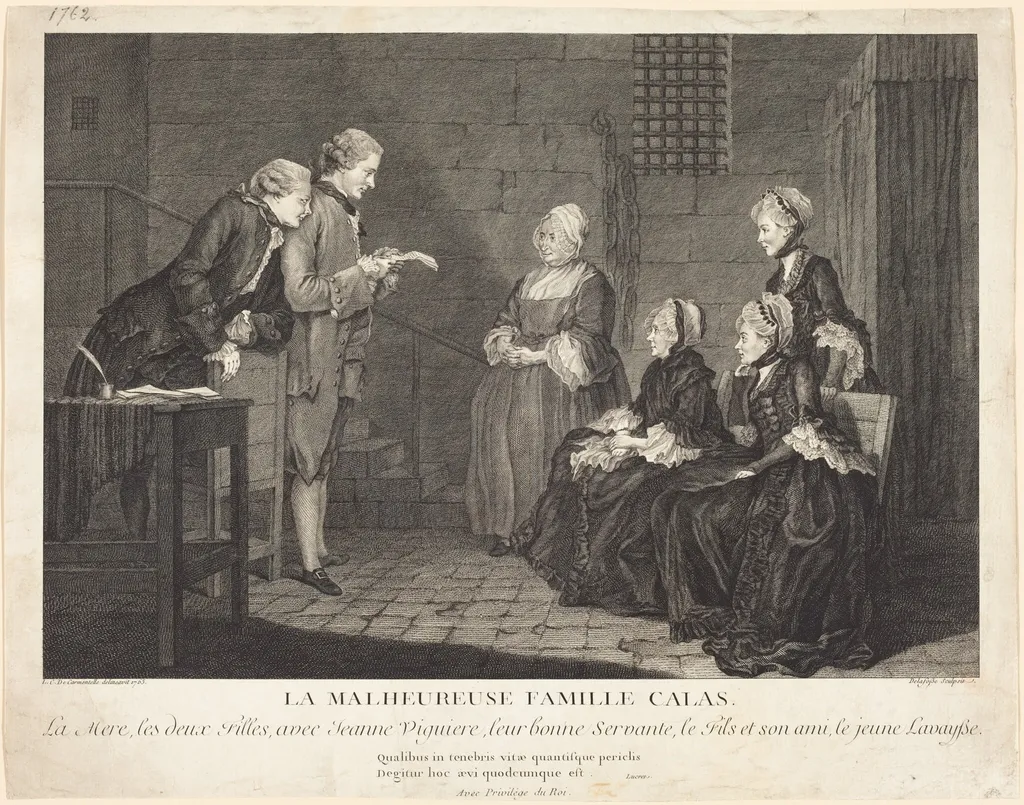
La malheureuse famille Calas (The Unfortunate Calas Family) is an ink print by the Romanticist artist Jean-Baptiste Delafosse. It dates from 1765 and is held in the collection of the National Gallery of Art.
About this work
Overview
The composition centers on a man holding a document, surrounded by seven family members whose postures and expressions convey unease.
Created around 1765 by Jean-Baptiste Delafosse, this engraving depicts a moment of emotional gravity within the Calas family. Rendered in fine cross-hatched lines on laid paper, the print captures a quiet, tense gathering in a modest interior. The composition centers on a man holding a document, surrounded by seven family members whose postures and expressions convey unease. The scene’s austerity reflects both the gravity of the moment and the limitations of the medium.
Subject & Meaning
The image illustrates the Calas family during a period of crisis following the wrongful conviction and execution of Jean Calas for the alleged murder of his son—a case later exposed as a religiously motivated miscarriage of justice. The family’s somber assembly suggests they are receiving news of legal developments. Their unified gaze toward the document implies a shared burden, transforming the scene into a quiet indictment of institutional injustice and familial suffering.
Technique & Style
Delafosse employed meticulous cross-hatching to model form and atmosphere, using dense parallel lines to suggest shadow and texture. The stone walls and floor gain weight through layered strokes, while the figures’ dark clothing emerges from areas of high contrast. The barred window and staircase are rendered with restrained detail, focusing attention on the group’s expressions. The engraving’s precision reflects the academic tradition of French printmaking, prioritizing clarity over ornamentation.
History & Provenance
The engraving was produced shortly after the Calas affair gained public attention in France, fueled by Voltaire’s campaign to overturn the verdict. Delafosse’s work likely served as a visual supplement to pamphlets and polemics circulating among reform-minded audiences. Though no early ownership records are widely documented, its survival suggests it was circulated among Enlightenment circles interested in legal reform and religious tolerance.
Context
This print emerged during a period of growing public scrutiny of judicial abuses in ancien régime France. The Calas case became a symbol of Catholic intolerance toward Protestants, and images like this helped translate legal tragedy into accessible visual narratives. Engravings such as this one played a role in shaping public opinion, bridging the gap between written advocacy and popular awareness in the years before the Revolution.
Legacy
Though not widely reproduced today, the engraving remains a significant artifact of 18th-century social commentary. It exemplifies how print media could humanize political causes by focusing on domestic suffering. Its restrained aesthetic and emotional gravity distinguish it from more sensationalist imagery of the era, offering a quiet but enduring testament to the power of visual testimony in the fight for justice.
Artist & collection