Artwork
Degas
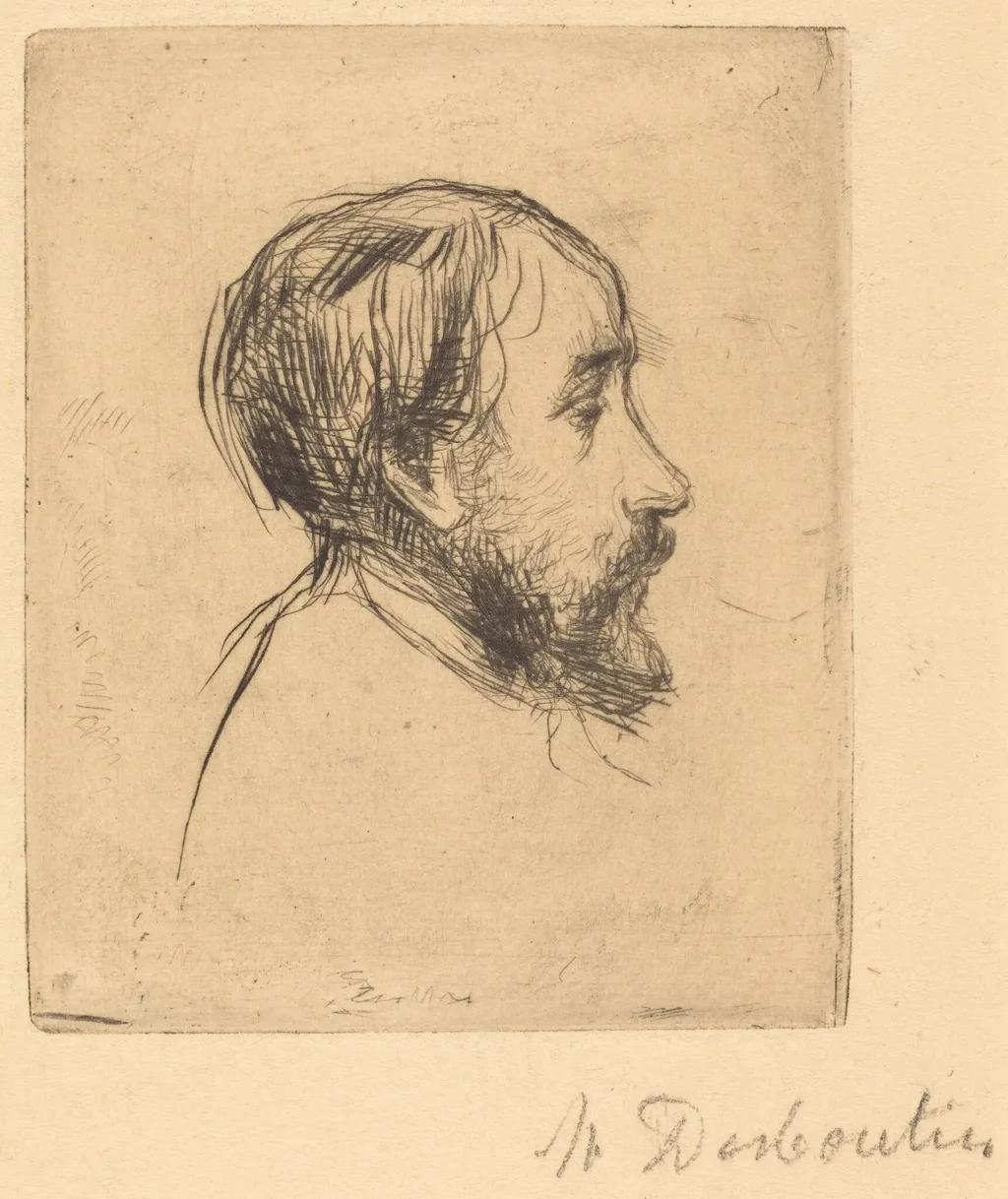
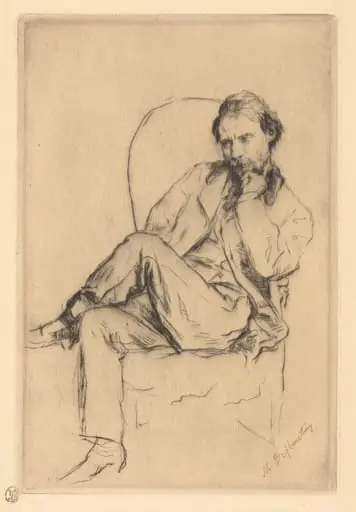
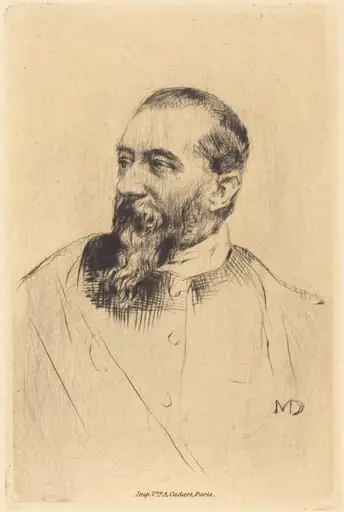
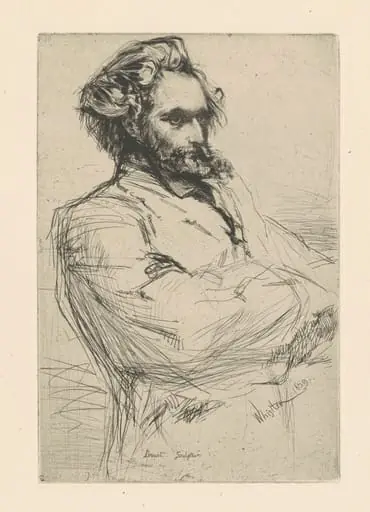
Degas is an ink print by the Impressionist artist Marcellin-Gilbert Desboutin. It dates from 1875 and is held in the collection of the National Gallery of Art.
About this work
Overview
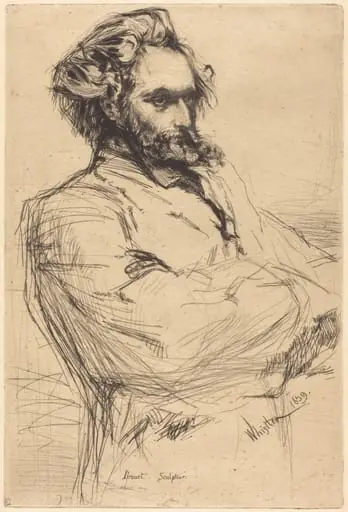
This drypoint print, made in 1875 by Marcellin-Gilbert Desboutin, depicts the French artist Edgar Degas in profile. Rendered on laid paper, the work belongs to a series of intimate portraits Desboutin produced of his contemporaries. The image captures Degas in a moment of stillness, emphasizing texture and tone over detail, characteristic of Desboutin’s approach to printmaking.
Subject & Meaning
The portrait presents Degas as a contemplative figure, his head turned to the right, eyes lowered, and beard framing a face turned inward. His open collar and relaxed posture suggest informality, perhaps reflecting a private moment rather than a formal commission. The downward gaze conveys introspection, aligning with Degas’s known reserve and focus on internal observation in his art.
Technique & Style
Desboutin employed drypoint to carve fine, incised lines directly into the plate, creating rich, velvety blacks and subtle gradations of tone. The contrast between bold contour lines and softer, smudged shading builds volume without relying on precise modeling. The texture of the laid paper enhances the tactile quality of the ink, reinforcing the intimate, handcrafted nature of the image.
History & Provenance
Created during a period of close association between Desboutin and Degas, the print emerged from their shared circle in Parisian artistic circles.
Created during a period of close association between Desboutin and Degas, the print emerged from their shared circle in Parisian artistic circles. Desboutin, a printmaker and painter, often portrayed friends and colleagues. This portrait likely originated as a personal exchange or study, later entering private collections before being acquired by institutions focused on 19th-century print culture.
Context
In the 1870s, Parisian artists increasingly turned to printmaking as a means of personal expression outside the Salon system. Drypoint, with its immediacy and tonal richness, appealed to those seeking alternatives to academic painting. Desboutin’s portrait of Degas reflects this trend, capturing not just likeness but the intellectual atmosphere of a generation redefining artistic identity.
Legacy
Though not widely exhibited during Desboutin’s lifetime, this portrait remains a significant example of artist-portraiture in late 19th-century France. It offers insight into the personal relationships among Impressionist-era figures and demonstrates how printmaking served as a vehicle for psychological depth. The work continues to be studied for its technical nuance and its quiet documentation of artistic camaraderie.
Artist & collection