Artwork
The Satyr's Family
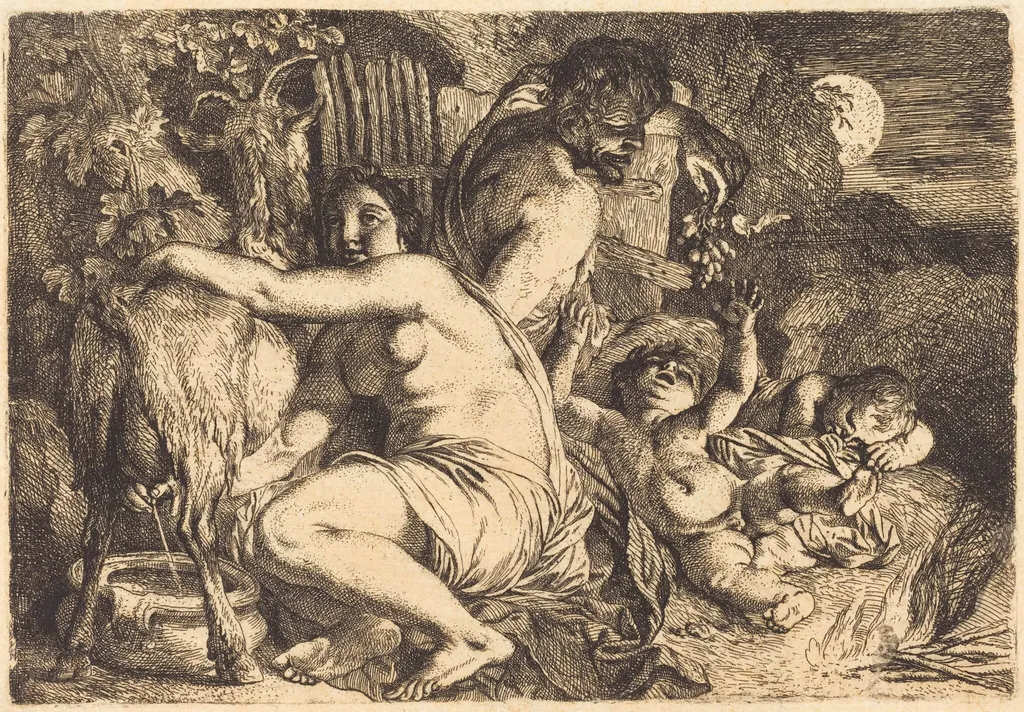
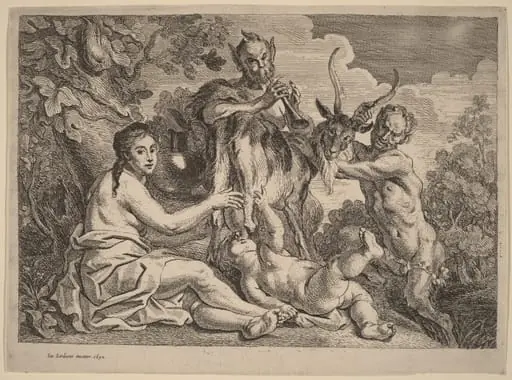
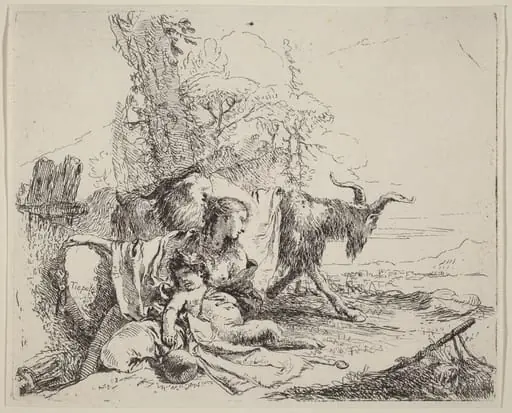
The Satyr's Family is an ink print by the Baroque artist Christian Wilhelm Ernst Dietrich. It dates from 1743 and is held in the collection of the National Gallery of Art.
About this work
Overview
Christian Wilhelm Ernst Dietrich’s 1743 print, titled The Satyr’s Family, is an etching executed on laid paper. The work presents a small, intimate tableau populated by a half‑clothed male figure, a woman, and two infants, all set within a lush, tangled foliage that suggests a forest clearing. The composition balances figure and nature, drawing the viewer’s eye across the intertwined forms.
Subject & Meaning
The surrounding vines and blossoms reinforce a pastoral, almost idyllic atmosphere, hinting at themes of nurture and natural harmony.
The central figure, a bearded man with curly hair, reclines while cradling a sleeping child, evoking a paternal presence. Adjacent, a long‑haired woman seated on a draped cloth holds another infant, creating a familial grouping that references classical mythological motifs of satyrs and their domestic scenes. The surrounding vines and blossoms reinforce a pastoral, almost idyllic atmosphere, hinting at themes of nurture and natural harmony.
Technique & Style
Dietrich achieved the soft modeling of flesh and foliage through delicate cross‑hatching and varied line density, typical of eighteenth‑century etching. The etched lines spiral around the bodies and leaves, imparting a subtle sense of motion. The texture of the laid paper contributes to the tonal richness, while the contrast between deep shadows and fine highlights enhances the three‑dimensional illusion of the figures within the verdant setting.
History & Provenance
Created in 1743, The Satyr’s Family reflects Dietrich’s engagement with the German Baroque tradition and his interest in mythological subjects. The print was produced in limited numbers, as was customary for etchings of the period, and examples have appeared in several European collections, documenting its circulation among connoisseurs of the mid‑eighteenth century.
Artist & collection