Artwork
Fédération Générale de Français, au Champ de Mars, le 14 Juillet 1790
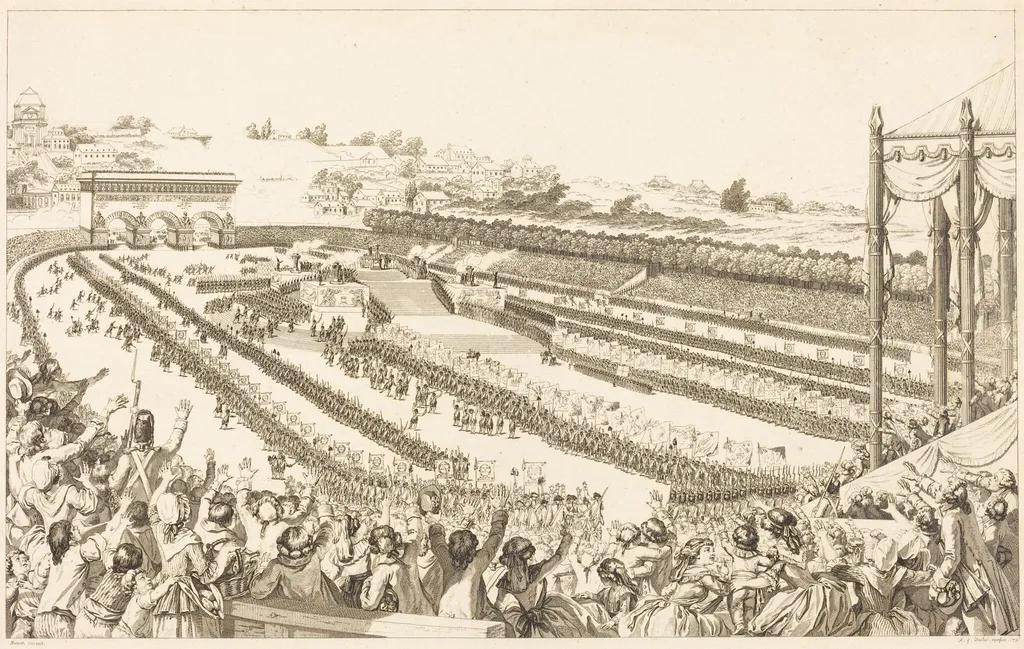
Fédération Générale de Français, au Champ de Mars, le 14 Juillet 1790 is an ink print by the Romanticist artist Antoine-Jean Duclos. It dates from 1791 and is held in the collection of the National Gallery of Art.
About this work
Overview
Created in 1791 by Antoine-Jean Duclos, this etching captures the Festival of the Federation held on the Champ de Mars in Paris on July 14, 1790. Executed in fine linear detail on laid paper, the print serves as a documentary record of a pivotal civic event during the early French Revolution, commemorating national unity through a mass gathering of citizens and soldiers.
Subject & Meaning
The stage beneath a monumental arch, flanked by classical architecture, symbolizes the new civic order—emphasizing collective identity over monarchy or clergy.
The scene depicts thousands of French citizens and military personnel assembled to swear allegiance to the nation and the constitutional monarchy. Soldiers stand in disciplined ranks at the center, while civilians in the foreground gesture and cheer. The stage beneath a monumental arch, flanked by classical architecture, symbolizes the new civic order—emphasizing collective identity over monarchy or clergy.
Technique & Style
Duclos employed precise etching techniques to render intricate details across a vast composition. Each figure, from uniformed troops to individual spectators, is carefully delineated with fine lines, creating a sense of depth and movement. The density of detail transforms the print from mere illustration into a meticulous visual archive, reflecting Enlightenment ideals of order and observation.
History & Provenance
The print was produced shortly after the event it depicts, likely intended for distribution among the educated public and revolutionary sympathizers. As a contemporary record, it circulated in Parisian circles as both commemorative artifact and political statement. Its survival in institutional collections attests to its early recognition as a significant document of revolutionary visual culture.
Context
The Festival of the Federation marked the first anniversary of the Storming of the Bastille and was designed to unify France under a constitutional framework. Held before a crowd estimated at 300,000, it was the largest public assembly of its kind in Europe at the time. Duclos’s print reflects the era’s enthusiasm for civic ritual and the visual representation of popular sovereignty.
Legacy
Though not widely known today, the etching remains a valuable primary source for understanding how revolutionary events were documented and disseminated. Its precision and scale influenced later depictions of public ceremonies, contributing to the tradition of using print media to shape collective memory during periods of political transformation.
Artist & collection


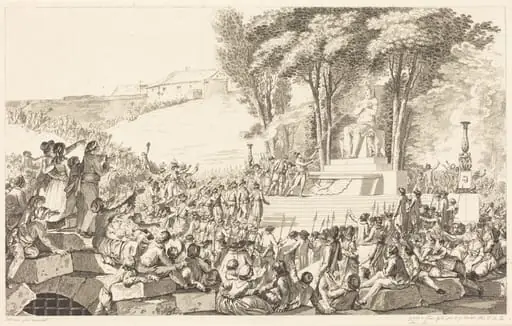 La Fontaine de la Régénération sur les débris de la Bastille, le 10 Aout 1793
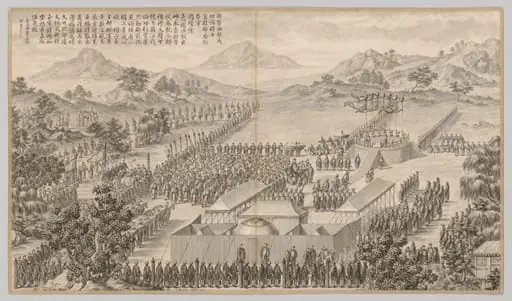 Rewards to Generals and Officers in Quelling the Uigurs: from Battle Scenes of the Quelling of Rebellions in the Western Regions, with Imperial Poems
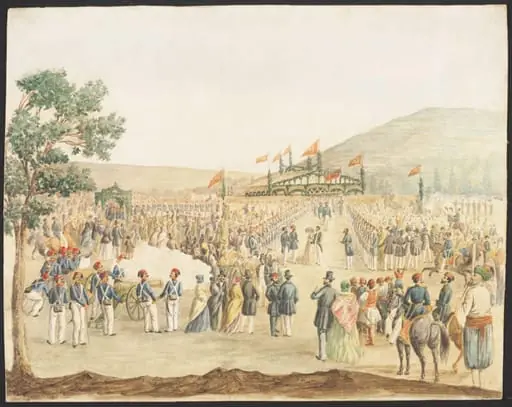 A Reception, probably for Naval Dignitaries, in Turkey
 One of Thirty-two paintings depicting festivals, ceremonies and occupations.
 The Drinking Customs of Society or Worship of Bacchus
 Fireworks on the Arno
 The Review
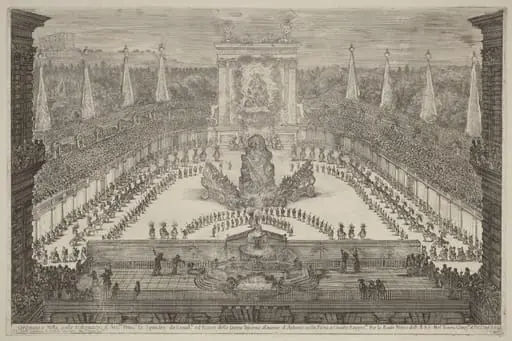 The Prince of Tuscany, His Horse Troops and Carriages around Mount Atlas
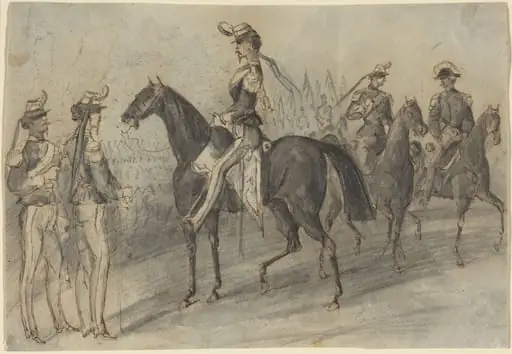 Military Parade
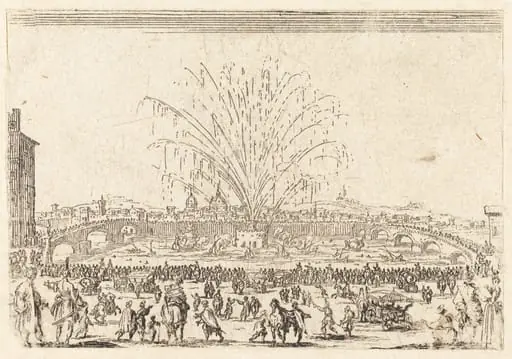 Fireworks on the Arno, Florence