Artwork
Charles Francois Paul Le Normant de Tournehem
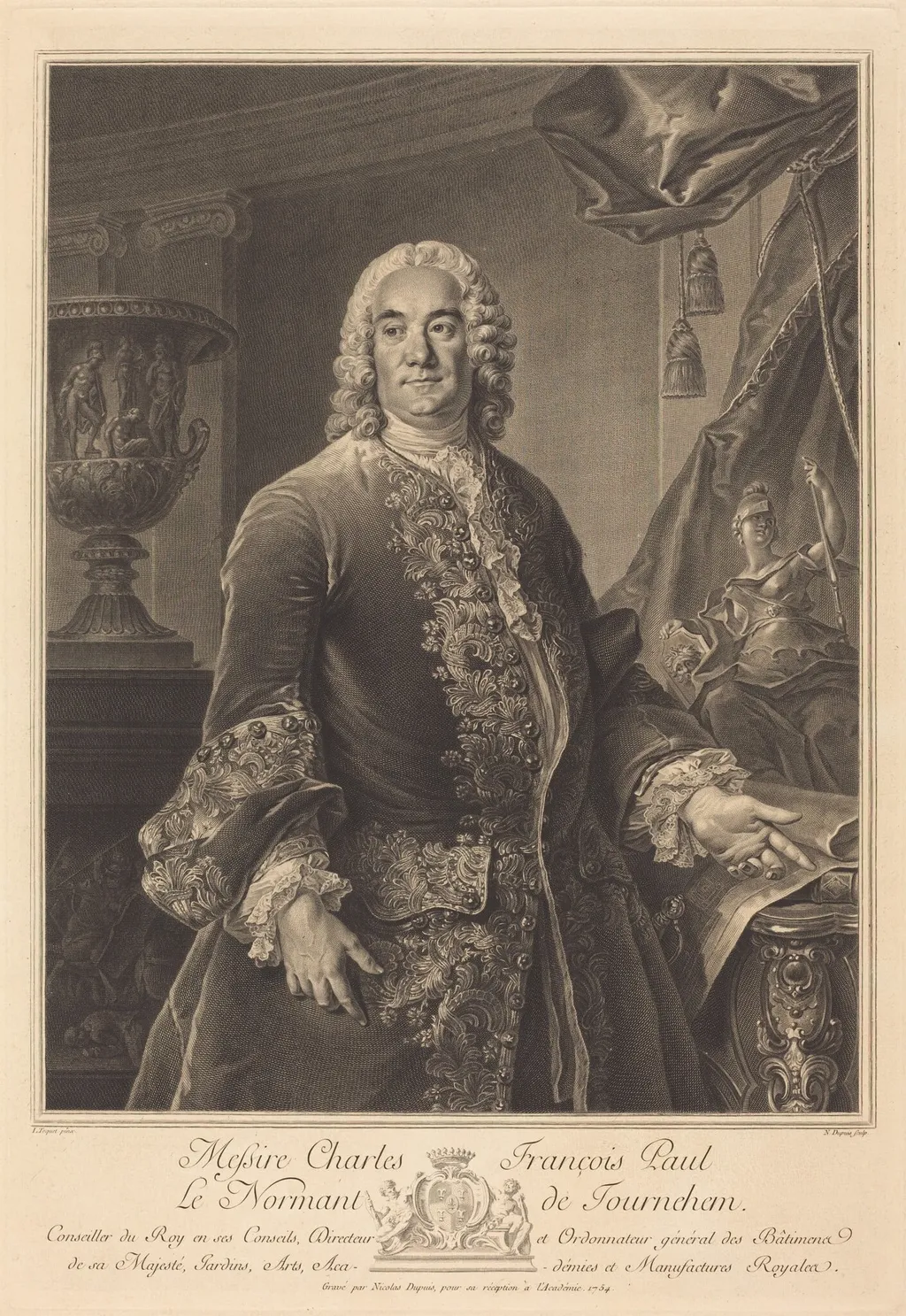
Charles Francois Paul Le Normant de Tournehem is an ink print by the Romanticist artist Nicolas-Gabriel Dupuis. It dates from 1754 and is held in the collection of the National Gallery of Art.
About this work
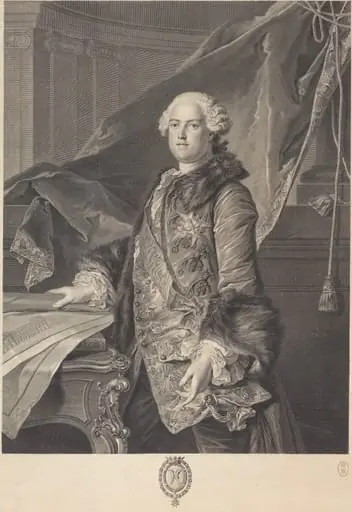
He stands confidently, one hand resting on his hip, while a curtain and decorative vase frame him from behind.
This is a black-and-white portrait of a man in a fancy, embroidered coat with wide cuffs. He stands confidently, one hand resting on his hip, while a curtain and decorative vase frame him from behind. The background shows a statue and a draped figure, adding a touch of drama.
The name at the bottom reads *Charles Francois Paul Le Normant de Tournehem*, and the print was made in 1754. The artist used a method that creates fine lines and shading—likely etching.
Next, look up etching to see how artists like Dupuis made detailed prints.
Overview
The print is a mid‑18th‑century portrait of Charles Francois Paul Le Normant de Tournehem, executed by the French engraver Nicolas‑Gabriel Dupuis in 1754. Rendered in monochrome, the image presents the sitter in an elaborate embroidered coat with pronounced cuffs, standing before a theatrical backdrop that includes a curtain, a vase, a statue and a draped figure.
Subject & Meaning
Le Normant de Tournehem is depicted with a confident pose, one hand placed on his hip, suggesting status and self‑assurance. The surrounding decorative elements—particularly the classical statue and the flowing drapery—evoke the cultured milieu of the French aristocracy, aligning the sitter with the ideals of refinement and learned taste prevalent among the elite of the Ancien Régime.
Technique & Style
Dupuis employed the etching process, a printmaking technique that uses acid‑etched lines on a metal plate to achieve delicate shading and fine detail. The resulting work displays crisp, controlled lines that define the textures of fabric and the subtle modeling of the figure, characteristic of French academic portraiture in the 1750s.
History & Provenance
Created in 1754, the engraving was likely commissioned to commemorate Le Normant de Tournehem’s social standing. While specific ownership records are scarce, the print has survived in museum collections and private holdings, reflecting the period’s practice of disseminating aristocratic likenesses through reproducible prints.
Context
The portrait belongs to a broader trend in mid‑century France where engravers reproduced fashionable portraiture for a wider audience. Dupuis, active in Paris, contributed to this market, providing images that combined the elegance of painted portraiture with the accessibility of printed media.
Legacy
Although not as widely known as contemporary oil portraits, the engraving offers valuable insight into 18th‑century French visual culture, illustrating both the technical skill of etchers like Dupuis and the visual conventions used to convey aristocratic identity during the pre‑revolutionary era.
Artist & collection