Artwork
The Ploughman
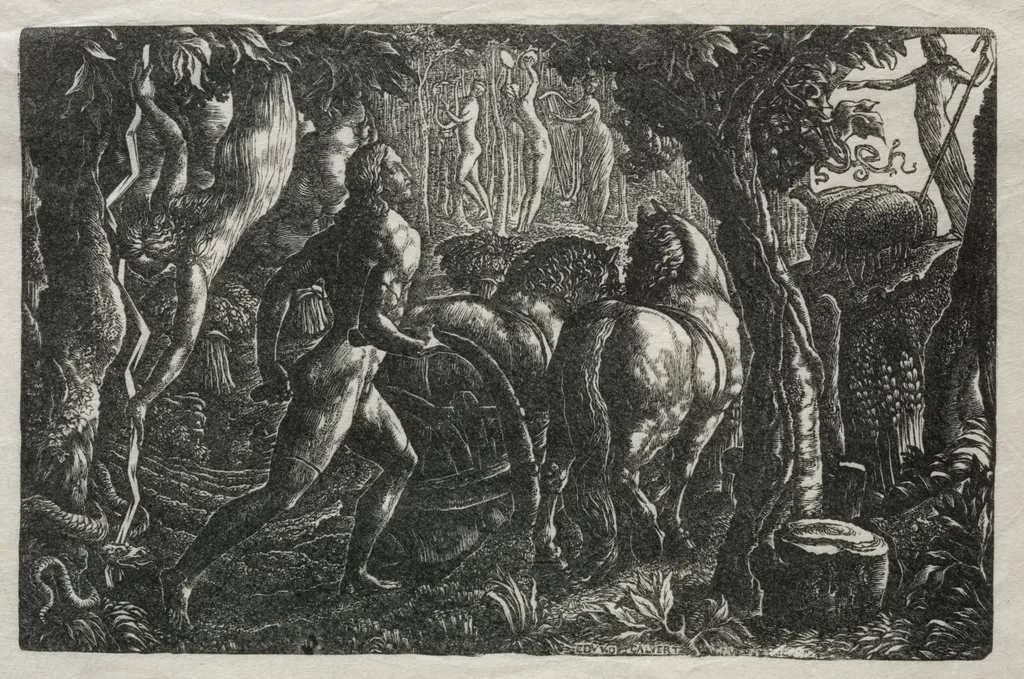
The Ploughman is a print by the Romanticist artist Edward Calvert. It dates from 1829 and is held in the collection of the Cleveland Museum of Art.
About this work
Overview
The composition includes a woman carrying grain and a child observing from behind, with a distant castle and dense trees framing the scene.
Created in 1829 by Edward Calvert, this black-and-white print depicts a rural laborer guiding two oxen across a field. The composition includes a woman carrying grain and a child observing from behind, with a distant castle and dense trees framing the scene. Executed as an etching, the work employs bold, incised lines to model form and depth, characteristic of Calvert’s intimate engagement with printmaking techniques of the early 19th century.
Subject & Meaning
The scene portrays agricultural labor not as mere toil but as a quiet, almost sacred act. The ploughman’s muscular form, the attentive child, and the woman with harvested grain suggest continuity between human effort and natural cycles. The castle and trees in the background introduce a symbolic layer, hinting at the enduring presence of tradition and authority amid daily work.
Technique & Style
Calvert used deep etching to carve sharp, expressive lines into a metal plate, creating strong contrasts between light and shadow. The heavy ink application enhances the three-dimensional quality of the figures and landscape, demonstrating a mastery of chiaroscuro. The texture of soil, bark, and fabric is rendered with deliberate, tactile precision, giving the image a sculptural weight uncommon in prints of the period.
History & Provenance
The print was produced in 1829 and entered the collection of The Cleveland Museum of Art through documented acquisition. It remains one of the few surviving impressions from Calvert’s limited print runs, reflecting his preference for small editions and personal distribution. Its preservation in a major institution underscores its significance within British printmaking of the Romantic era.
Context
Calvert worked in the shadow of William Blake’s mystical symbolism, yet his imagery remained grounded in rural life. While contemporaries focused on industrial change, he turned to agrarian scenes infused with quiet reverence. This print aligns with early 19th-century Romantic ideals that idealized labor and nature, though without overt political or sentimental rhetoric.
Legacy
Though not widely known during his lifetime, Calvert’s prints gained retrospective attention for their poetic restraint and technical rigor. The Ploughman exemplifies his unique fusion of folk subject matter with fine printmaking craft, influencing later artists interested in the dignity of manual labor and the expressive potential of etching.
Artist & collection