Artwork
The Market Place, Salisbury
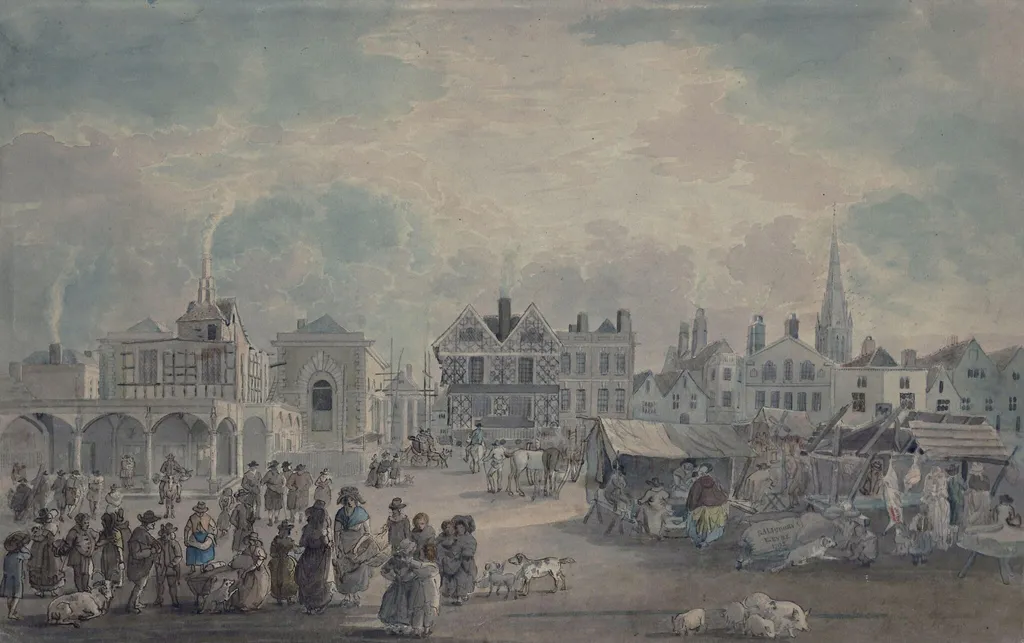
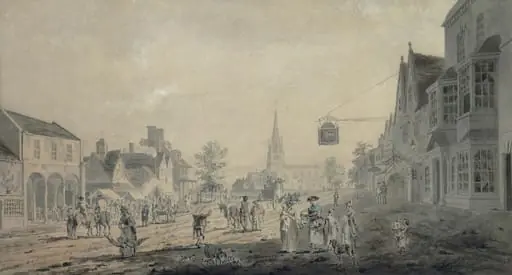
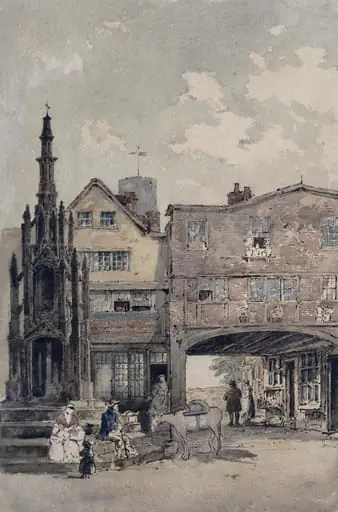
The Market Place, Salisbury is a watercolor work on paper by the Romanticist artist Edward Eyre. It dates from 1792 and is held in the collection of the Victoria and Albert Museum.
About this work
Overview
Signed and dated by the artist, the work is a precise record of daily commerce in late 18th-century England.
Painted in 1792, this watercolour by Edward Eyre captures the bustling market square of Salisbury. Signed and dated by the artist, the work is a precise record of daily commerce in late 18th-century England. Executed in transparent washes, it conveys both the activity of the crowd and the quiet presence of the town’s architecture, rendered with careful attention to natural light and atmospheric tone.
Subject & Meaning
The scene portrays ordinary life: vendors display goods under canvas tents, shoppers carry bundles, and animals move freely among pedestrians. Dogs wander unchained, suggesting a time before strict urban regulation. The composition avoids idealization, presenting the market as a functioning, unvarnished space. The inclusion of the church spire anchors the scene in a specific place, reinforcing its documentary character.
Technique & Style
Eyre employed delicate watercolour washes to suggest texture and depth without heavy outlines. Light falls softly across stone facades and clothing, creating subtle contrasts that enhance the sense of real-time atmosphere. The sky, rendered in pale, diffused tones, unifies the composition and softens the urban setting. The technique reflects a preference for observational accuracy over dramatic effect.
History & Provenance
The work is known only through its inscription and surviving physical record. No documented ownership history precedes its modern appearance in collections. As a small-scale watercolour by a relatively minor artist, it likely circulated among local patrons or was kept as a personal record. Its survival suggests it was valued for its topographical detail rather than artistic fame.
Context
Created during the rise of Romanticism, the painting aligns with the period’s interest in everyday life and vernacular architecture. While not overtly emotional or sublime, it shares the movement’s turn toward authenticity in depicting ordinary scenes. Salisbury’s medieval layout and active market made it a natural subject for artists seeking to record the rhythms of provincial England.
Legacy
The painting remains a quiet testament to the visual culture of provincial England before industrialization. It contributes to a broader archive of topographical watercolours that document urban life in the late 18th century. Though not widely exhibited, it offers insight into how ordinary spaces were observed and preserved by artists outside the academic mainstream.
Artist & collection
Artist
British watercolorist Edward Eyre painted street scenes alive with local color and bustling detail.