Artwork
Witney, Oxfordshire
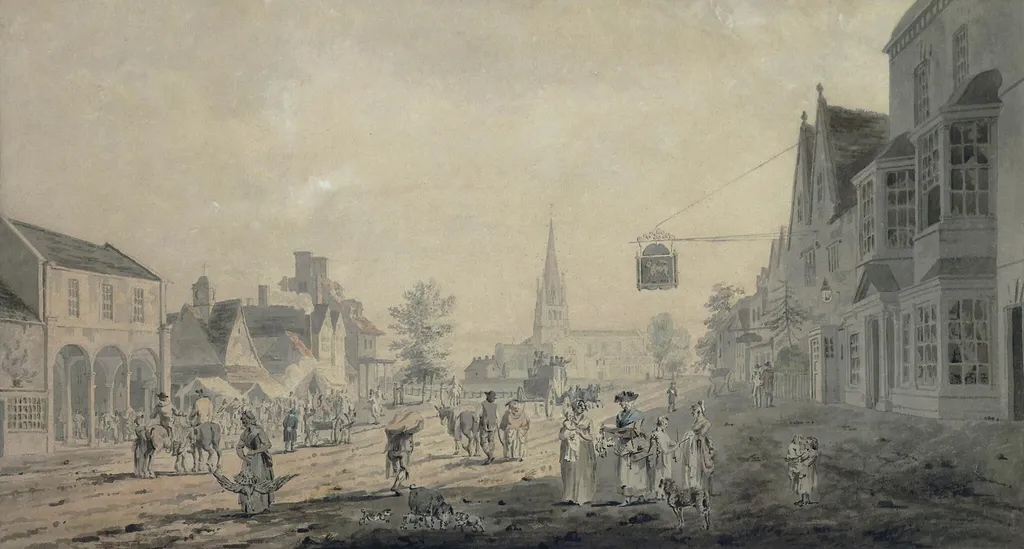
Witney, Oxfordshire is a watercolor work on paper by Paul RA Sandby. It dates from 1750 and is held in the collection of the Victoria and Albert Museum.
About this work
Overview
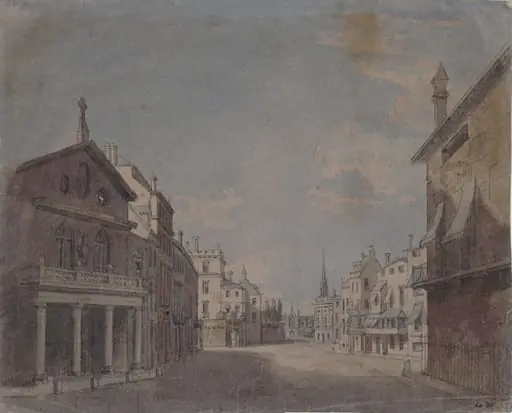
The composition centers on a narrow street lined with modest stone buildings, their facades suggesting local craftsmanship.
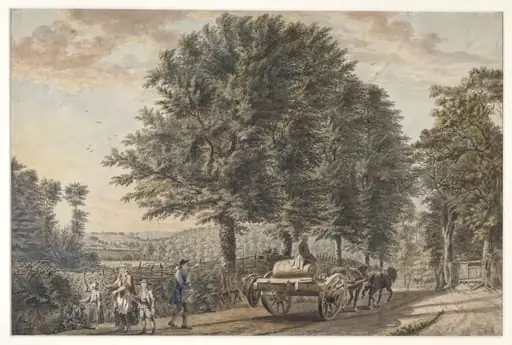
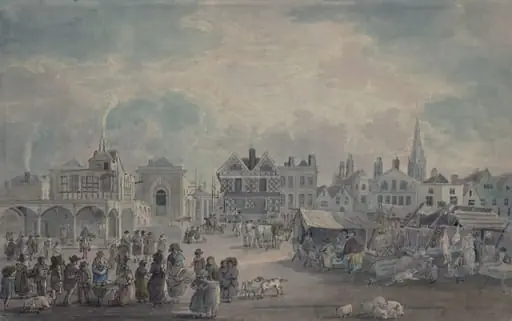
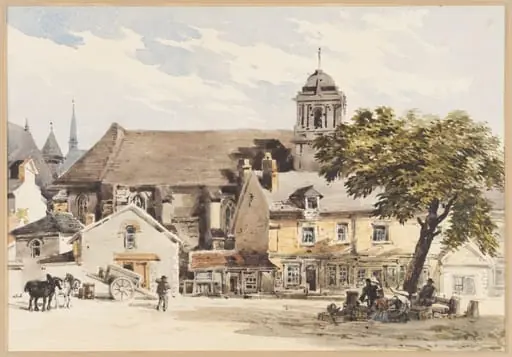
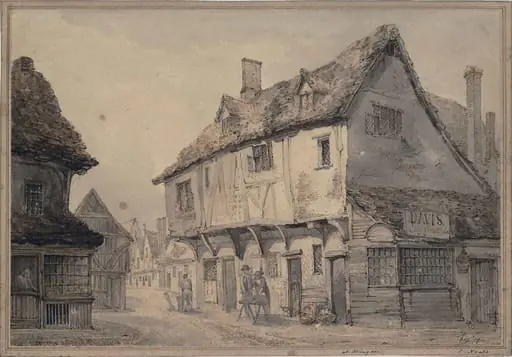
A watercolour by Paul Sandby captures a weekday scene in Witney, Oxfordshire, rendered with quiet precision. The composition centers on a narrow street lined with modest stone buildings, their facades suggesting local craftsmanship. A market hall anchors the left, the Bull Inn the right, while a church spire rises beyond. Figures move through the space with unposed naturalism, conveying routine activity rather than staged spectacle.
Subject & Meaning
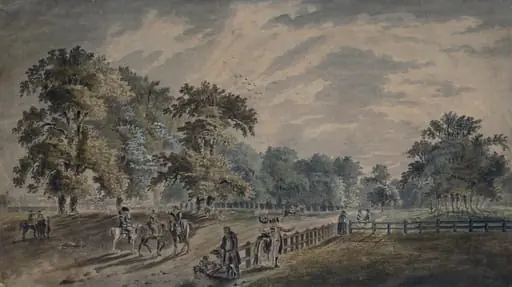
The painting documents everyday life in an 18th-century English market town. Figures include pedestrians, riders on horses and donkeys, and small groups engaged in conversation, suggesting a community bound by commerce and social ritual. The presence of the Angel sign hints at a local inn or meeting point, reinforcing the scene’s function as a civic hub. No single event dominates; instead, the work emphasizes continuity in daily rhythms.
Technique & Style
Sandby employs transparent watercolour washes to suggest light and texture without heavy detail. Buildings are defined by soft outlines and muted earth tones, while figures are rendered with minimal brushwork, enough to imply motion and posture. The sky is lightly graded, avoiding dramatic contrast, which enhances the scene’s grounded, observational quality. The technique reflects topographical precision tempered with gentle atmospheric tone.
History & Provenance
Painted in the latter half of the 18th century, the work likely stems from Sandby’s travels through Oxfordshire as part of his broader documentation of English towns. It was probably created for private patrons interested in regional topography rather than public exhibition. Its survival suggests it remained in family collections, avoiding the dispersal common to lesser-known works of the period.
Context
During Sandby’s time, watercolour was gaining traction as a medium for recording landscapes and urban scenes, distinct from oil’s grandeur. Witney, known for wool production, was a modest but active market town. This painting aligns with a growing interest in vernacular architecture and local life, reflecting Enlightenment-era curiosity in documenting the ordinary rather than the monumental.
Legacy
Though not widely exhibited, the work contributes to a body of topographical watercolours that preserved the appearance of English towns before industrial transformation. Sandby’s approach influenced later artists who valued observational accuracy over idealization. This piece remains a quiet record of pre-industrial community life, valued today for its historical fidelity rather than artistic flourish.
Artist & collection
Artist
Paul Sandby painted Britain’s rolling hills and old buildings in soft watercolours during the late 1700s.