Artwork
Slate Fences, Abergynolwyn, Merionethshire
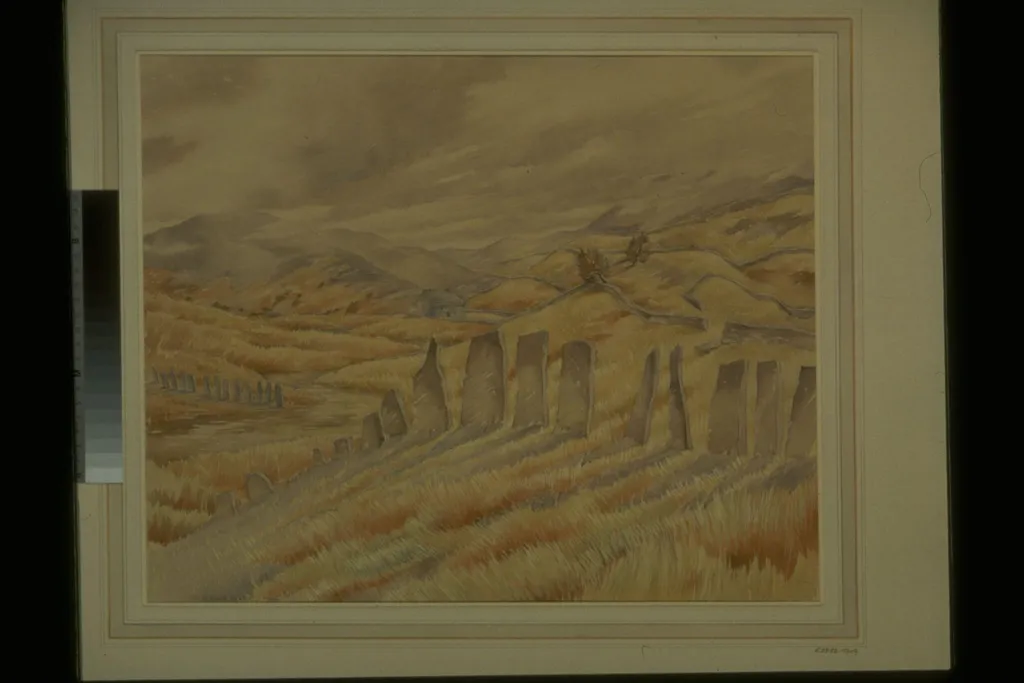
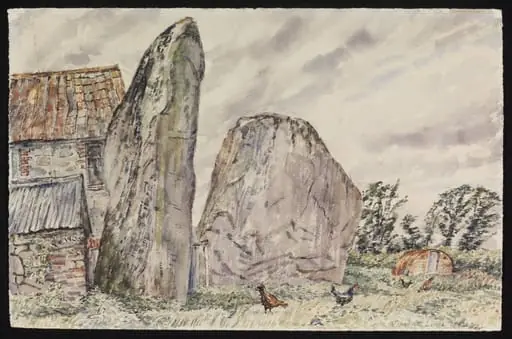
Slate Fences, Abergynolwyn, Merionethshire is a watercolor work on paper by the British Romanticist artist Mildred Eldridge. It dates from 1943 and is held in the collection of the Victoria and Albert Museum.
About this work
Overview
The painting presents slate slabs arranged as boundary fences across rolling, treeless hills, rendered in restrained earth tones.
Mildred Eldridge’s 1943 watercolour captures a quiet stretch of countryside near Abergynolwyn in Merionethshire, Wales. The painting presents slate slabs arranged as boundary fences across rolling, treeless hills, rendered in restrained earth tones. Executed as part of the *Recording Britain* project, the work serves as a topographical record of rural landscapes during wartime, preserving regional character amid national uncertainty.
Subject & Meaning
The slate fences, formed from locally quarried material, reflect a practical adaptation to the region’s geology and economy. Their repetitive, upright forms evoke a somber, almost memorial quality, suggesting a quiet dialogue between human labor and the land. The winding road invites the viewer’s gaze inward, emphasizing isolation and continuity rather than disruption, reinforcing the scene’s sense of enduring, unremarkable resilience.
Technique & Style
Eldridge employed transparent watercolour washes to convey the texture and weight of the slate without heavy detail. Subtle gradations of gray, brown, and muted green suggest varying light conditions across the hills, while the soft edges of the fences contrast with the sharper contours of the road. The technique balances precision with atmospheric looseness, capturing both material solidity and the hushed stillness of the landscape.
History & Provenance
Commissioned in 1943 by the Committee for the Employment of Artists in Wartime under the Ministry of Labour and National Service, the painting was funded by the Pilgrim Trust and overseen by Sir Kenneth Clark. Part of the *Recording Britain* initiative, it was created to document at-risk rural scenes during wartime. The work entered the Victoria and Albert Museum’s collection as part of this national effort to preserve visual records of Britain’s changing topography.
Context
The *Recording Britain* project prioritized topographical accuracy over artistic innovation, focusing on landscapes and vernacular structures threatened by conflict or modernization. While predominantly centered on England and Scotland, it included select Welsh sites like Abergynolwyn, acknowledging the region’s distinct rural character. The slate fences, common in quarrying communities, represented a uniquely Welsh adaptation to landscape and industry.
Legacy
Eldridge’s watercolour remains a quiet testament to the intersection of place, labor, and preservation. As part of the *Recording Britain* archive, it contributes to a broader historical record of wartime Britain’s rural fabric. Its understated realism and regional specificity continue to inform studies of landscape, material culture, and the role of art in documenting everyday environments during periods of national upheaval.
Artist & collection
Artist
Mildred Elsie Eldridge known as Elsi Eldridge, was a British artist, mural painter and book illustrator.