Artwork
Dead Tree
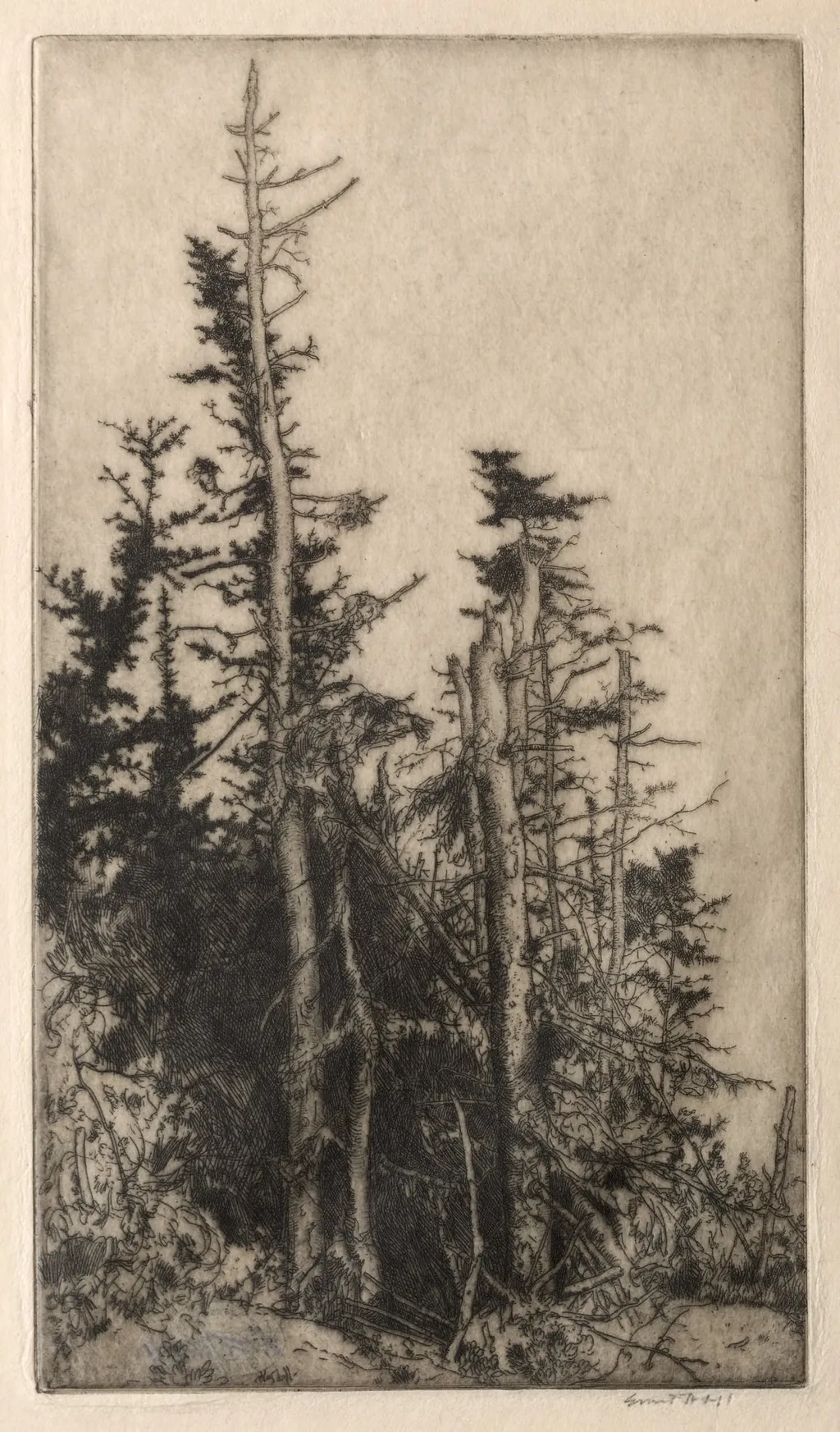
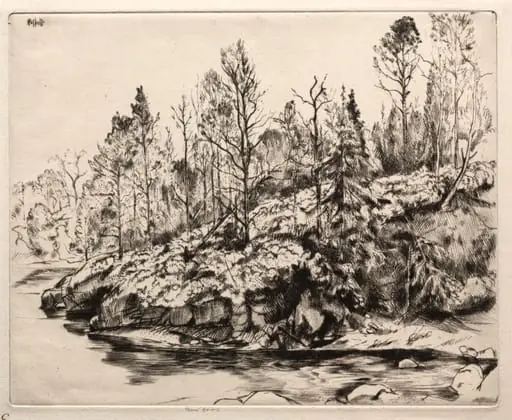
Dead Tree is a print by Ernest Haskell. It dates from 1910 and is held in the collection of the Cleveland Museum of Art.
About this work
Overview
The work is part of the collection at The Cleveland Museum of Art, where it is preserved as an example of early 20th-century graphic experimentation.
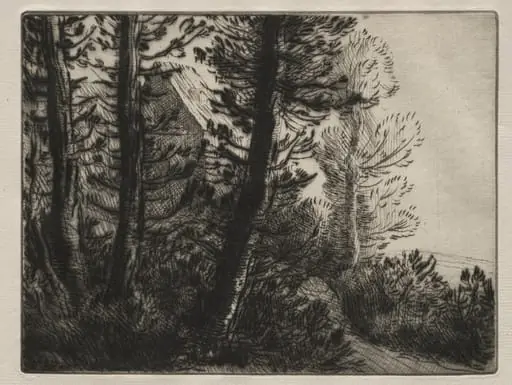
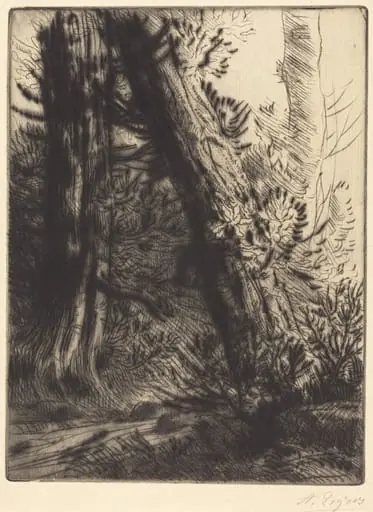
Dead Tree is a monochrome print made around 1910 by American artist Ernest Haskell. It depicts a dense cluster of slender, leafless trees rising from a cluttered undergrowth. The composition emphasizes verticality and texture, rendered entirely in fine, dark lines against a pale ground. The work is part of the collection at The Cleveland Museum of Art, where it is preserved as an example of early 20th-century graphic experimentation.
Subject & Meaning
The subject is a stand of dead or dormant trees, stripped of foliage and tightly packed. Their gnarled trunks and angular branches suggest resilience amid decay. The absence of leaves and the tangled roots below evoke a sense of stillness and quiet endurance. There is no human presence, allowing the natural forms to stand as silent witnesses to seasonal cycles and the passage of time.
Technique & Style
Haskell employed a dense, linear technique, using fine, scratchy strokes to build texture and form. The bark is rendered with repeated, irregular lines that mimic the roughness of wood, while the roots and underbrush are suggested through overlapping, chaotic marks. The contrast between the dark ink and the untouched paper creates depth without shading, relying on line weight and density to define volume and space.
History & Provenance
Created circa 1910, the print entered the collection of The Cleveland Museum of Art at an early date, likely through acquisition or donation in the decades following its creation. Haskell, known for his detailed drawings and prints of natural subjects, produced this work during a period when American artists were increasingly turning to direct observation of the landscape. Its preservation reflects institutional interest in graphic arts of the era.
Context
In the early 1900s, American printmakers were exploring ways to move beyond traditional illustration toward more expressive, personal styles. Haskell’s work aligns with this shift, drawing from the tradition of etching and drypoint while emphasizing texture over narrative. The focus on a solitary, barren grove reflects broader cultural interests in nature’s raw forms, distinct from romanticized landscapes of earlier decades.
Legacy
Dead Tree remains a representative example of Haskell’s commitment to detailed, tactile rendering of natural forms. While not widely reproduced, it contributes to the understanding of early 20th-century American printmaking’s turn toward intimate, observational subjects. Its presence in a major museum collection affirms its role in documenting the period’s evolving aesthetic values in graphic art.
Artist & collection

Artist
Ernest Haskell was an American artist and illustrator, internationally famous in his lifetime and remembered for his etchings, as well as engravings, pen-and-ink drawings, lithographs and watercolors.

![Old Trees at Naushon Island [plate 2], by Robert Swain Gifford](https://artifactworldgallery.com/img/robert-swain-gifford--old-trees-at-naushon-island-plate-2--74282486ac5ae211-w320.webp)