Artwork
An Unknown
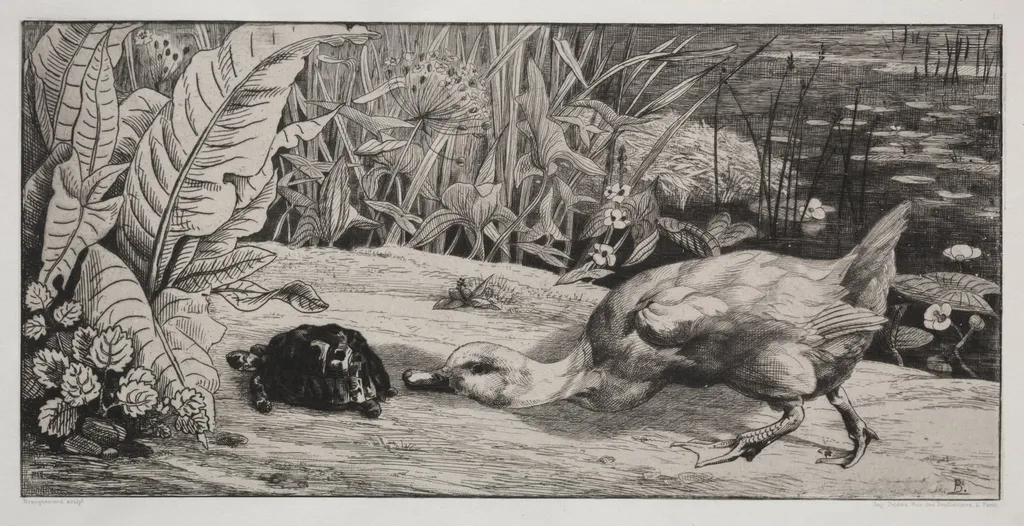
An Unknown is a print by the Impressionist artist Félix Bracquemond. It dates from 1862 and is held in the collection of the Cleveland Museum of Art.
About this work
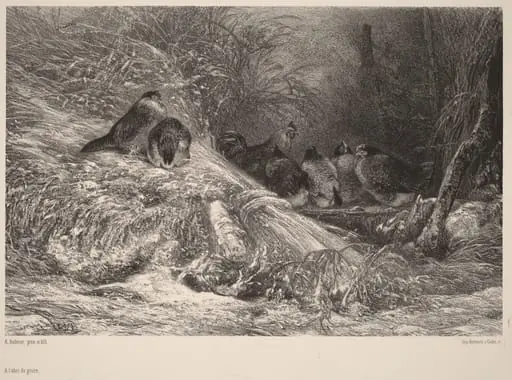
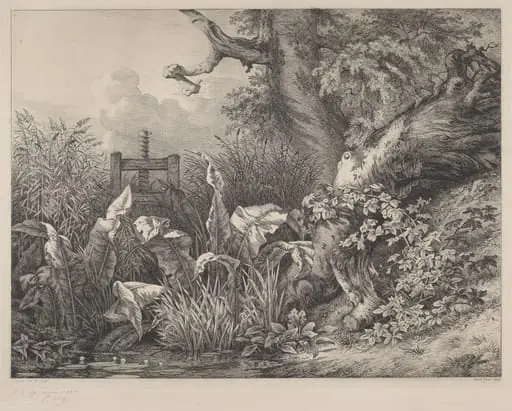
Tall plants and flowers fill the background, and the scene looks like a quiet forest floor.
This print shows a dead hare lying on the ground with a small dog sniffing at it. Tall plants and flowers fill the background, and the scene looks like a quiet forest floor. The artist used only black lines and shading to create the whole image.
The dog’s focus on the hare adds a sense of stillness to the scene. This work was made in 1862 by a French artist who often explored nature in his prints.
Next, check out Félix Bracquemond to see how he blended realism with detailed linework.
Overview
Created in 1862 by French artist Félix Bracquemond, this print depicts a dead hare resting on the forest floor, observed by a small dog. Rendered entirely in black ink, the composition relies on fine linear details and subtle tonal gradations to define form and space. The quiet, intimate scene reflects Bracquemond’s interest in natural subjects and his mastery of printmaking techniques of the period.
Subject & Meaning
The image captures a moment of stillness between life and death: the hare, motionless, lies amid wild vegetation, while the dog, attentive and poised, sniffs at its remains. There is no overt drama or narrative resolution—only observation. The scene evokes a quiet contemplation of nature’s cycles, free from sentimentality, aligning with the artist’s preference for unembellished naturalism.
Technique & Style
Bracquemond employed drypoint and etching to produce delicate, precise lines that model form through shading rather than color. The background foliage is rendered with intricate, overlapping strokes, creating depth without clutter. The dog’s fur and the hare’s texture are suggested through varied line weight and density, demonstrating his skill in translating observed detail into monochrome print.
History & Provenance
The print entered the collection of The Cleveland Museum of Art as part of its broader acquisition of 19th-century French prints. While its early ownership history is not fully documented, its preservation reflects growing institutional interest in printmakers who elevated everyday natural scenes to the level of fine art during the mid-1800s.
Context
In 1860s France, artists increasingly turned to nature as a subject independent of myth or moral allegory. Bracquemond, influenced by Japanese woodblock prints and the Realist movement, rejected academic conventions in favor of direct observation. This work exemplifies his role in redefining printmaking as a medium for intimate, unidealized depictions of the natural world.
Legacy
Bracquemond’s focus on subtle naturalism and technical precision in printmaking influenced later generations of artists, particularly those engaged with the revival of etching in the late 19th century. Though not widely known today, his work contributed to a broader shift in how nature was represented in graphic arts—emphasizing quiet observation over dramatic narrative.
Artist & collection

Artist
Félix Henri Bracquemond (French pronunciation: ; 22 May 1833 – 29 October 1914) was a French painter, etcher, and printmaker.