Artwork
Barrel-Vaulted Arcade Rendered in Perspective
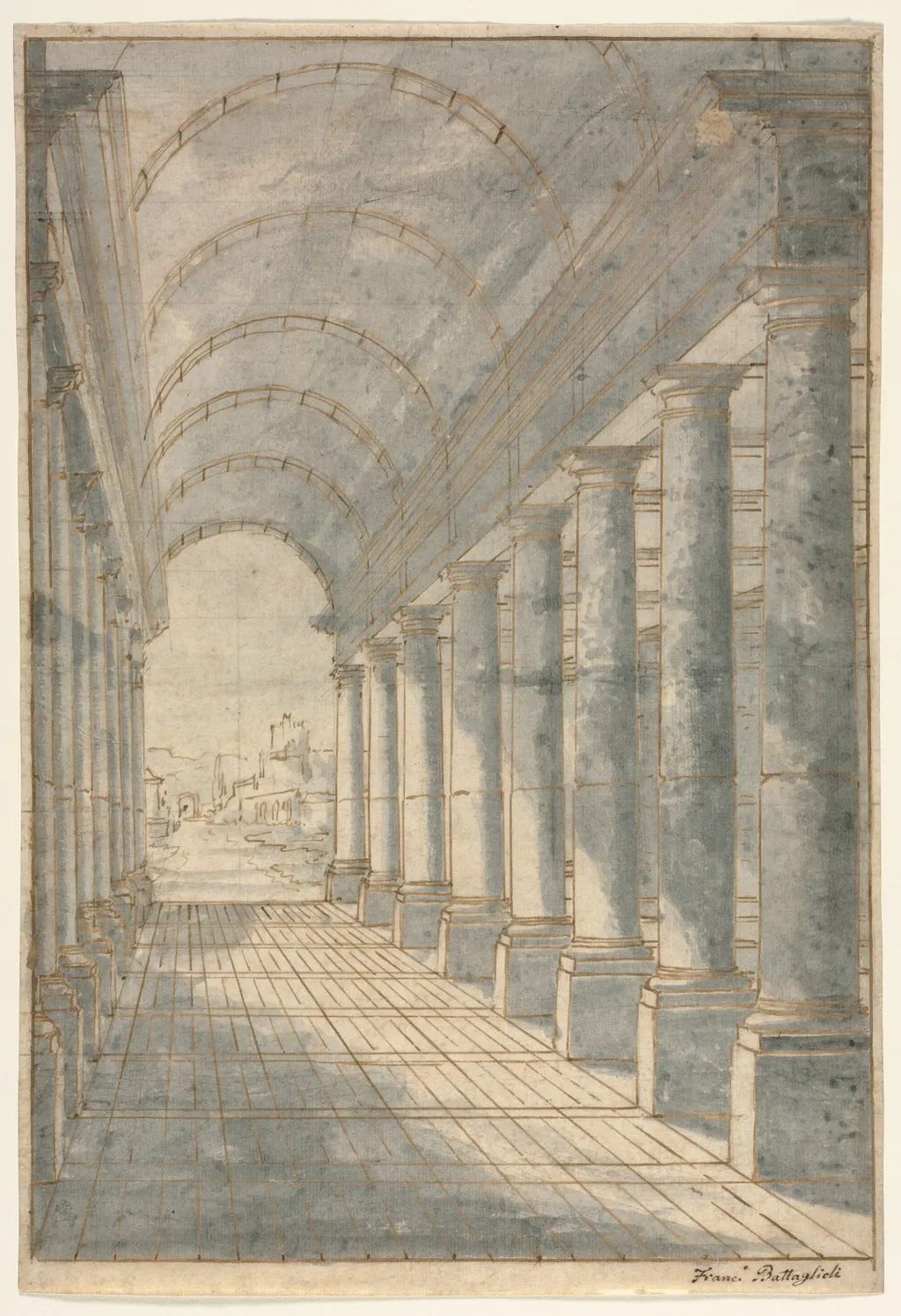
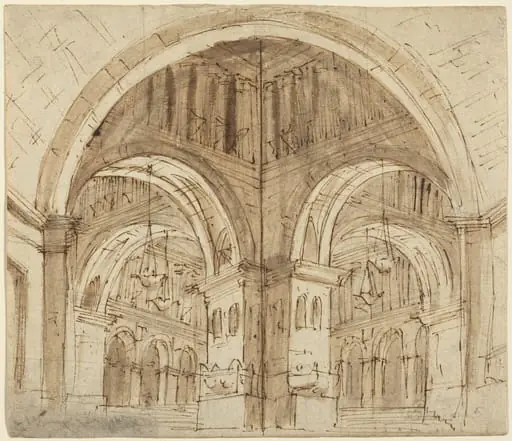
Barrel-Vaulted Arcade Rendered in Perspective is a drawing by the Romanticist artist Francesco Battaglioli. It dates from 1788 and is held in the collection of the Cleveland Museum of Art.
About this work
Overview
Created around 1788 by Francesco Battaglioli, this drawing presents a meticulously rendered interior arcade with a barrel vault.
Created around 1788 by Francesco Battaglioli, this drawing presents a meticulously rendered interior arcade with a barrel vault. Executed in monochrome tones, it demonstrates a rigorous command of linear perspective and spatial depth. The work belongs to a body of architectural studies produced by Battaglioli during his time in Venice, where he focused on capturing structured urban environments with precision.
Subject & Meaning
The drawing depicts a long, colonnaded corridor under a curved ceiling, extending toward a distant urban vista. The architecture suggests a public or institutional space, possibly inspired by Venetian buildings. The receding arches and diminishing columns guide the viewer’s eye into the distance, emphasizing spatial order rather than narrative. The inclusion of a distant town implies a connection between interior design and the broader cityscape.
Technique & Style
Rendered in gray and white washes, the drawing relies on subtle tonal gradations to model volume and distance. Precise linear construction defines the arches, columns, and floor tiles, reflecting a methodical approach to perspective. Battaglioli avoids decorative flourish, favoring clarity and structural logic. The monochromatic palette enhances the illusion of depth, aligning with academic traditions of architectural drafting.
History & Provenance
Francesco Battaglioli, born in Modena and active in Venice, produced numerous architectural drawings and vedute during the late 18th century. This work likely served as a study or preparatory sketch, possibly for larger paintings or commissions. It entered the Cleveland Museum of Art’s collection as part of a broader acquisition of Italian drawings, reflecting the museum’s interest in Enlightenment-era architectural representation.
Context
In the decades before Romanticism’s emotional turn, architectural drawing in Italy emphasized rational form and optical accuracy. Battaglioli’s work aligns with the tradition of Venetian vedutisti like Canaletto, though his focus is more on interior geometry than bustling public life. His drawings were valued by collectors and architects seeking clear, measurable representations of space.
Legacy
Battaglioli’s drawings, including this one, remain significant as examples of late 18th-century architectural pedagogy. They illustrate how perspective was taught and applied in a period transitioning from Baroque grandeur to Neoclassical restraint. While not widely known today, such works underpin the technical foundations of architectural illustration in the modern era.
Artist & collection
Artist
. Francesco Battaglioli (Modena, 1725 – Venice, 1796) was an Italian painter, known as painter of veduta and capriccios based on the scenery of Venice and the Venetian mainland (Brescia and Treviso).

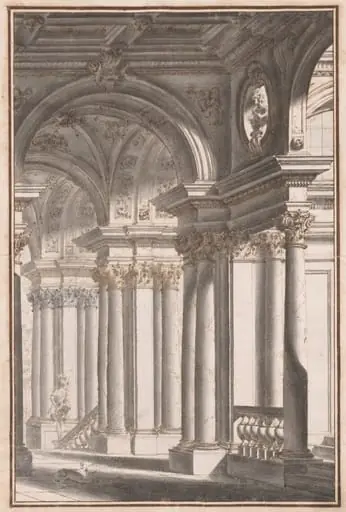 Architectural Capriccio with a Soldier and Dog
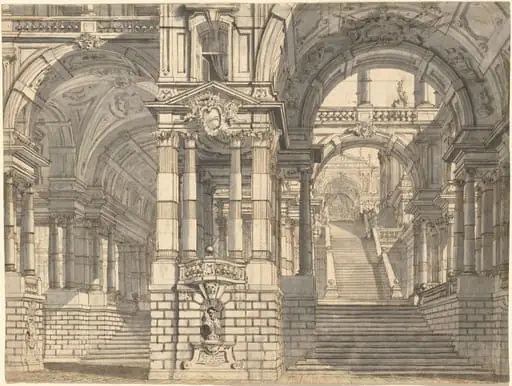 Fantasy of Magnificent Courtyards and Loggie with a Monumental Staircase
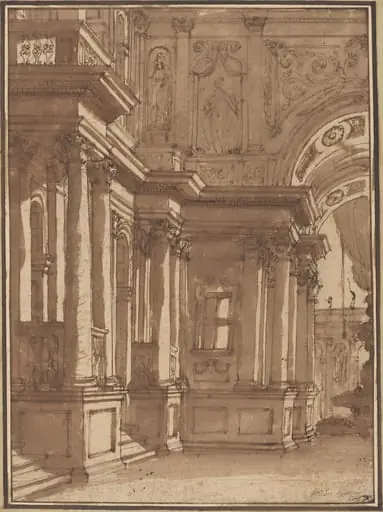 Interior of a Palace
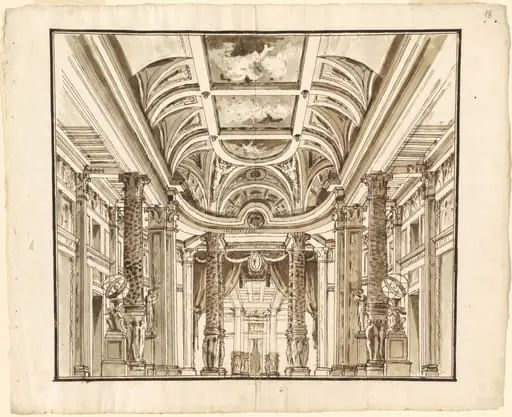 Fantasy of a Great Hall with Basketweave Columns
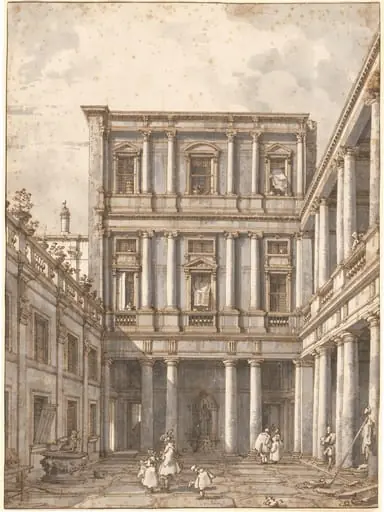 A Venetian Courtyard, in the Procuratie Nuove
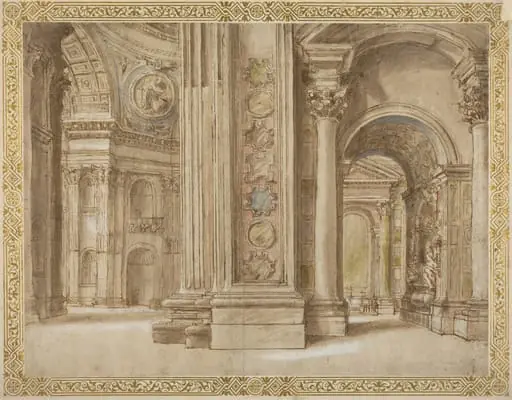 The Interior of Saint Peter's, Rome
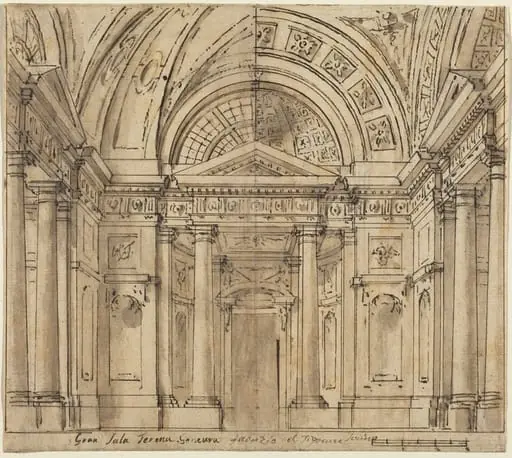 Design for Entrance to a Hall
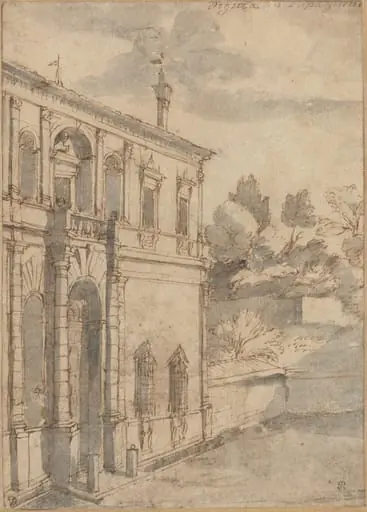 Villa di Papa Giulio
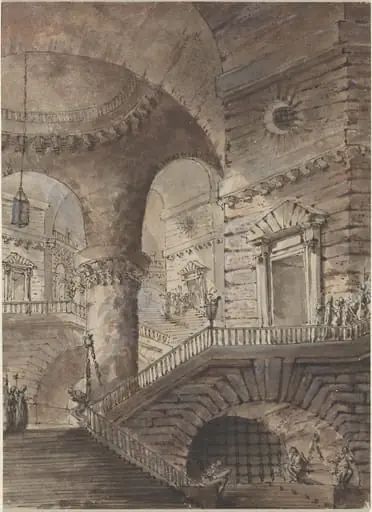 Roman Prison
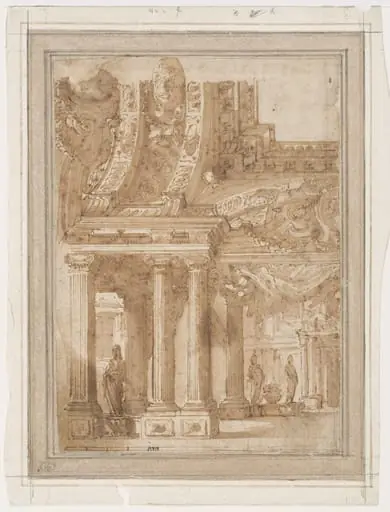 Untitled
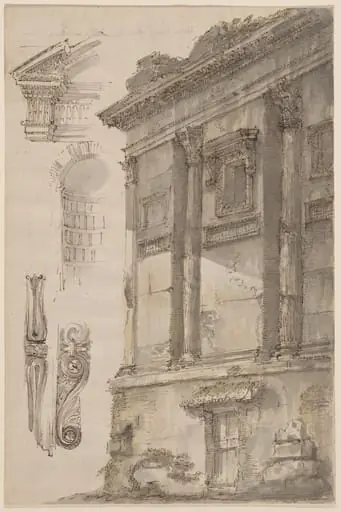 Studies of the Cenotaph of Annia Regilla
 Design for a Vaulted Hall