Artwork
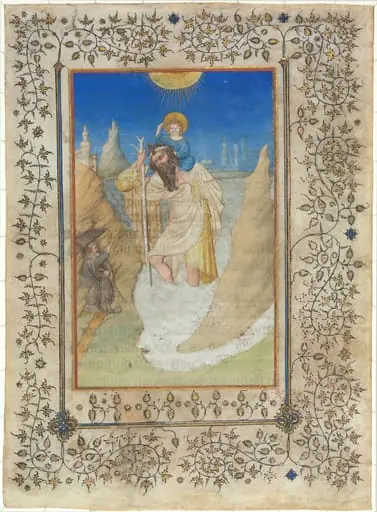
Saint Christopher [recto]
![Saint Christopher [recto], by French 15th Century, ink, 1460](https://artifactworldgallery.com/img/french-15th-century--saint-christopher-recto--704690a705f2f63e-w1024.webp)
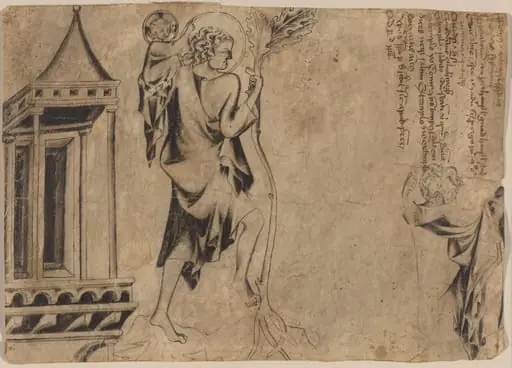
Saint Christopher [recto] is an ink print by the Renaissance artist French 15th Century. It dates from 1460 and is held in the collection of the National Gallery of Art.
About this work
The figures are outlined in black, with brown and yellow added by hand, and the ground looks like rough, cracked earth.
This broken piece of paper shows a simple drawing of a bearded man carrying a small child on his shoulders. Behind them, a church with a cross-topped roof and a small tower peek through the trees. The figures are outlined in black, with brown and yellow added by hand, and the ground looks like rough, cracked earth.
The drawing is a woodcut, meaning it was carved into wood and then printed. This style was common in the 15th century, when books and images were often made this way.
Look up woodcut to see how artists carved and printed these early images.
Overview
The work is a hand‑colored woodcut on laid paper, depicting a bearded figure bearing a child upon his shoulders before a modest church set amid trees. The composition is rendered in black outlines, with brown and yellow pigments applied manually to accentuate clothing and terrain, which appears as cracked earth. The fragmentary state of the paper suggests it is a surviving portion of a larger printed sheet.
Subject & Meaning
The image presents the traditional iconography of Saint Christopher, the patron saint of travelers, shown carrying the Christ Child across a river. The presence of a small church with a cross‑topped roof in the background reinforces the Christian context, while the rugged ground may allude to the saint’s legendary crossing of a dangerous waterway.
Technique & Style
Executed as a woodcut, the design was incised into a wooden block, inked, and pressed onto laid paper. After printing, the artist added hand‑applied brown and yellow coloration, a common practice in the 15th century to enliven otherwise monochrome prints. The linear quality of the carving and the modest palette reflect the practical aesthetics of early printmaking.
History & Provenance
Woodcuts of this type were widely produced in the late medieval period for devotional books and portable images. The piece’s material—laid paper and hand‑coloring—indicates a production date in the 1400s, though no specific workshop or patron is recorded. Its current fragmented condition suggests it may have been part of a larger devotional sheet that was later cut or damaged.
Artist & collection

Artist
This artist hid their best work inside old travel trunks. They glued vivid woodcuts into the lids of wooden boxes meant to be carried on horseback, like secret postcards from God. If you’ve ever pried open a cracked lid…

![Saint John the Baptist [recto], by German 15th Century](https://artifactworldgallery.com/img/german-15th-century--saint-john-the-baptist-recto--4347da889e7eef62-w320.webp)