Artwork
Noah's Sacrifice
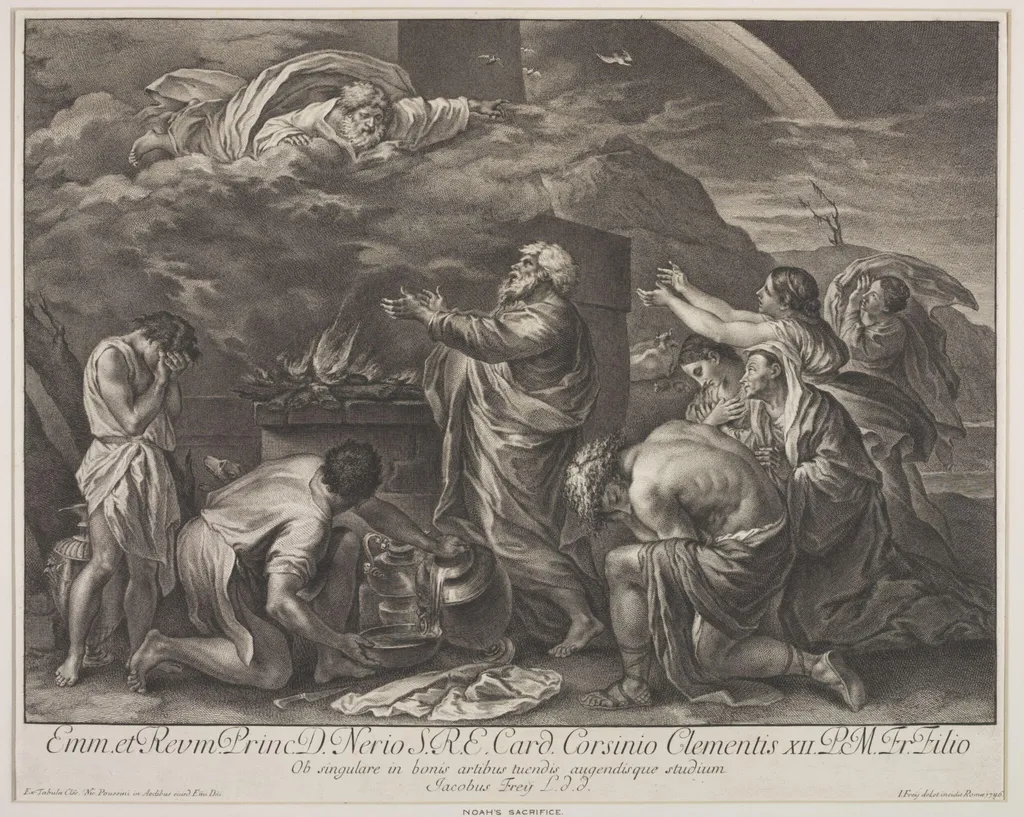
Noah's Sacrifice is a print by Johannes Jakob Frey. It dates from 1850 and is held in the collection of the Victoria and Albert Museum.
About this work
Overview
Frey’s version captures the aftermath of the flood, focusing on Noah’s act of devotion as a symbolic renewal of the covenant between humanity and the divine.
Johannes Jakob Frey’s 1850 print, *Noah's Sacrifice*, reproduces a composition originally conceived by Nicolas Poussin. Executed on paper, the work translates Poussin’s painterly vision into a graphic medium, preserving the narrative gravity of the biblical moment. Frey’s version captures the aftermath of the flood, focusing on Noah’s act of devotion as a symbolic renewal of the covenant between humanity and the divine.
Subject & Meaning
The scene illustrates Noah offering a burnt sacrifice to God after the waters recede, as recounted in Genesis. Figures gather around an altar, their postures conveying humility and awe. The rainbow arching above them signals divine promise and the end of judgment. The composition emphasizes ritual as an act of gratitude, framing human survival as contingent on reverence and divine mercy.
Technique & Style
Frey employs chiaroscuro to model forms and direct attention toward the altar, where light intensifies the flames and the figures’ gestures. The contrast between illuminated foreground and shadowed periphery enhances spatial depth. Linework is precise yet restrained, reflecting the printmaker’s fidelity to Poussin’s classical composition while adapting it to the tonal limitations of the medium.
History & Provenance
Frey’s print was produced in 1850 as part of a broader 19th-century interest in reproducing Old Master compositions for wider audiences. It derives directly from Poussin’s earlier painting, likely accessed through engravings or studio studies. The work circulated in academic and religious circles, serving both as devotional imagery and as an educational tool for artists studying classical narrative structure.
Context
In mid-19th-century Europe, biblical themes remained central to artistic training and public taste. Frey’s print aligns with a revival of classical ideals in art, where Poussin’s ordered compositions were held as models of moral clarity. The emphasis on ritual and divine covenant resonated with contemporary religious sentiment, even as industrialization reshaped cultural priorities.
Legacy
Frey’s print endures as a documented example of how 19th-century printmakers mediated Old Master imagery for new audiences. While not widely exhibited today, it reflects the enduring influence of Poussin’s compositional language and the role of reproductive prints in sustaining religious iconography beyond the original painting’s physical presence.
Artist & collection
Artist
Mid-19th-century religious prints by Johannes Jakob Frey bring Bible scenes and saints’ lives to paper.

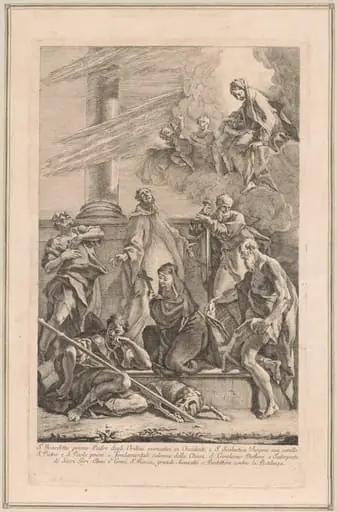 The Madonna and Child with Two Angels and Saints Scholastica, Benedict, Roch, Peter, Paul and Jerome
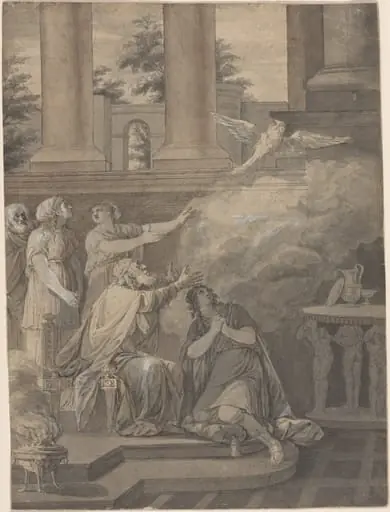 Pallas Athene in the Form of a Bird Leaving Nestor and Telemachus
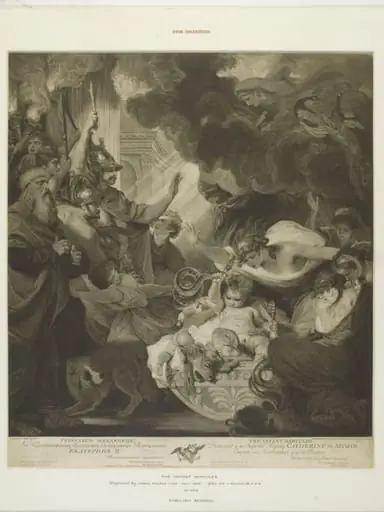 The Infant Hercules
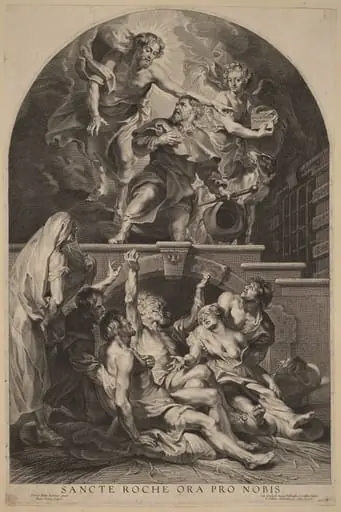 Jesus Christ Appearing to Saint Roch
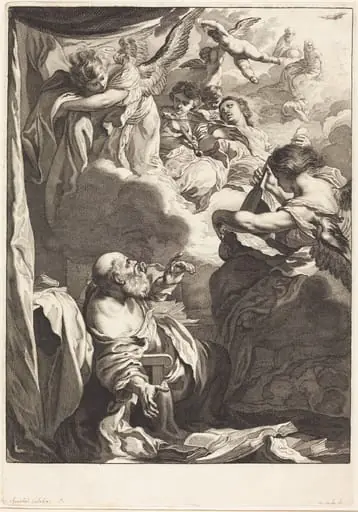 The Ecstasy of Saint Paul
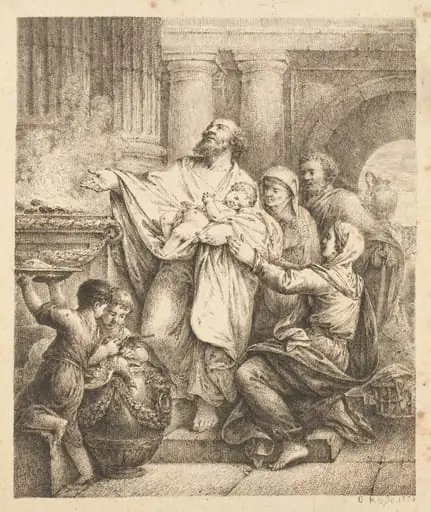 Presentation in the Temple
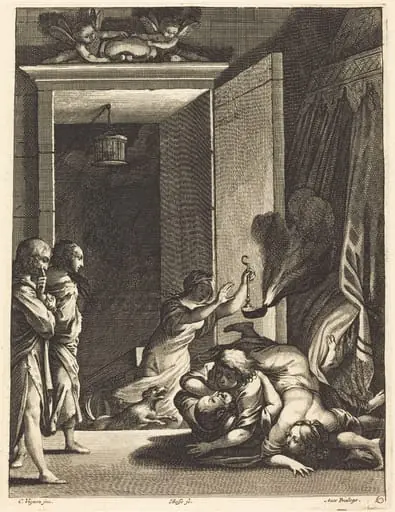 Illustration to Jean Desmarets' "L'Ariane"
 The Children of Israel and the Plague of Fiery Serpents