Artwork
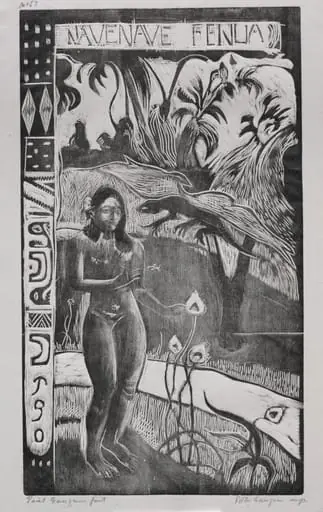
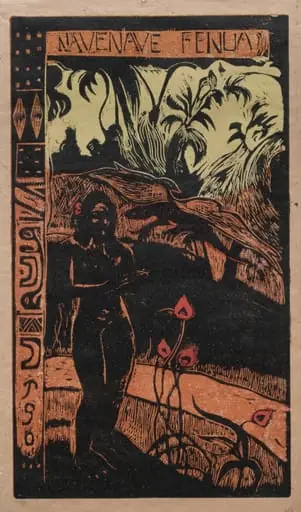
Nave Nave Fenua
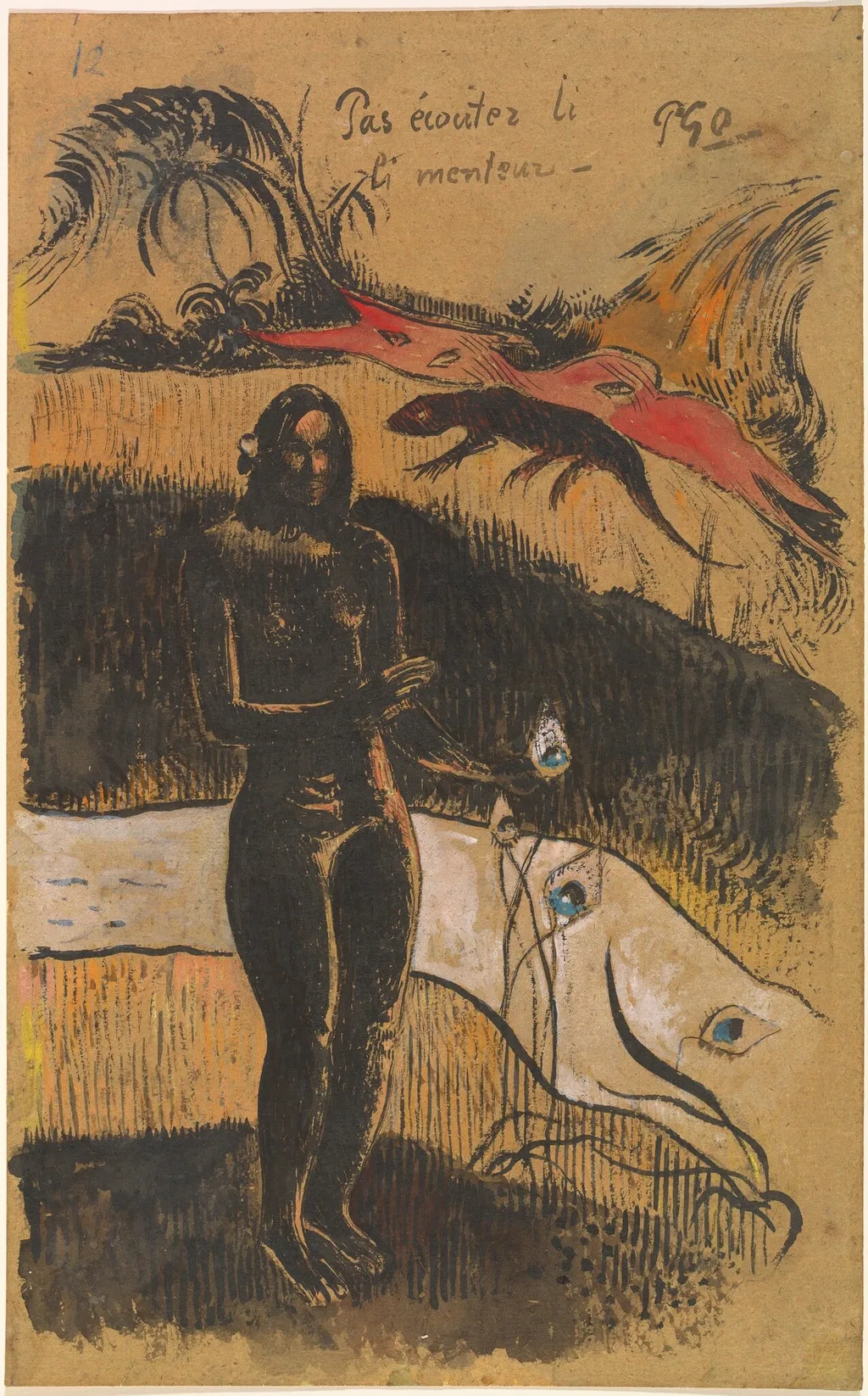
Nave Nave Fenua is an ink drawing by the Impressionist artist Paul Gauguin. It dates from 1894 and is held in the collection of the National Gallery of Art.
About this work
Overview
Created around 1894, *Nave Nave Fenua* is a drawing by Paul Gauguin executed in brush, gouache, and India ink on dark tan wove paper.
Created around 1894, *Nave Nave Fenua* is a drawing by Paul Gauguin executed in brush, gouache, and India ink on dark tan wove paper. It reflects his shift from Impressionist naturalism toward symbolic abstraction, characteristic of his Synthetist approach. The work combines loose, expressive lines with flat areas of color, emphasizing emotional tone over realistic detail. Its medium and surface suggest a spontaneous, intimate mode of expression, distinct from his larger oil paintings.
Subject & Meaning
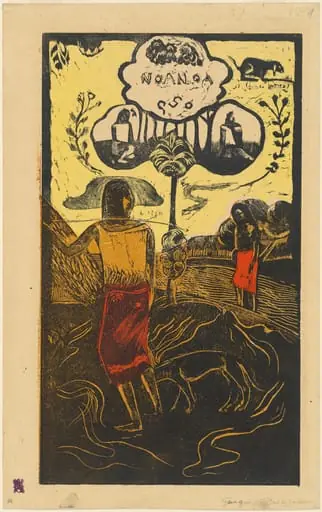
The image depicts a solitary woman in a dark dress and headscarf, holding a stick, standing beside a horse with a red saddle and pale coat marked by blue eyes. The scene evokes a quiet, possibly allegorical moment, set against a backdrop of tall grass, a wooden fence, and a distant red roof. The French inscription at the top—'Don’t listen to the liar'—introduces a cryptic, possibly personal or spiritual warning, suggesting themes of distrust, truth, or inner conflict.
Technique & Style
Gauguin employed gouache for opaque, matte color fields and India ink for bold, defining outlines, creating a graphic quality that flattens spatial depth. The dark tan paper serves as a mid-tone ground, allowing selective use of earthy browns and greens to emerge with restraint. Bright red accents in the saddle and roof contrast sharply with muted surroundings, while the pen work adds rhythmic, almost calligraphic structure. The style prioritizes symbolic form over observational accuracy.
History & Provenance
The drawing was made during Gauguin’s time in Tahiti, following his departure from Europe in search of what he perceived as uncorrupted cultural and spiritual life. Though less documented than his oil paintings, this work belongs to a series of intimate drawings from his Pacific period, often made on readily available paper. Its survival suggests it was retained by the artist or a close associate, later entering institutional collections.
Context
In the mid-1890s, Gauguin sought to distance himself from Western artistic conventions, embracing Polynesian motifs and indigenous symbolism. *Nave Nave Fenua*—whose title translates to 'Land of the Blessed'—reflects his idealized vision of Tahiti, even as the imagery retains elements of European rural life. The work sits at the intersection of his personal mythology and the colonial gaze, blending local scenery with psychological and moral undertones.
Legacy
Though not widely exhibited, *Nave Nave Fenua* exemplifies Gauguin’s late drawing practice, where simplicity of form and symbolic weight took precedence over technical finish. It influenced later modernists interested in non-Western aesthetics and expressive line. The work’s quiet intensity and enigmatic text continue to invite interpretation, offering insight into Gauguin’s inner world during a period of intense personal and artistic transformation.
Artist & collection
Artist
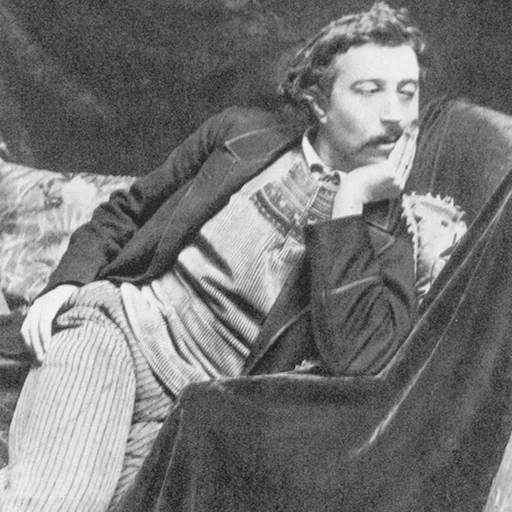
Eugène Henri Paul Gauguin (; French: ; 7 June 1848 – 8 May 1903) was a French painter, sculptor, printmaker, ceramist, and writer, whose work has been primarily associated with the Post-Impressionist and Symbolist movements.

![Arearea no Varua Ino (Words of the Devil) [recto], by Paul Gauguin](https://artifactworldgallery.com/img/paul-gauguin--arearea-no-varua-ino-words-of-the-devil-recto--0bfcd29d383e4267-w320.webp)