Artwork
Te Po (The Long Night)
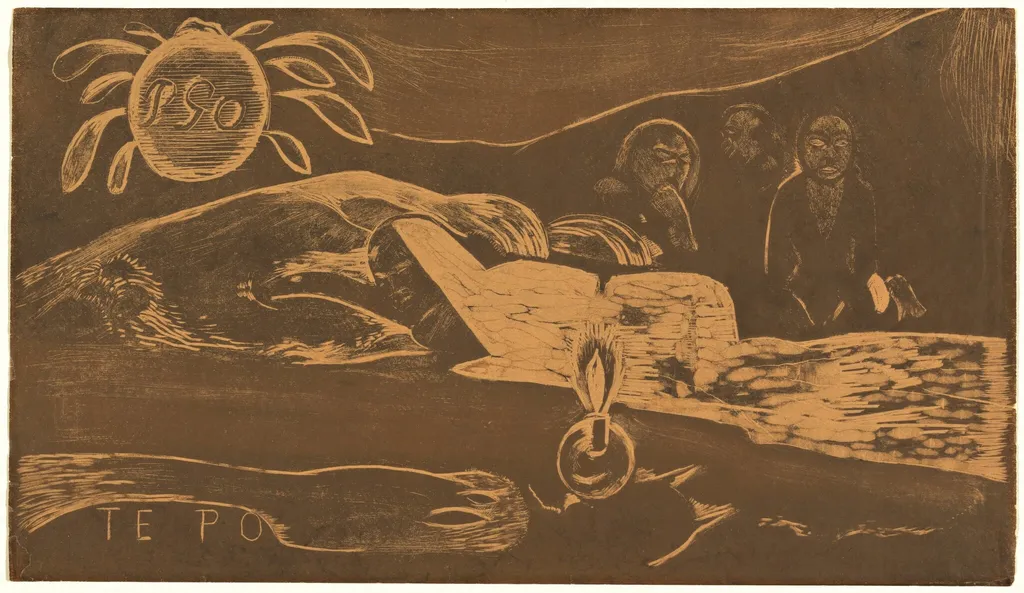
Te Po (The Long Night) is an ink print by the Impressionist artist Paul Gauguin. It dates from 1894 and is held in the collection of the National Gallery of Art.
About this work
Overview
Unlike traditional printmaking, Gauguin embraced the roughness of the woodcut medium, allowing the grain and tool marks to contribute to the mood of the image.
Created in 1894, *Te Po (The Long Night)* is a woodcut printed in bistre ink on cream paper by Paul Gauguin. The work belongs to his series of prints made during his time in Tahiti, where he sought to distill spiritual and emotional themes through simplified visual language. Unlike traditional printmaking, Gauguin embraced the roughness of the woodcut medium, allowing the grain and tool marks to contribute to the mood of the image.
Subject & Meaning
The scene depicts three figures resting on a beach beneath a large, luminous moon. Their postures—lying, sitting, curled—suggest rest, contemplation, or perhaps exhaustion. The title, meaning 'The Long Night' in Tahitian, evokes a sense of stillness and introspection. Gauguin avoids narrative detail, instead using the figures as symbols of human vulnerability against the vastness of nature and the cosmos.
Technique & Style
Gauguin carved directly into a woodblock, using bold, incised lines to define forms and negative space to suggest shadow. The bistre ink, a brown pigment derived from soot, enhances the somber tone. The print’s texture arises from the wood’s grain and the uneven pressure of hand-printing, rejecting smooth realism in favor of expressive abstraction. Forms are reduced to essential contours, aligning with Synthetist principles that prioritize emotional resonance over optical accuracy.
History & Provenance
Made during Gauguin’s second stay in Tahiti, *Te Po* was part of a small group of woodcuts he produced between 1893 and 1895. Few impressions were printed, and most were retained by the artist or given to close associates. The work remained largely private during his lifetime, circulating in limited circles before entering institutional collections in the 20th century.
Context
Gauguin’s woodcuts emerged from his rejection of European artistic conventions and his search for an alternative visual language rooted in non-Western aesthetics. Influenced by Oceanic carvings and Japanese prints, he used the woodcut to bypass academic training and embrace a more direct, tactile process. These works were integral to his broader project of cultural and spiritual reinvention in the South Pacific.
Legacy
Though not widely known in his time, *Te Po* and Gauguin’s other woodcuts influenced early 20th-century modernists drawn to their expressive simplicity and rejection of naturalism. Artists such as Matisse and the German Expressionists later cited his prints as examples of how form and material could convey inner states. The work stands as a quiet but significant contribution to the evolution of modern printmaking.
Artist & collection
Artist
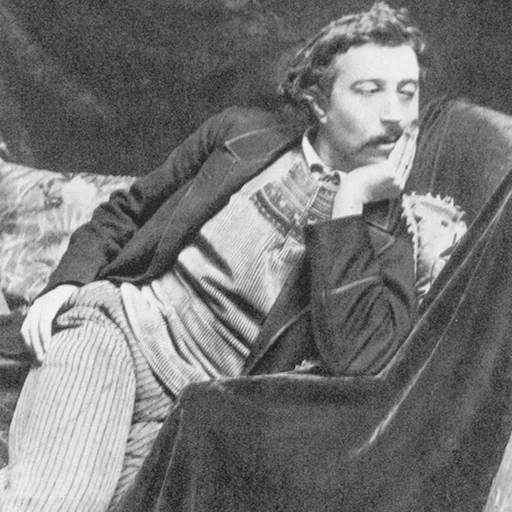
Eugène Henri Paul Gauguin (; French: ; 7 June 1848 – 8 May 1903) was a French painter, sculptor, printmaker, ceramist, and writer, whose work has been primarily associated with the Post-Impressionist and Symbolist movements.

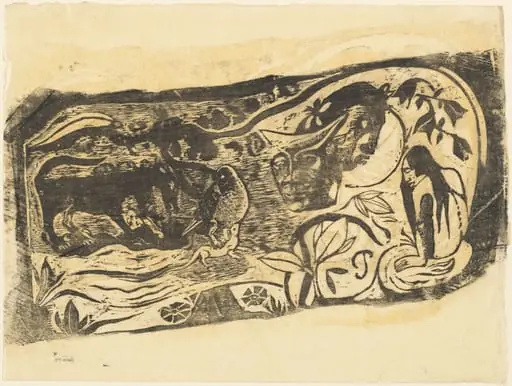 Plate with the Head of a Horned Devil (Planche au diable cornu)
![Mahna no Varua Ino (The Demon Speaks) [verso], by Paul Gauguin](https://artifactworldgallery.com/img/paul-gauguin--mahna-no-varua-ino-the-demon-speaks-verso--4d5371963e3166cc-w320.webp) Mahna no Varua Ino (The Demon Speaks) [verso]
Mahna no Varua Ino (The Demon Speaks) [verso]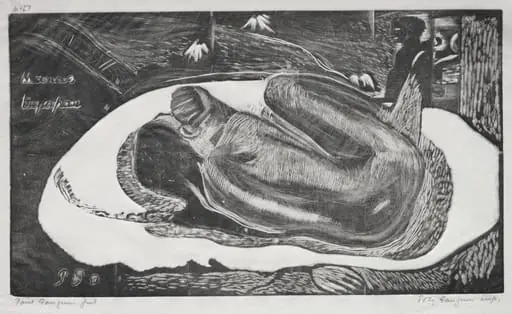 Noa Noa: Manao Yupapau ( Watched by the Spirts of the Dead)
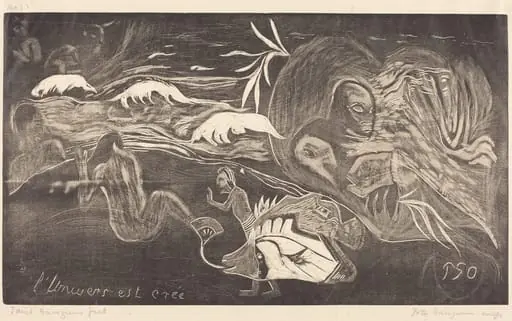 L'Univers est crée (The Creation of the Universe)
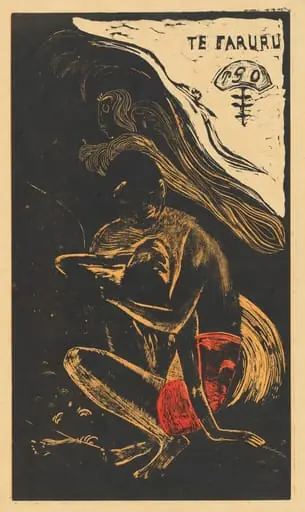 Te Faruru (They are Making Love Here)
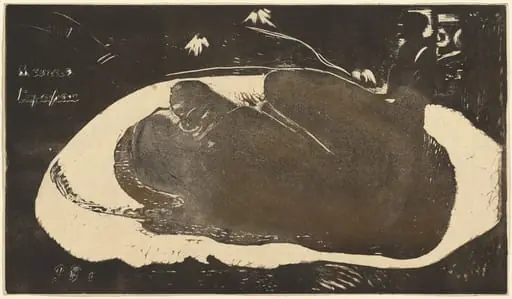 Manao Tupapau (She is Haunted by a Spirit)
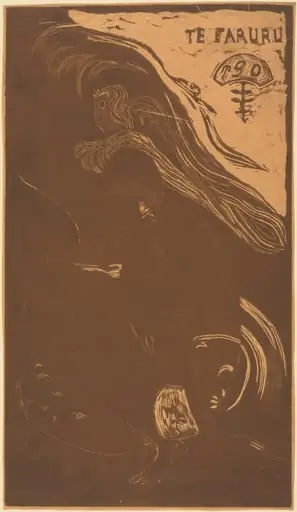 Te Faruru (They are Making Love Here)
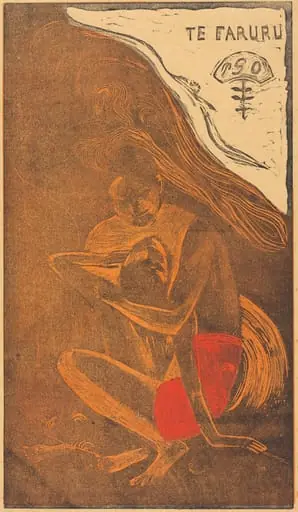 Te Faruru (They are Making Love Here)
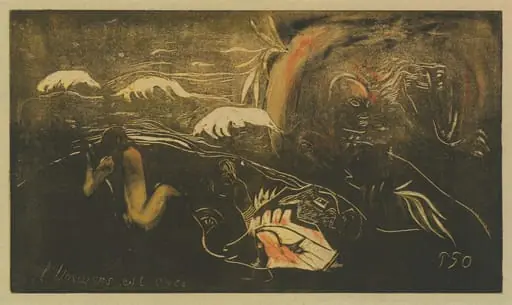 The Universe is Created (L'Univers est créé)