Artwork
Last Judgment
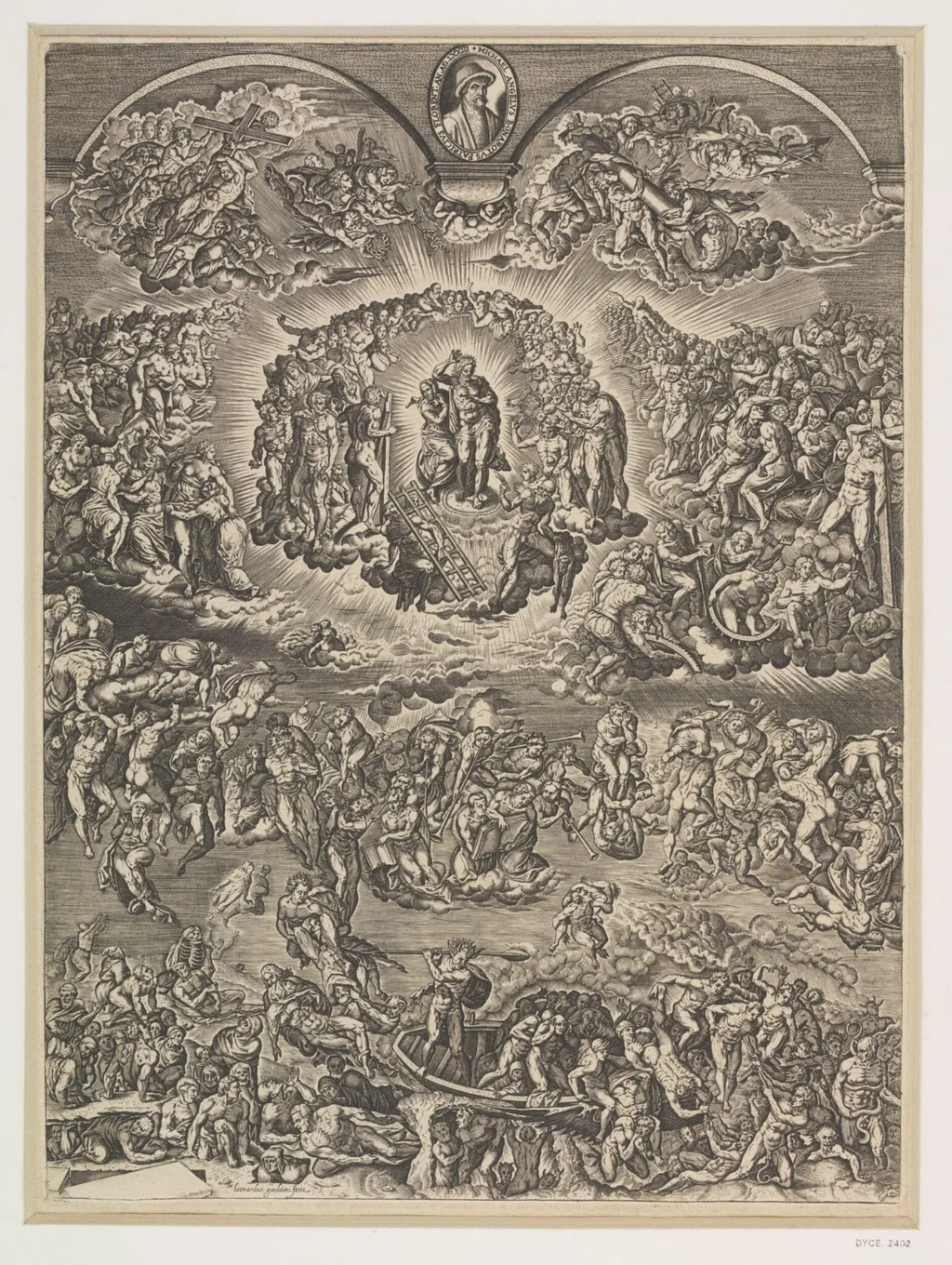
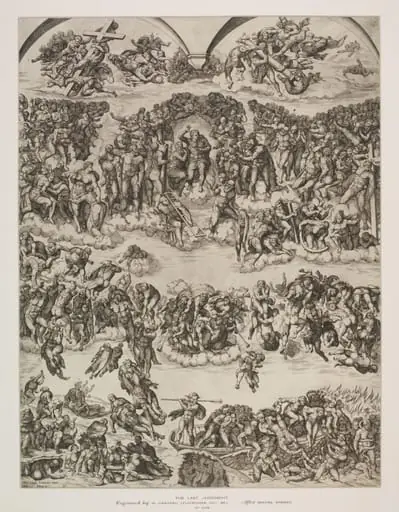
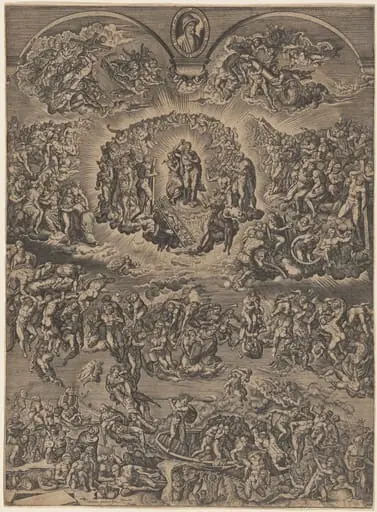
Last Judgment is a print by Léonard Gaultier. It is held in the collection of the Victoria and Albert Museum.
About this work
Overview
Executed in monochrome tones, the composition captures the dramatic intensity of the original while adapting it to the conventions of printmaking.
This 1650 print reproduces Michelangelo’s Last Judgment fresco from the Sistine Chapel, translated through an earlier engraving by Martino Rota and then reworked by Léonard Gaultier. Executed in monochrome tones, the composition captures the dramatic intensity of the original while adapting it to the conventions of printmaking. The work serves as a reproductive medium, preserving and disseminating Michelangelo’s monumental vision to audiences beyond Rome.
Subject & Meaning
The scene depicts the Second Coming of Christ and the final judgment of souls, as described in the Book of Revelation. Christ, centrally positioned with a halo, presides over a swirling mass of resurrected figures—some ascending toward salvation, others dragged downward by demons. The division between redemption and damnation is rendered through dynamic motion and spatial tension, reflecting theological themes of divine justice and human fate.
Technique & Style
Gaultier employed engraving to translate Michelangelo’s sculptural figures into fine linear contrasts. The palette is restricted to ink on paper, using hatching and cross-hatching to model form and suggest depth. Dark, cloudy backgrounds and stark highlights create a chiaroscuro effect, enhancing the emotional gravity of the scene. The figures are rendered with muscular tension and contorted poses, echoing the Mannerist emphasis on expressive movement.
History & Provenance
The print derives from Martino Rota’s 1560s engraving, which was among the first accurate reproductions of Michelangelo’s fresco. Gaultier’s 1650 version refined Rota’s composition, likely for wider circulation in northern Europe. It was produced during a period when reproductive prints were key to spreading Renaissance imagery. The work’s survival in multiple institutional collections attests to its role in art education and devotional practice.
Context
Created decades after the Council of Trent, the print reflects the Catholic Church’s renewed emphasis on doctrinal clarity and emotional religious imagery. While Michelangelo’s original fresco faced criticism for its nudity, Gaultier’s monochrome version softened its controversy, making it more acceptable for private devotion. The print’s popularity coincided with growing demand for religious art in domestic and scholarly settings across Europe.
Legacy
Gaultier’s print helped preserve the visual language of Michelangelo’s Last Judgment for generations unfamiliar with the Sistine Chapel. It influenced later engravers and served as a reference for artists studying composition and figure dynamics. Though overshadowed by the fresco, the print remains a significant artifact of early modern print culture and the transmission of High Renaissance ideals through mechanical reproduction.
Artist & collection
Artist
Léonard Gaultier, or, as he sometimes signed himself, Galter, a French engraver, was born at Mainz about 1561, and died in Paris in 1641.