Artwork
Christ Falling Under the Weight of the Cross
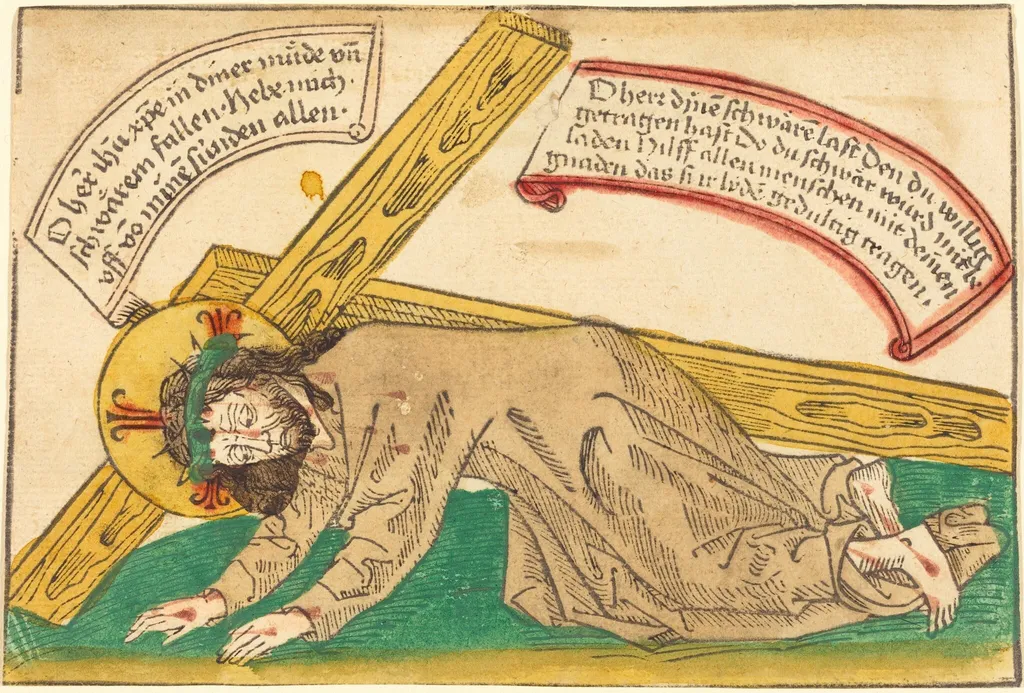
Christ Falling Under the Weight of the Cross is an ink print by the Renaissance artist German 15th Century. It dates from 1485 and is held in the collection of the National Gallery of Art.
About this work
Overview
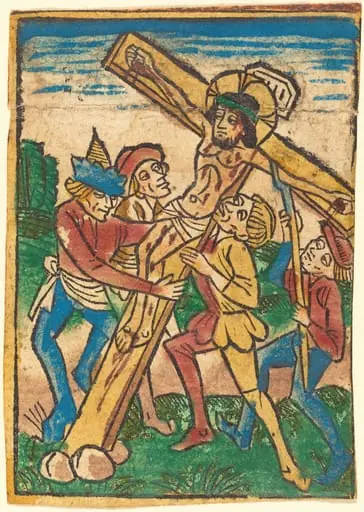
The composition centers on a bearded figure crowned with thorns, his arms outstretched as he collapses onto a green cloth while bearing a heavy wooden cross.
Christ Falling Under the Weight of the Cross is a hand‑colored woodcut print. Executed on paper, the image combines black‑line woodcut with applied pigments of yellow ochre, tan, green and red, creating a vivid contrast against a neutral background. The composition centers on a bearded figure crowned with thorns, his arms outstretched as he collapses onto a green cloth while bearing a heavy wooden cross.
Subject & Meaning
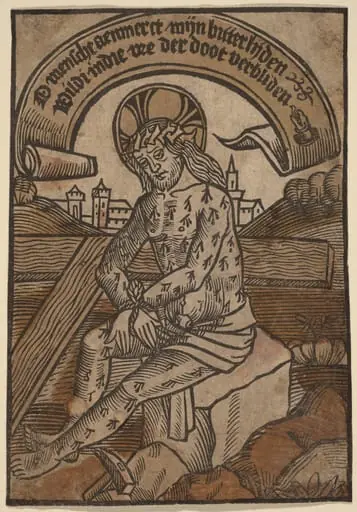
The scene depicts the moment of Christ’s struggle under the cross, a motif drawn from the Passion narrative. The crown of thorns, the burdened cross, and the figure’s forward fall convey physical exhaustion and spiritual surrender. Two German‑language scrolls hover above, one attached to the cross, suggesting a textual commentary that would have guided contemporary viewers toward contemplation of Christ’s suffering.
Technique & Style
The work employs traditional woodcut relief printing: the artist carved the image in reverse on a block of wood, inked the raised surfaces, and pressed the block onto paper. After printing, selective areas were hand‑colored with pigments, a common practice in the 15th–16th centuries to enhance visual impact. The bold use of bright yellow and red against a muted tan background heightens the drama, reflecting the expressive palette typical of religious prints of the period.
Context
Produced before the advent of photography, the print belongs to a tradition of devotional imagery intended for personal or liturgical use. Hand‑colored woodcuts were affordable alternatives to painted panels, allowing broader dissemination of biblical scenes. The inclusion of German text indicates a target audience in German‑speaking regions, where such prints served both as visual meditation aids and as carriers of scriptural or didactic messages.
Artist & collection

Artist
This 15th-century German artist carved vivid religious scenes into metal and wood, then hand-painted them in bright, symbolic colors.

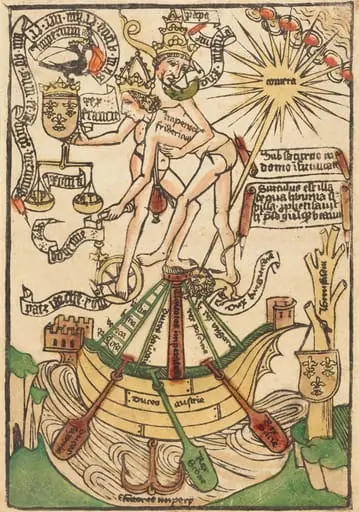 Allegory of the Meeting of Pope Paul II and Emperor Frederick III
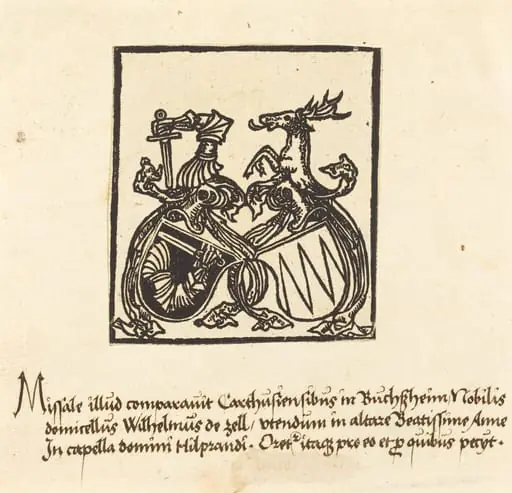 Bookplate of Wilhelm von Zell
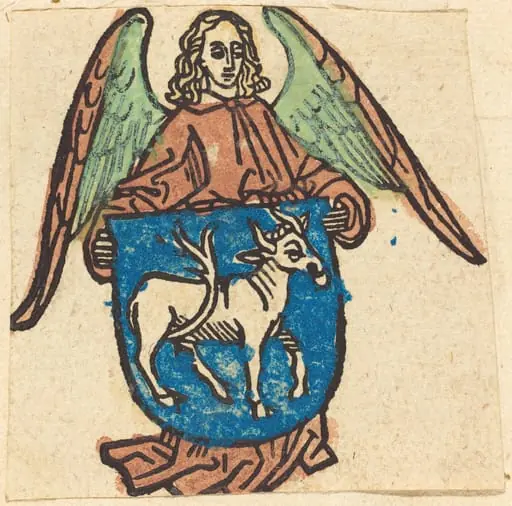 Bookplate of Hilprand Brandenburg of Bibrach
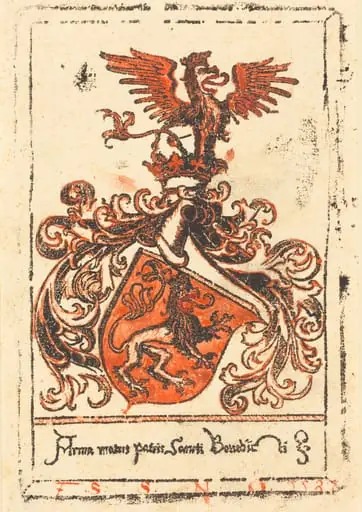 Bookplate of the Abbey of Ottobeuren
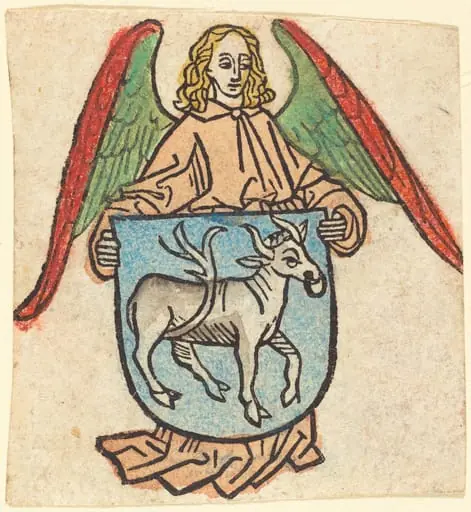 Bookplate of Hilprand Brandenburg of Bibrach
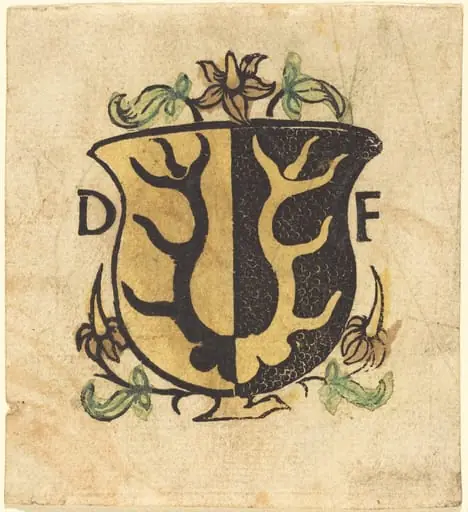 Bookplate of Dominicus Frauenfelder
![Studies for Six Figures (sheet from a model book) [recto], by German 15th Century](https://artifactworldgallery.com/img/german-15th-century--studies-for-six-figures-sheet-from-a-model-book-recto--4837429e0755bc3f-w320.webp) Studies for Six Figures (sheet from a model book) [recto]
Studies for Six Figures (sheet from a model book) [recto] Christ and Mary Interceding with God the Father