Artwork
Saint Agnes
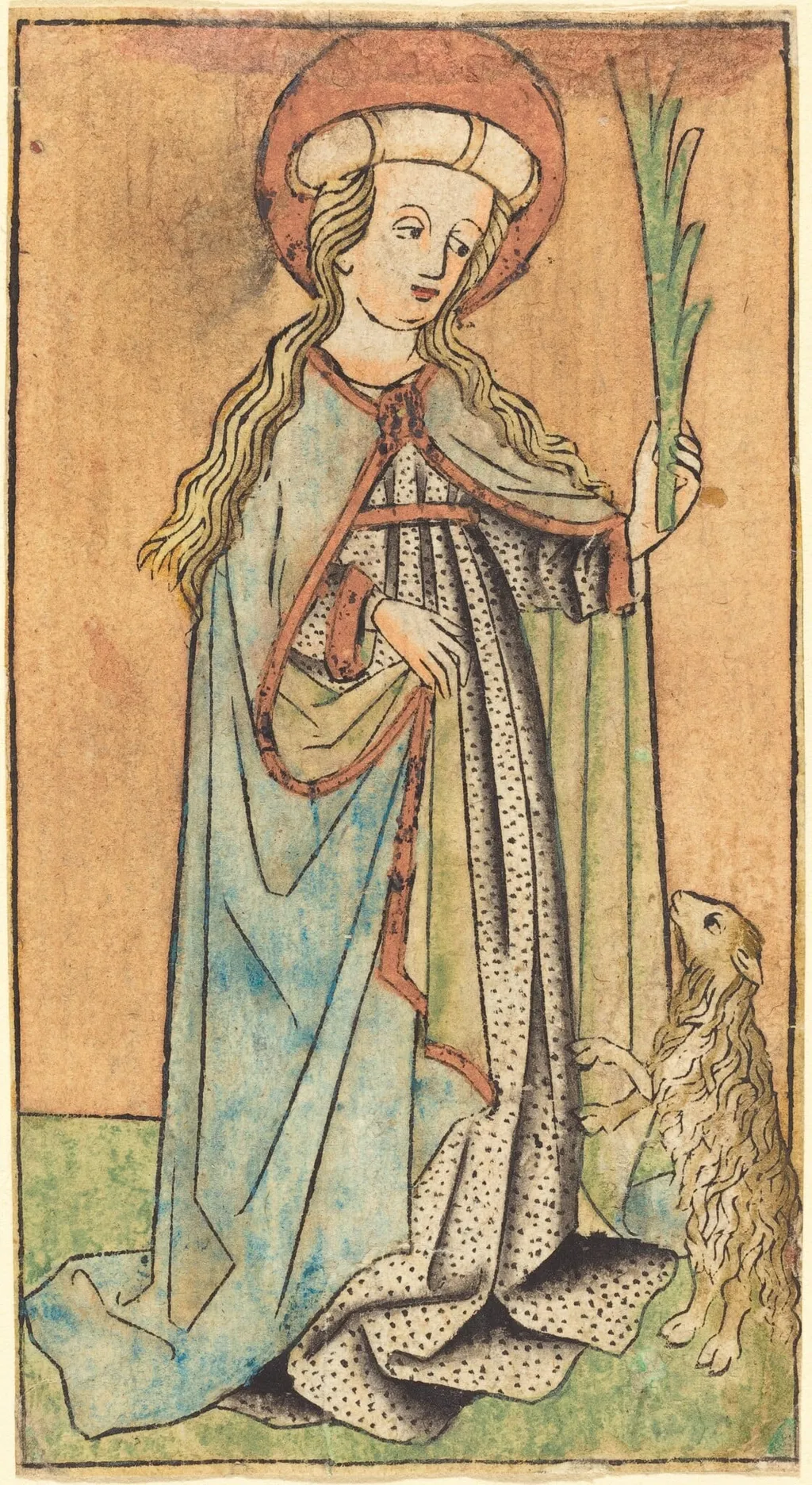
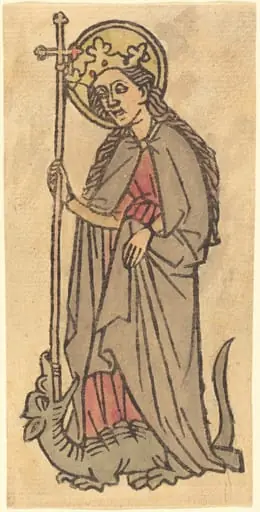
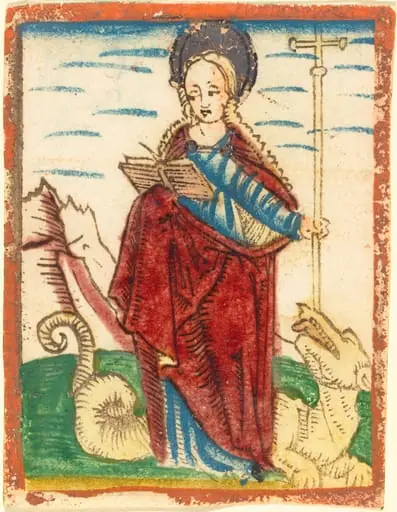
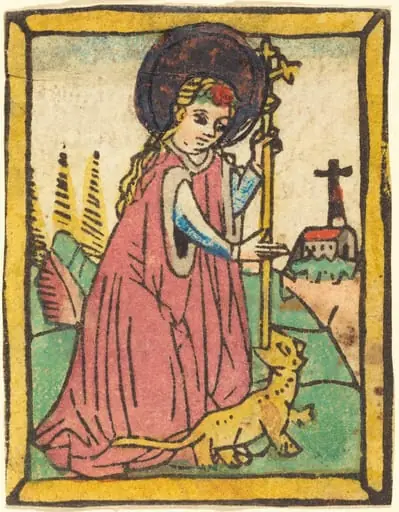
Saint Agnes is an ink print by the Renaissance artist German 15th Century. It dates from 1450 and is held in the collection of the National Gallery of Art.
About this work
This painting is reminiscent of the work of German 15th Century artists, who were known for their detailed and expressive woodcuts.
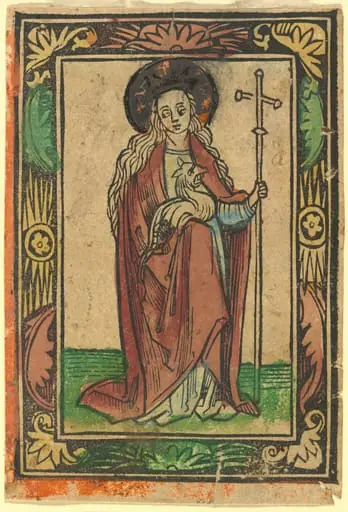
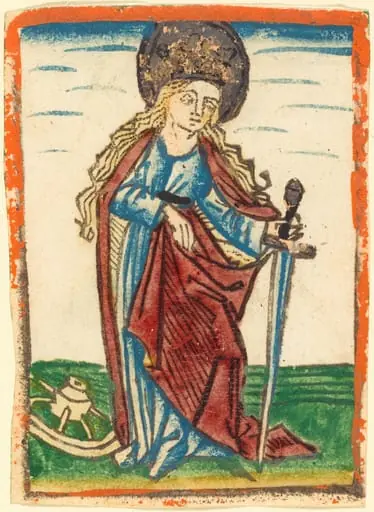
The painting depicts a woman with long, wavy blonde hair, wearing a blue robe over a white dress with black dots. She has a red halo around her head and holds a green plant in her right hand. A lamb is at her feet, looking up at her. The woman's attire is detailed, with a red belt around her waist and a white head covering.
The background of the painting is a warm, orange-tan color, which complements the cool tones of the woman's blue robe. The overall effect is one of serenity and devotion.
This painting is reminiscent of the work of German 15th Century artists, who were known for their detailed and expressive woodcuts.
Overview
This hand‑colored woodcut portrays Saint Agnes, a youthful female figure with flowing blonde hair, dressed in a blue robe over a white, polka‑dotted gown. A red halo crowns her head, and she holds a green plant in her right hand while a small lamb rests at her feet, gazing upward. The composition is set against a warm orange‑tan background that balances the cooler tones of her attire.
Subject & Meaning
The saint is identified by her traditional attributes: the lamb, symbolising her purity and martyrdom, and the green plant, often interpreted as a reference to her virginity or a specific botanical emblem associated with her legend. The red halo denotes sanctity, and the overall serene pose conveys devotion and gentle piety.
Technique & Style
Executed as a woodcut, the image is printed on laid paper and subsequently hand‑colored with a palette of orange‑tan, green, light blue, gray, carmine and gold. The fine line work and intricate detailing reflect the influence of 15th‑century German printmakers, whose expressive woodcuts combined precise carving with vivid coloration.
History & Provenance
The work belongs to the tradition of early modern devotional prints, though its exact date and creator are not recorded. It has circulated among collectors of religious prints, and its hand‑coloring suggests it was intended for private contemplation rather than public display.
Context
Saint Agnes was a popular subject in medieval and Renaissance art, often depicted with a lamb as her attribute. This woodcut aligns with that iconography while incorporating the rich, multi‑colored approach typical of later Northern European print culture, bridging medieval symbolism with early modern aesthetic sensibilities.
Artist & collection

Artist
This 15th-century German artist carved vivid religious scenes into metal and wood, then hand-painted them in bright, symbolic colors.

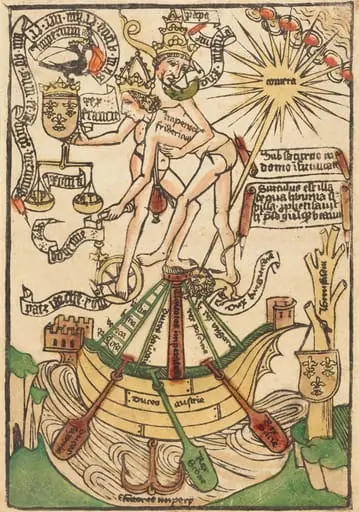 Allegory of the Meeting of Pope Paul II and Emperor Frederick III
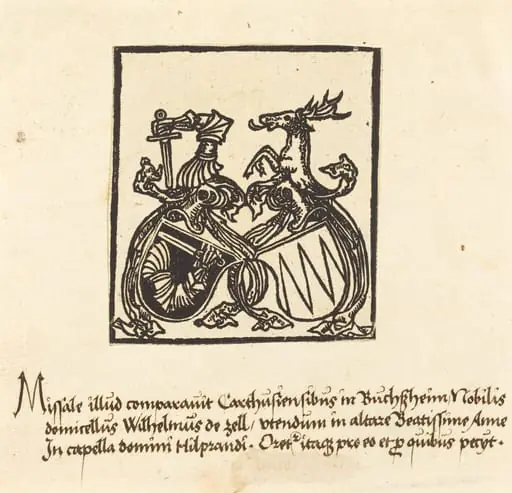 Bookplate of Wilhelm von Zell
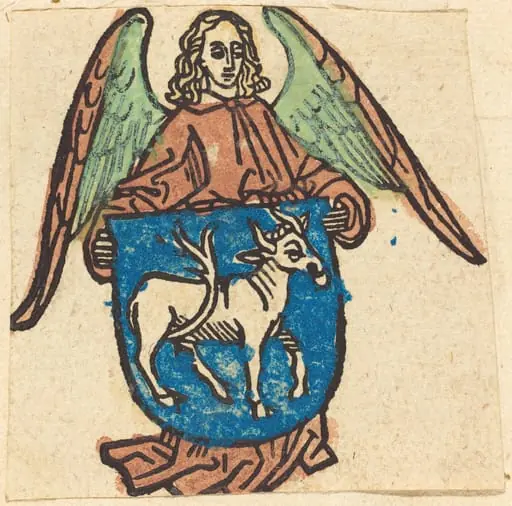 Bookplate of Hilprand Brandenburg of Bibrach
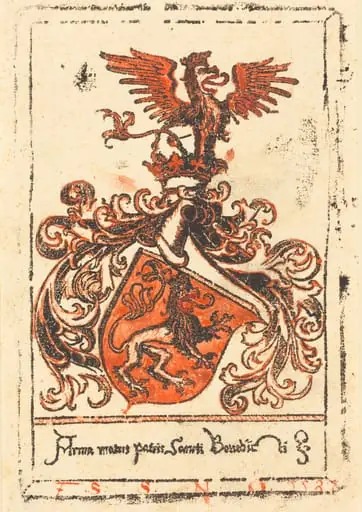 Bookplate of the Abbey of Ottobeuren
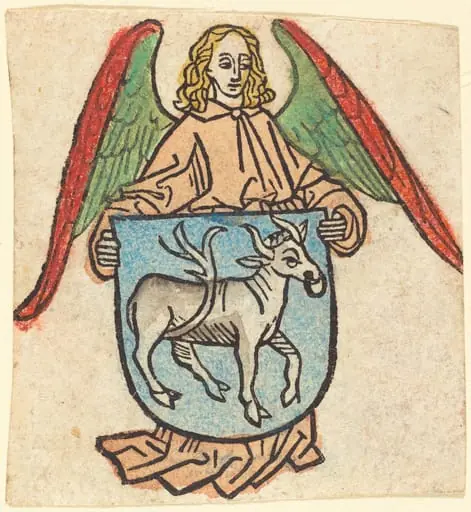 Bookplate of Hilprand Brandenburg of Bibrach
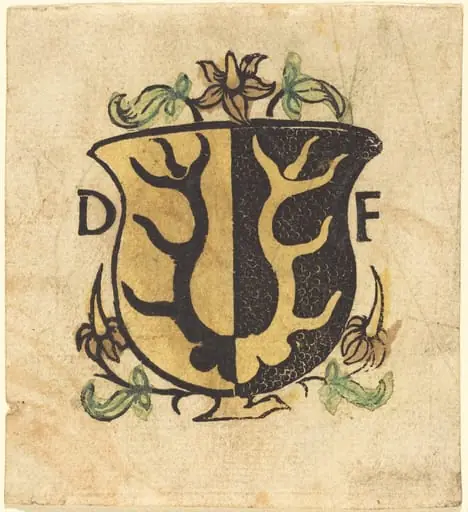 Bookplate of Dominicus Frauenfelder
![Studies for Six Figures (sheet from a model book) [recto], by German 15th Century](https://artifactworldgallery.com/img/german-15th-century--studies-for-six-figures-sheet-from-a-model-book-recto--4837429e0755bc3f-w320.webp) Studies for Six Figures (sheet from a model book) [recto]
Studies for Six Figures (sheet from a model book) [recto]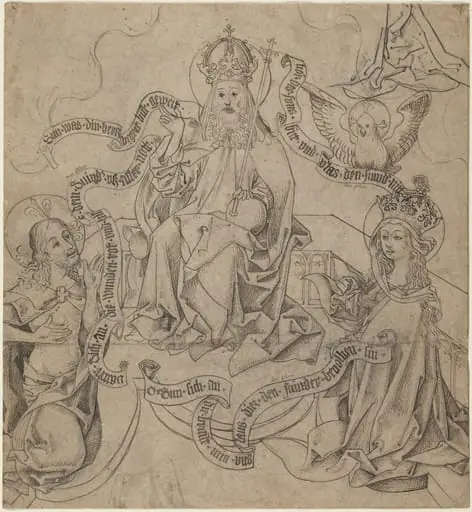 Christ and Mary Interceding with God the Father