Artwork
The Entombment
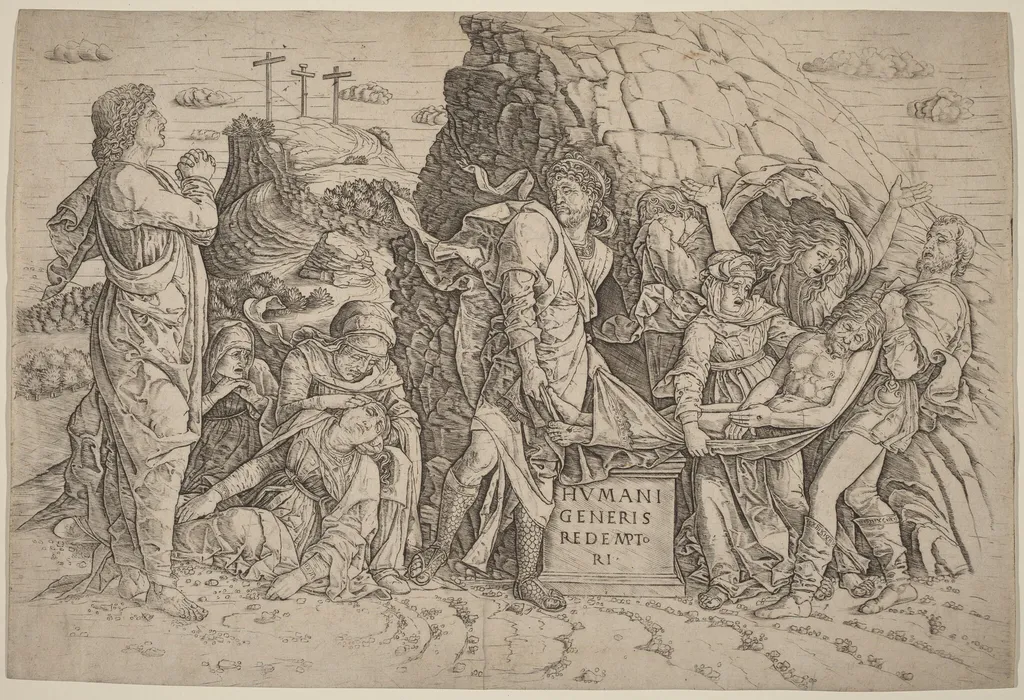
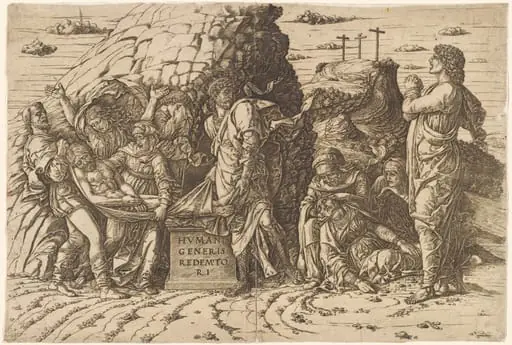
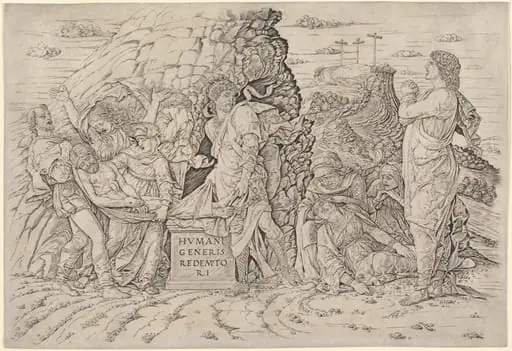
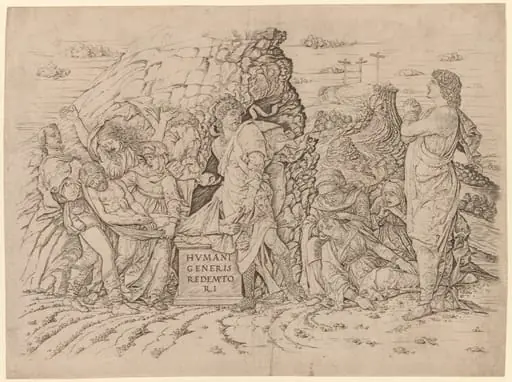
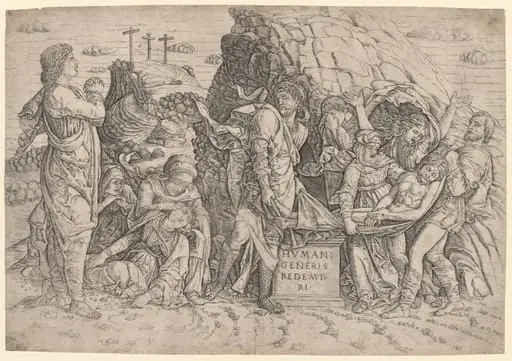
The Entombment is an ink print by the Renaissance artist Giovanni Antonio da Brescia. It dates from 1509 and is held in the collection of the National Gallery of Art.
About this work
Overview
Giovanni Antonio da Brescia, an Italian engraver active in the early sixteenth century, produced an engraving titled *The Entombment* around 1509. Executed on laid paper, the print portrays the biblical moment of Christ’s burial and reflects the artist’s engagement with religious narrative during the Renaissance.
Subject & Meaning
Figures display a range of emotions, some reaching toward the bier, others kneeling or holding objects such as flowers or cloth.
The image concentrates on a crowded group surrounding a rocky tomb where a shrouded body is being lowered. Figures display a range of emotions, some reaching toward the bier, others kneeling or holding objects such as flowers or cloth. Inscribed on the tomb’s base are the words *HUMANI GENERIS REDEMPTOR*—“Redeemer of the Human Race”—linking the scene to broader theological concepts prevalent in the period.
Technique & Style
Created through engraving, the work employs fine incised lines to render a dense composition of figures, stone architecture, and three crosses protruding from a wall. The use of laid paper provides a textured surface that accentuates the contrast between the darkened lines and the paper’s natural tone, characteristic of Northern Italian printmaking of the era.
History & Provenance
During his early career, da Brescia signed prints with the initials “Z.A.”; by about 1507 he began using more elaborate monograms such as “IO.AN.BX.” *The Entombment* bears one of these later signatures, helping to date the piece to the years surrounding 1509. The print’s subsequent ownership record is limited, but it remains a documented example of the artist’s mature output.
Context
The composition reflects the Renaissance interest in dramatizing sacred events with heightened emotional expression. The inclusion of a detailed tomb inscription and the crowded, tactile arrangement of mourners echo contemporary devotional prints that aimed to make biblical narratives accessible to a broad audience.
Artist & collection

Artist
Giovanni Antonio da Brescia was an Italian engraver of northern Italy, active in the approximate period 1490–1519, during the Italian Renaissance.