Artwork
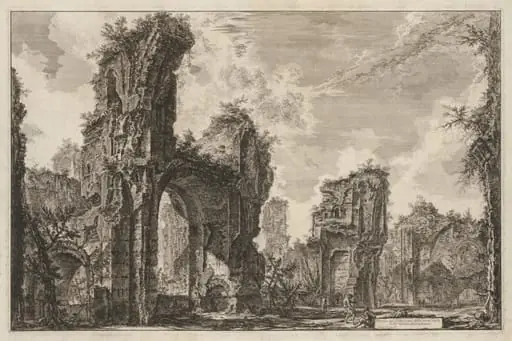
Veduta dei muri che investivano le falde del Monte Celio
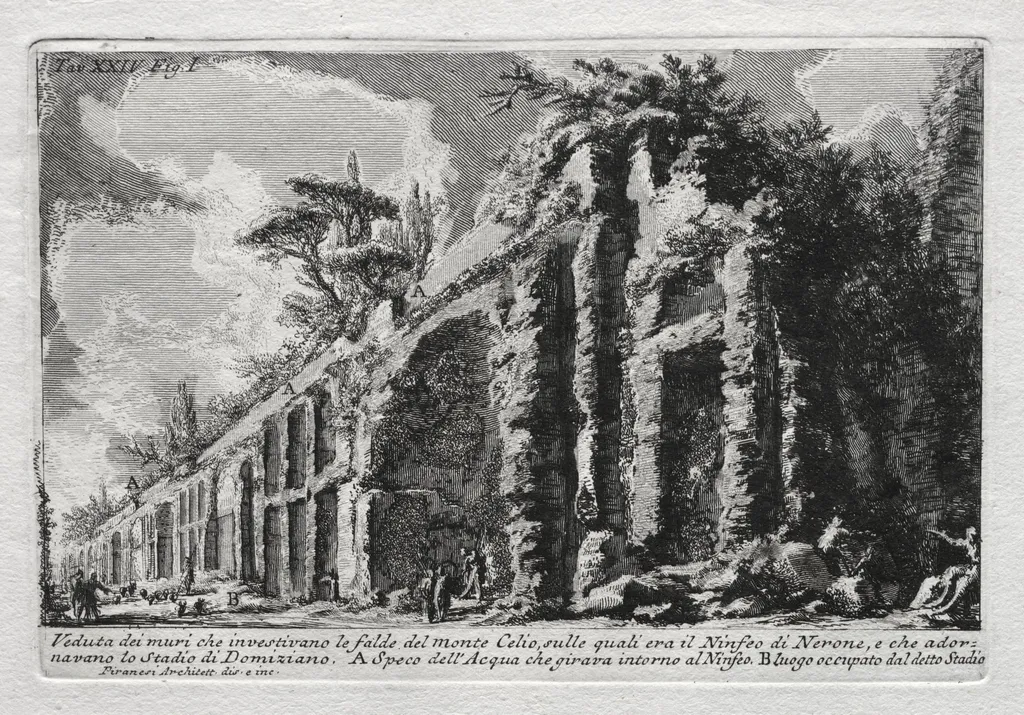
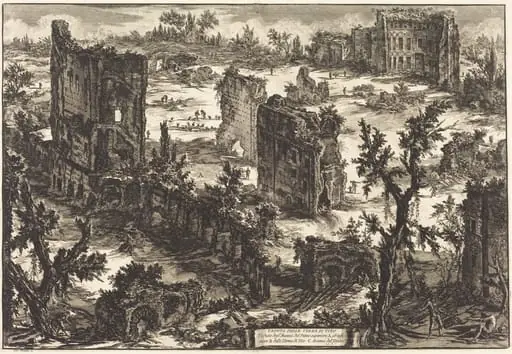
Veduta dei muri che investivano le falde del Monte Celio is a print by the Romanticist artist Giovanni Battista Piranesi. It dates from 1754 and is held in the collection of the Cleveland Museum of Art.
About this work
Overview
Created around 1754, this print by Giovanni Battista Piranesi depicts the ancient stone walls clinging to the slopes of Monte Celio in Rome.
Created around 1754, this print by Giovanni Battista Piranesi depicts the ancient stone walls clinging to the slopes of Monte Celio in Rome. Executed in etching, it belongs to a series of topographical views that document the city’s layered architectural remains. The work reflects Piranesi’s interest in recording Rome’s enduring structural fragments, blending observation with artistic interpretation.
Subject & Meaning
The subject is a fragment of Rome’s Republican-era fortifications, overgrown and weathered, integrated into the natural slope of the hill. Rather than idealizing the ruins, Piranesi emphasizes their decay and persistence, suggesting time’s quiet dominance over human construction. The walls are not merely architectural relics but markers of continuity, silently bearing witness to centuries of change.
Technique & Style
Piranesi employed fine-line etching to render texture and volume, using deep shadows and precise hatching to model the stone surfaces. The contrast between light and dark enhances the mass of the walls and the depth of the terrain, creating a sense of spatial immersion. His method prioritizes tactile detail over romanticized drama, grounding the scene in physical reality.
History & Provenance
The print was produced during Piranesi’s early years in Rome, when he was systematically documenting the city’s antiquities. It entered the collection of The Cleveland Museum of Art in the 20th century, likely as part of a larger group of his architectural prints acquired for their scholarly and aesthetic value. Its preservation reflects ongoing interest in 18th-century topographical printmaking.
Context
In mid-18th-century Rome, antiquarian interest in ancient ruins was growing among travelers and scholars. Piranesi’s prints responded to this demand, offering precise yet evocative records of sites often overlooked by more polished architectural renderings. His focus on marginal or crumbling structures challenged prevailing tastes that favored grand, intact monuments.
Legacy
This work contributes to Piranesi’s broader influence on how ruins were perceived—not as mere relics, but as complex records of time and labor. His detailed, unembellished approach inspired later architects and archaeologists to value the authenticity of decay. The print remains a reference point in studies of urban memory and the representation of antiquity.
Artist & collection

Artist
Giovanni Battista (or Giambattista) Piranesi (Italian pronunciation: ; also known as simply Piranesi; 4 October 1720 – 9 November 1778) was an Italian classical archaeologist, architect, and artist, famous for his…