Artwork
Peter the Great of Russia
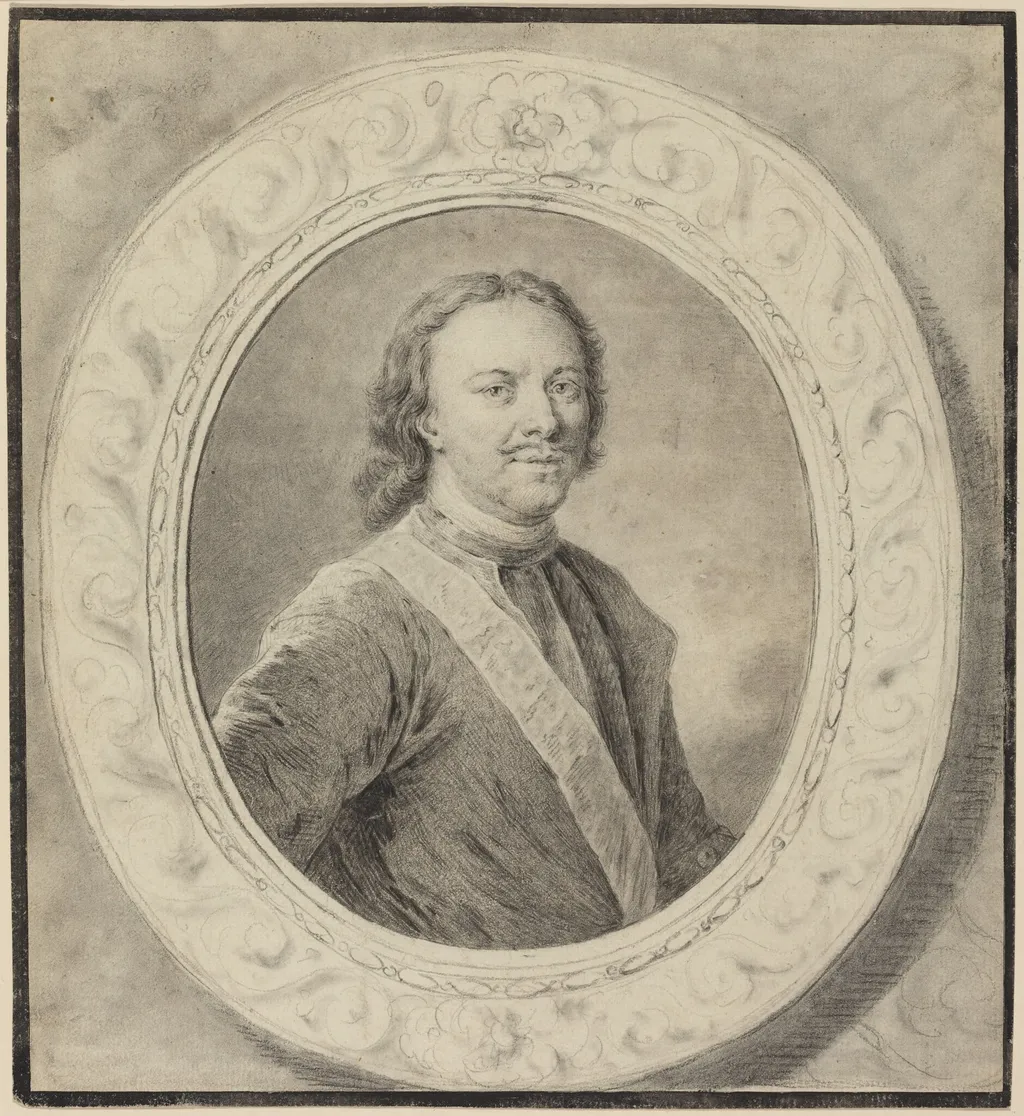
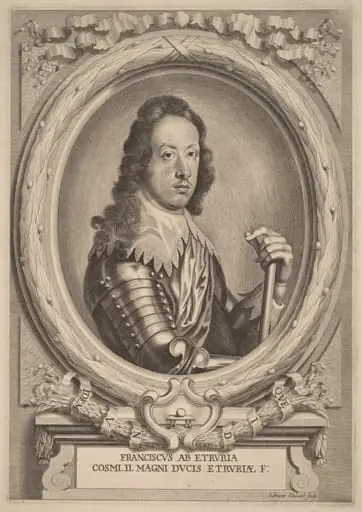
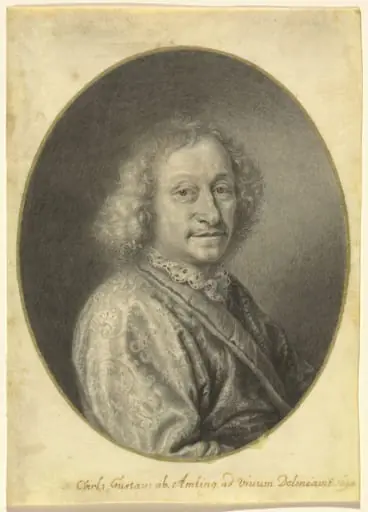
Peter the Great of Russia is a graphite drawing by the Baroque artist Carl Guttenberg. It dates from 1766 and is held in the collection of the National Gallery of Art.
About this work
Overview
This graphite and gray wash drawing, executed in 1766 by Carl Guttenberg, depicts Peter the Great of Russia. Rendered on laid paper, the portrait captures the tsar in profile with subtle tonal modeling. The work belongs to a tradition of 18th-century European portraiture that favored restrained elegance over theatricality, reflecting both technical precision and historical reverence.
Subject & Meaning
The high-collared coat and lace-trimmed wrists indicate Westernized court dress, aligning with his efforts to modernize Russia along European lines.
Peter the Great, ruler of Russia from 1682 to 1725, is portrayed in mature adulthood, his curled hair and mustache suggesting both authority and personal identity. The high-collared coat and lace-trimmed wrists indicate Westernized court dress, aligning with his efforts to modernize Russia along European lines. The image functions as a visual testament to his legacy as a reformer who reshaped Russia’s cultural and political landscape.
Technique & Style
Guttenberg employed graded graphite washes to model the face with soft, directional light, emphasizing the forehead and cheekbones to create volume without harsh contours. The background features an oval frame adorned with delicate, swirling motifs, a Baroque-derived decorative element that frames the subject without distracting from it. The paper’s texture and faint underlying marks suggest age and material authenticity, reinforcing the drawing’s archival character.
History & Provenance
Created nearly half a century after Peter’s death, the drawing reflects a posthumous effort to memorialize the tsar within European artistic circles. Guttenberg, a German artist active in Russia, likely worked from earlier portraits or engravings. The piece entered institutional collections in the 19th century, where it was preserved as a historical document rather than a commissioned portrait.
Context
The portrait aligns with late Baroque conventions in European portraiture, which favored naturalistic rendering and restrained ornamentation. While Russia had begun to develop its own artistic identity, artists like Guttenberg bridged Western techniques with Russian subjects. This work exemplifies how Peter’s image was disseminated across Europe as a symbol of enlightened absolutism and cultural transformation.
Legacy
Though not widely exhibited, the drawing remains a key example of how Peter the Great’s likeness was preserved and interpreted in the decades after his death. Its quiet realism and technical discipline distinguish it from more flamboyant imperial portraits, offering a grounded, humanizing view of a ruler whose reforms left a lasting imprint on Russian statehood.
Artist & collection