Artwork
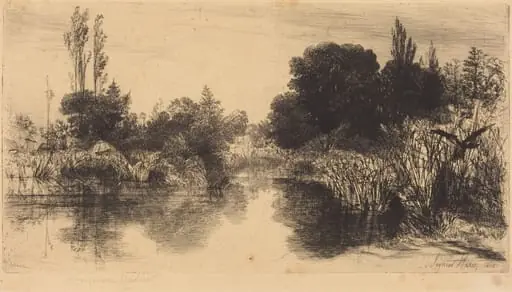
Shere Mill Pond (The Larger Plate)
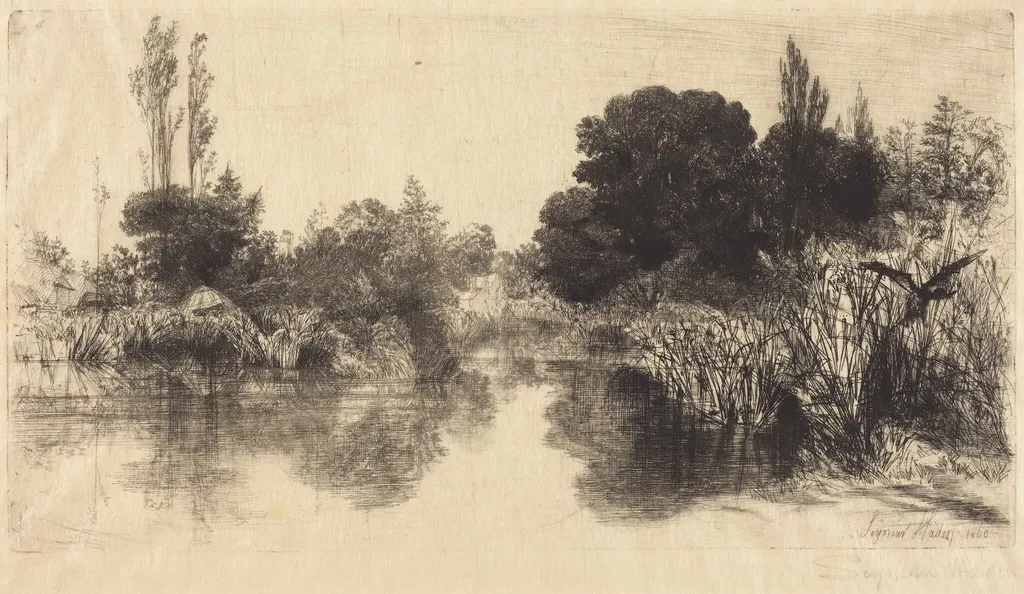
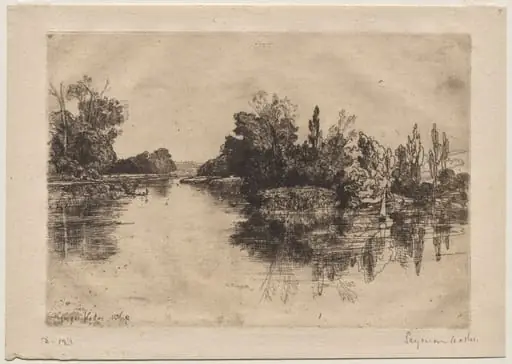
Shere Mill Pond (The Larger Plate) is an ink print by the Impressionist artist Francis Seymour Haden. It dates from 1860 and is held in the collection of the National Gallery of Art.
About this work
Overview
Francis Seymour Haden’s print Shere Mill Pond (The Larger Plate) dates from 1860. Executed as an etching with drypoint, the work presents a tranquil pond framed by reeds and trees, with a modest structure tucked against the shore. The composition captures a moment of still water, punctuated only by gentle ripples that suggest a quiet, rural setting.
Subject & Meaning
The image depicts a shallow waterbody surrounded by tall reeds that sway lightly above the surface, while dense foliage outlines the banks. A small building, partially concealed by vegetation, hints at human presence without dominating the natural scene. The work emphasizes the harmony between landscape and modest architecture, inviting contemplation of rural serenity.
Technique & Style
Haden combined traditional etching with drypoint, allowing for both crisp line work and softer, velvety tones. Fine incised lines render the play of light and shadow on water and foliage, while the darker, bolder strokes define the trees and reeds. The drypoint areas provide subtle texture, especially in the ripples and the building’s outline, enhancing the sense of depth.
History & Provenance
Created in the mid‑nineteenth century, the larger plate of Shere Mill Pond reflects Haden’s mature period as a printmaker. The work was part of his series of English landscape etchings, which were circulated among collectors and exhibited in print societies of the time. Its provenance includes holdings in several public collections that specialize in British printmaking.
Artist & collection