Artwork
Jersey Hills
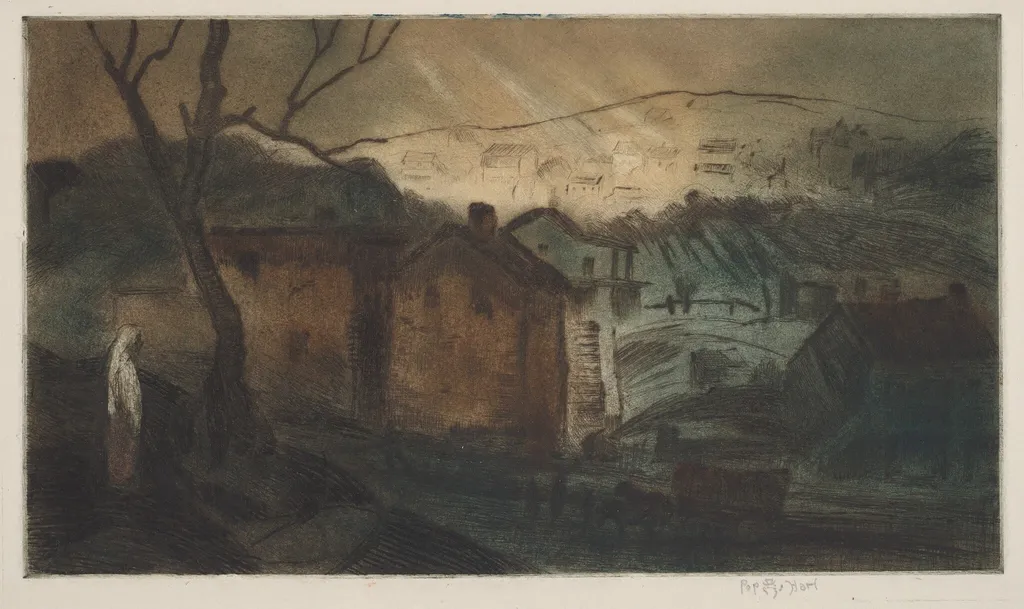
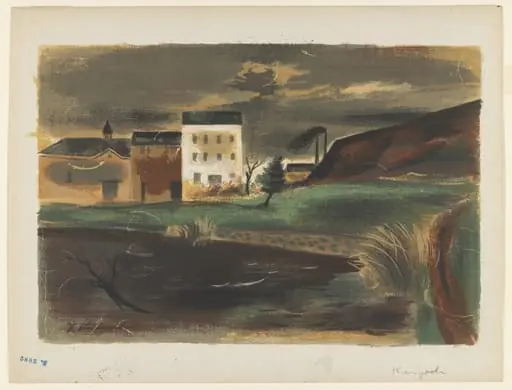
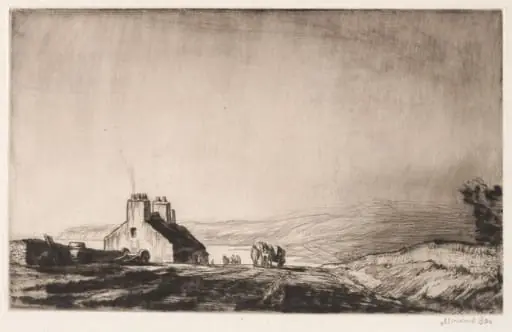
Jersey Hills is an ink print by George Overbury Hart. It dates from 1923 and is held in the collection of the National Gallery of Art.
About this work
Overview
Unlike traditional drypoints, the addition of color layers subtly modulates the tonal range, reinforcing the quietude of the scene without overt drama.
Created in 1923 by George Overbury Hart, Jersey Hills is a color drypoint print that captures a quiet rural landscape at twilight. The work employs sandpaper to roughen the plate’s surface, producing a grainy, tactile texture that enhances the sense of cold stillness. Unlike traditional drypoints, the addition of color layers subtly modulates the tonal range, reinforcing the quietude of the scene without overt drama.
Subject & Meaning
The scene depicts a modest cluster of snow-dusted dwellings nestled among bare trees, with a solitary figure moving near the left margin. The huddled houses and distant hills suggest isolation and endurance, while the fading light and muted gray sky evoke a moment of suspended calm. The lone walker, wrapped in dark clothing, adds a human presence without narrative resolution, emphasizing solitude over action.
Technique & Style
Hart used drypoint scratched directly into a metal plate, then abraded the surface with sandpaper to hold more ink and create a soft, uneven tone. Multiple color layers were applied by hand, allowing subtle shifts in hue across the sky, snow, and earth. The resulting texture is deliberately unrefined—rough, granular, and atmospheric—mirroring the chill and quiet of the winter landscape.
History & Provenance
Jersey Hills was produced during Hart’s active period in the early 1920s, when he focused on regional American landscapes through printmaking. The work was likely made in New Jersey, where Hart lived and drew inspiration from the local terrain. It entered public collections in the mid-20th century, valued for its technical innovation and quiet realism within the American print revival movement.
Context
In the 1920s, American artists increasingly turned to printmaking as a means of expressing personal, localized visions distinct from European modernism. Hart’s use of sandpaper in drypoint aligned with a broader interest in tactile, handcrafted surfaces. Jersey Hills reflects this trend, merging intimate observation with experimental technique to convey the subdued beauty of rural life.
Legacy
Jersey Hills remains a notable example of early 20th-century American printmaking for its technical ingenuity and restrained emotional tone. While not widely reproduced, it influenced later artists exploring texture and atmosphere in monochromatic and limited-color prints. Its quiet dignity continues to resonate within studies of regionalist print traditions.
Own this work as a print
Artist & collection


![Men Drinking at a Table [verso], by George Overbury Hart](https://artifactworldgallery.com/img/george-overbury-hart--men-drinking-at-a-table-verso--7e9475e5b5079377-w320.webp)
![Chicken Vendors [recto], by George Overbury Hart](https://artifactworldgallery.com/img/george-overbury-hart--chicken-vendors-recto--d97b582e13465974-w320.webp)