Artwork
From Bas-Meudon, Old Lavoir
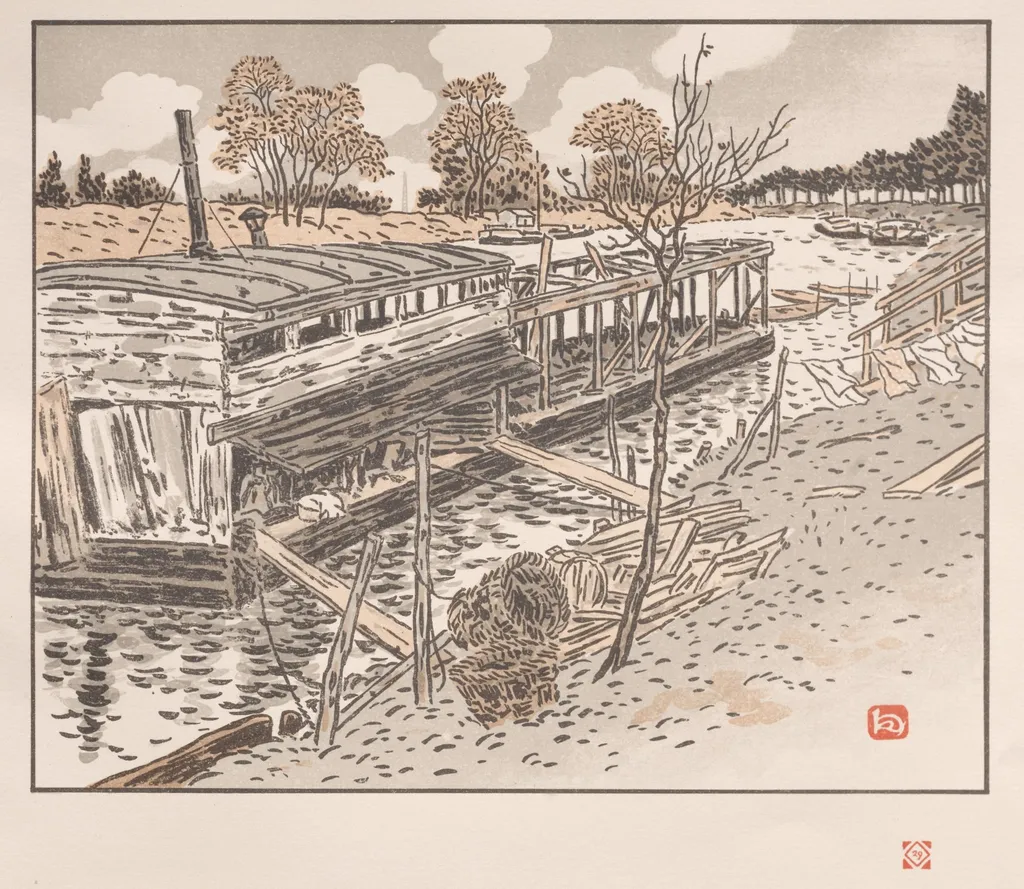
From Bas-Meudon, Old Lavoir is a print by Henri Rivière. It dates from 1902 and is held in the collection of the Cleveland Museum of Art.
About this work
Overview
Henri Rivière created a series of 36 prints capturing everyday life in and around Paris during the late 19th century. Each work includes the Eiffel Tower as a unifying element, anchoring the compositions to the city’s evolving identity. This print, titled From Bas-Meudon, Old Lavoir, focuses on a quiet industrial suburb, where the laundry trade thrived away from the urban core.
Subject & Meaning
The scene depicts a weathered washboat moored near a riverside laundry facility in Bas-Meudon, a working-class district on Paris’s western edge.
The scene depicts a weathered washboat moored near a riverside laundry facility in Bas-Meudon, a working-class district on Paris’s western edge. Rivière highlights the labor-intensive laundry industry, a vital but overlooked aspect of urban life. The distant silhouette of the Eiffel Tower suggests the city’s presence without intrusion, emphasizing the separation between metropolitan life and its peripheral economies.
Technique & Style
Rivière employed wood engraving to achieve fine tonal gradations and delicate line work, characteristic of his printmaking approach. The composition is restrained, with muted colors and a low horizon line that draws attention to the water and the boat. His attention to texture—weathered wood, rippling water, and folded linens—conveys quiet realism without romanticism.
History & Provenance
Created between 1886 and 1889, the series was produced during a period of rapid industrialization and artistic experimentation in France. Rivière, a close associate of Degas, was known for his dedication to documenting ordinary scenes. This print was part of a larger project intended to map the social geography of Paris through its overlooked spaces and routines.
Context
In the late 1800s, laundry work was predominantly performed by women in suburban river zones, where water access enabled the labor-intensive process. Bas-Meudon, though physically close to Paris, remained culturally and economically distinct. Rivière’s focus on such sites reflected a broader interest among artists in portraying the unseen mechanisms of urban existence.
Legacy
Rivière’s series contributed to the late 19th-century shift toward documenting everyday labor and marginal spaces. His prints influenced later generations of printmakers and urban observers, offering a sober, unsentimental record of industrial France. The work remains a quiet testament to the hidden rhythms of city life beyond its monuments.
Artist & collection
Artist
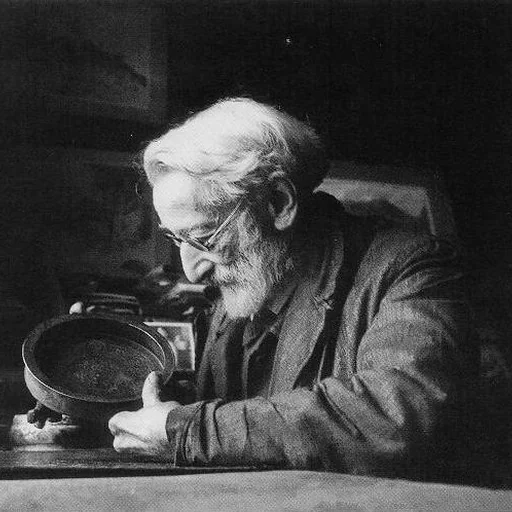
Henri Rivière (March 11, 1864 – August 24, 1951) was a French artist and designer best known for his creation of a form of shadow play at the Chat Noir cabaret, and for his post-Impressionist illustrations of Breton landscapes and the…

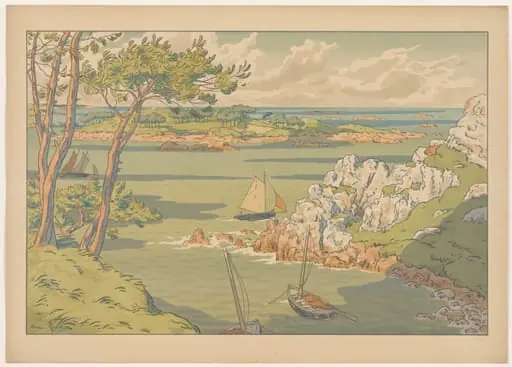 Aspects of Nature: The Island
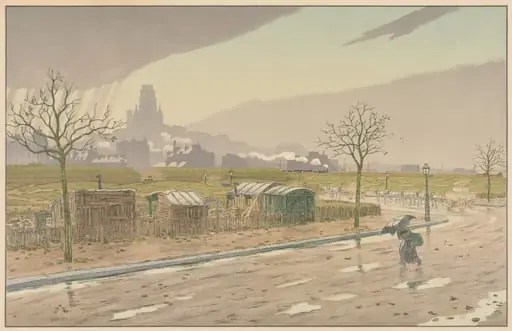 Parisian Landscapes: The Fortifications
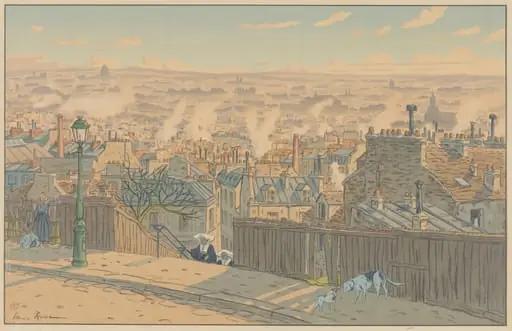 Parisian Landscapes: Paris seen from Montmartre
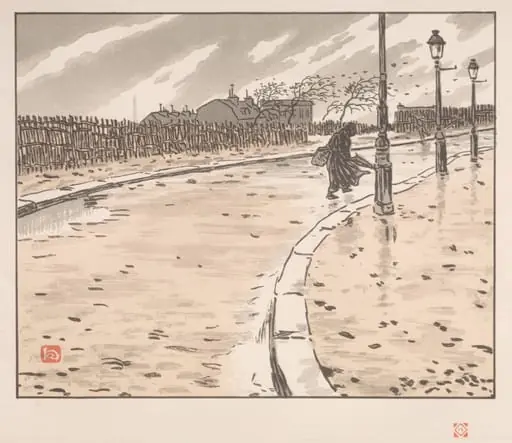 Thirty-Six Views of the Eiffel Tower: From Lamarck Street
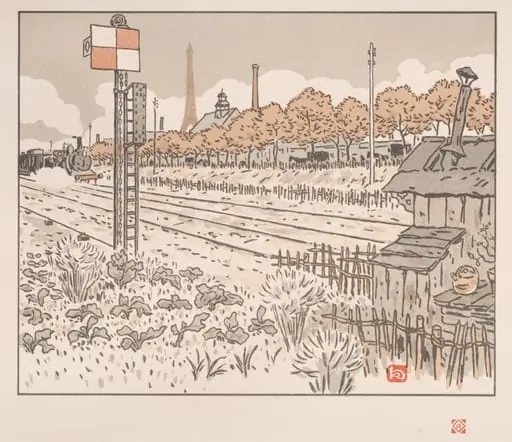 Thirty-Six Views of the Eiffel Tower: From the Quai de Javel (Switchman's Shanty)
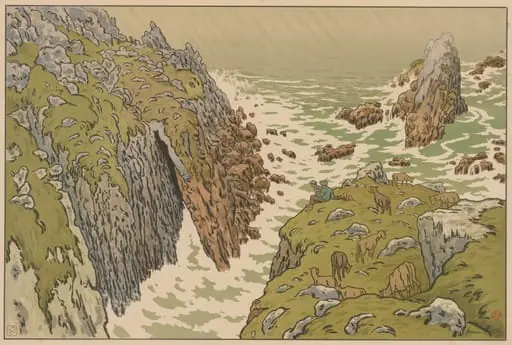 Aspects of Nature: The Cliff
 The Beautiful Countryside in Brittany: Street in Tréboul
 The Woods, Winter