Artwork
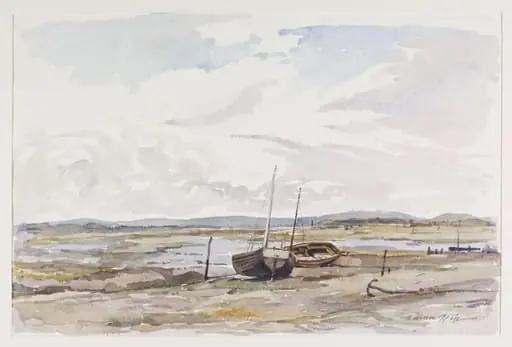
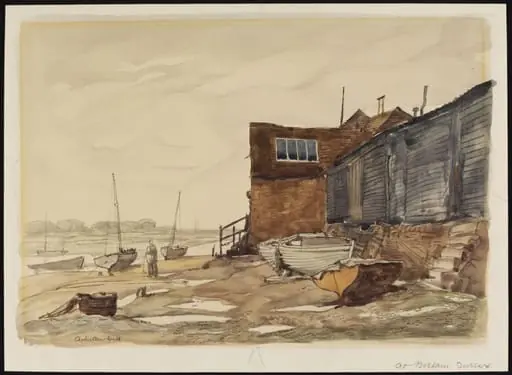
Entrance to Rye Harbour from Camber
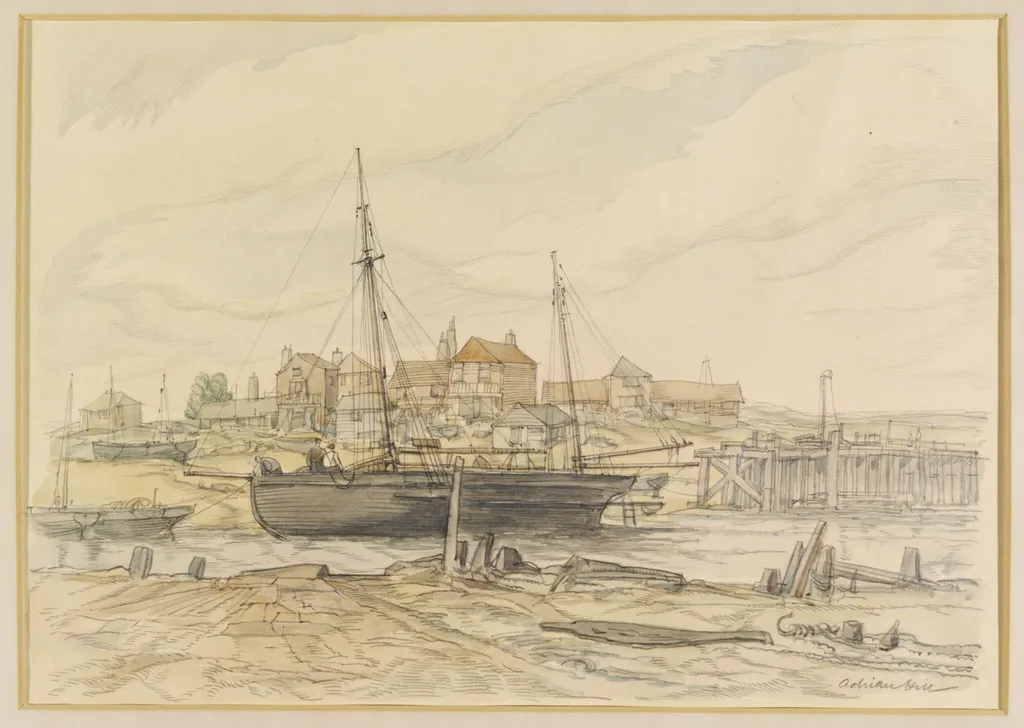
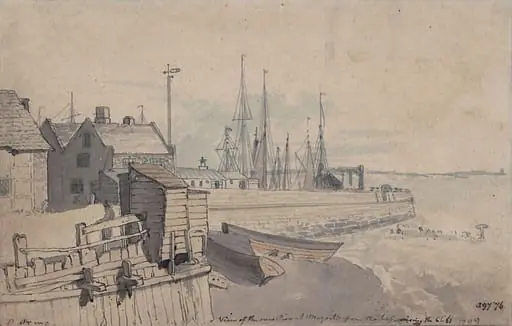
Entrance to Rye Harbour from Camber is a watercolor work on paper by the British Romanticist artist Hill. It dates from 1940 and is held in the collection of the Victoria and Albert Museum. Created in 1940, this watercolour captures the quiet entrance to Rye Harbour as viewed from Camber.
About this work
Overview
Created in 1940, this watercolour captures the quiet entrance to Rye Harbour as viewed from Camber.
Created in 1940, this watercolour captures the quiet entrance to Rye Harbour as viewed from Camber. It was produced as part of the Recording Britain project, a wartime initiative to visually document landscapes and vernacular architecture at risk of loss or change. The work belongs to a larger collection of over 1,500 pieces by 97 artists, all intended to preserve a visual record of England’s rural and coastal scenes during a time of national uncertainty.
Subject & Meaning
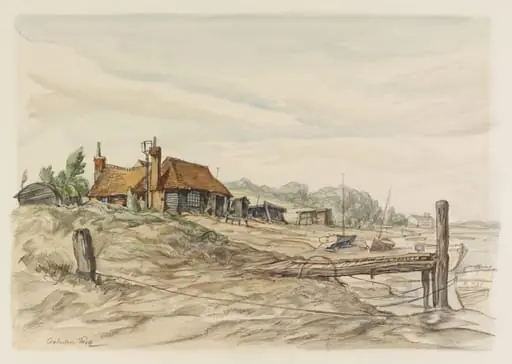
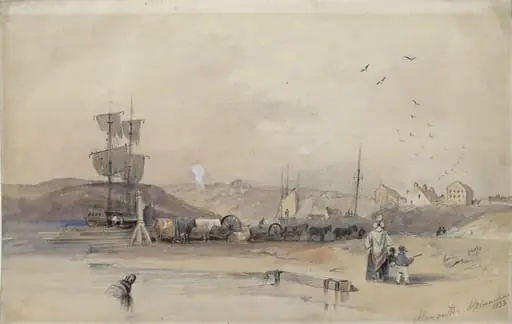
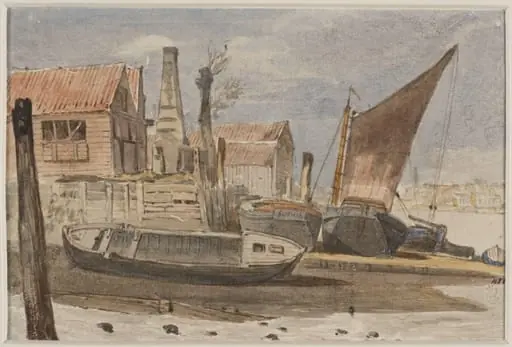
The scene portrays a tranquil harbor with two moored boats—one occupied by a solitary figure, the other empty—alongside a line of modest, low-roofed buildings. The still water and scattered driftwood suggest a moment of pause, reinforcing the project’s aim to record everyday, unassuming places. The absence of grandeur or activity underscores a quiet resilience in ordinary English coastal life, offering a subtle counterpoint to wartime disruption.
Technique & Style
The artist employed light pencil underdrawing followed by delicate watercolor washes to build subtle tonal variations. Brushwork is loose and economical, with forms suggested rather than meticulously rendered. The boats and structures are outlined with swift, sketch-like strokes, contributing to an impression of immediacy. The overall effect is understated, prioritizing atmosphere over detail, aligning with the project’s documentary rather than decorative intent.
History & Provenance
Commissioned under the Recording Britain project, initiated by Sir Kenneth Clark and funded by the Pilgrim Trust, the work was created between 1940 and 1943. It was collected alongside hundreds of other watercolours to form a national archive of threatened landscapes. The piece entered the Victoria and Albert Museum’s holdings, where it remains part of a curated collection dedicated to preserving Britain’s visual heritage during the Second World War.
Context
During the early years of the war, fears of aerial bombardment and social upheaval prompted efforts to safeguard cultural memory. Recording Britain responded by directing artists to rural and coastal sites often overlooked in official art. This watercolour reflects a broader cultural impulse to anchor national identity in familiar, unchanging places—offering solace through documentation when the future felt uncertain.
Legacy
The Recording Britain collection endures as a significant archive of mid-20th-century British topography. This watercolour, like others in the series, exemplifies how modest, observational art can serve as historical testimony. Its quiet realism continues to inform understandings of wartime Britain’s visual culture, offering insight into how artists responded to national anxiety through the careful recording of everyday scenes.
Artist & collection

Artist
A hill is a landform that extends above the surrounding terrain. It often has a distinct summit, and is usually applied to peaks which are above elevation compared to the relative landmass, though not as prominent as…