Artwork
Market Cross, Chichester
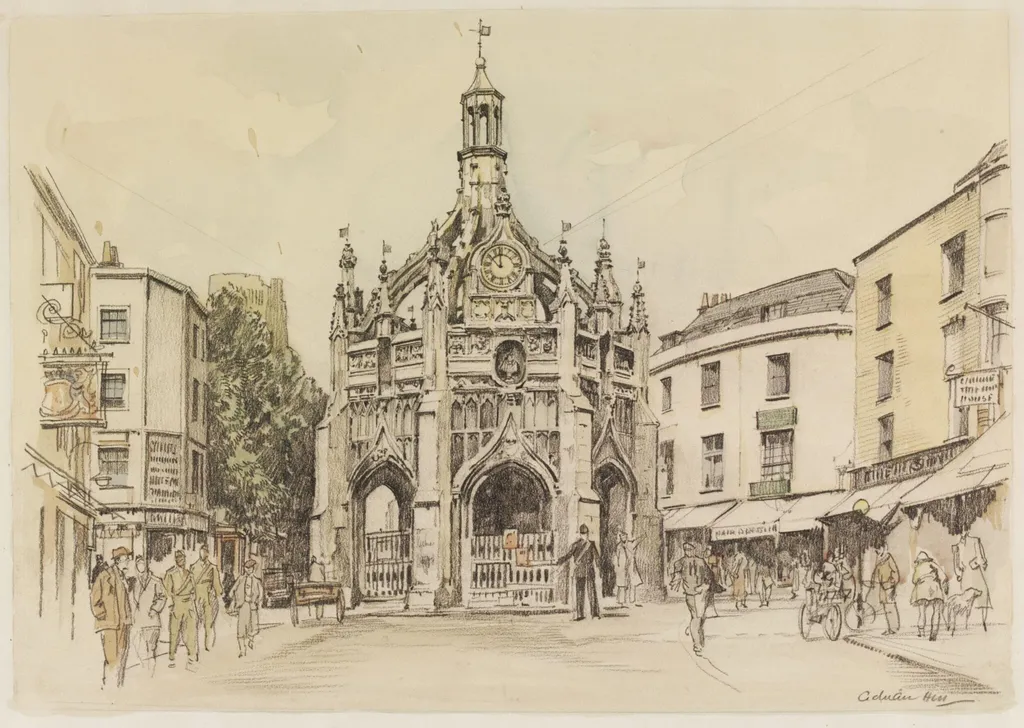
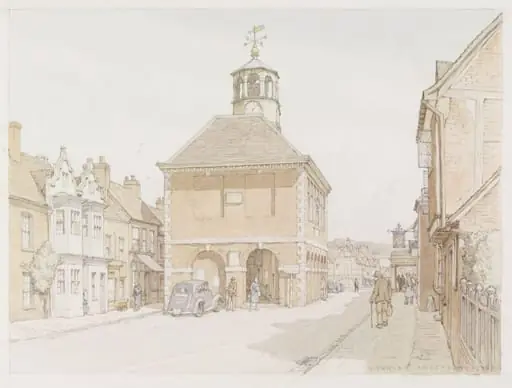
Market Cross, Chichester is a watercolor work on paper by the Social Realist artist Hill. It dates from 1940 and is held in the collection of the Victoria and Albert Museum.
About this work
Overview
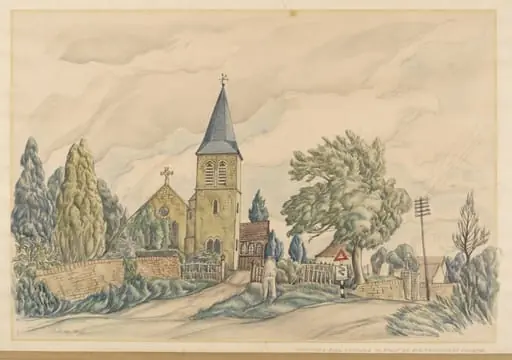
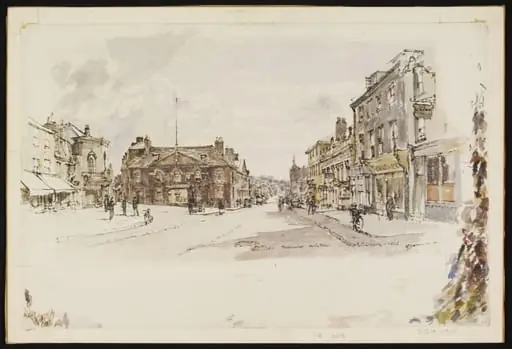
This 1940 watercolour by Margaret Hill portrays the Market Cross in Chichester, a prominent clock tower set within a bustling street. Executed as part of the Recording Britain scheme, the work records a specific moment in the town’s daily life, capturing both architecture and passers‑by in a single, compact composition.
Subject & Meaning
The composition centers on the ornate, pointed‑roofed clock tower, its arched windows and clock face rendered with clear detail. Around the monument, figures in hats and with shopping bags animate the scene, suggesting the market’s role as a social hub and emphasizing the continuity of local tradition amid wartime uncertainty.
Technique & Style
Hill employs swift, fluid lines and a light wash of colour, allowing the interplay of light and shadow to suggest atmosphere rather than precise realism. The sketchy quality of the watercolour conveys immediacy, while the careful rendering of the tower’s architectural features anchors the work in a recognisable, documentary mode.
History & Provenance
Created under the Recording Britain project, which Sir Kenneth Clark directed and the Pilgrim Trust funded, the piece is one of roughly 1,500 works produced between 1940 and 1943. The initiative aimed to preserve visual records of sites considered vulnerable to wartime damage or modern alteration, focusing on England, Wales, and Scotland, but excluding Northern Ireland.
Context
The Market Cross was selected as a representative English landmark, reflecting the scheme’s emphasis on market towns, churches, and monuments that embodied traditional scenery. Hill’s watercolour thus functions both as an artistic observation and as a historical document of a location potentially at risk during the Second World War.
Artist & collection

Artist
A hill is a landform that extends above the surrounding terrain. It often has a distinct summit, and is usually applied to peaks which are above elevation compared to the relative landmass, though not as prominent as…