Artwork
Convento da Serra
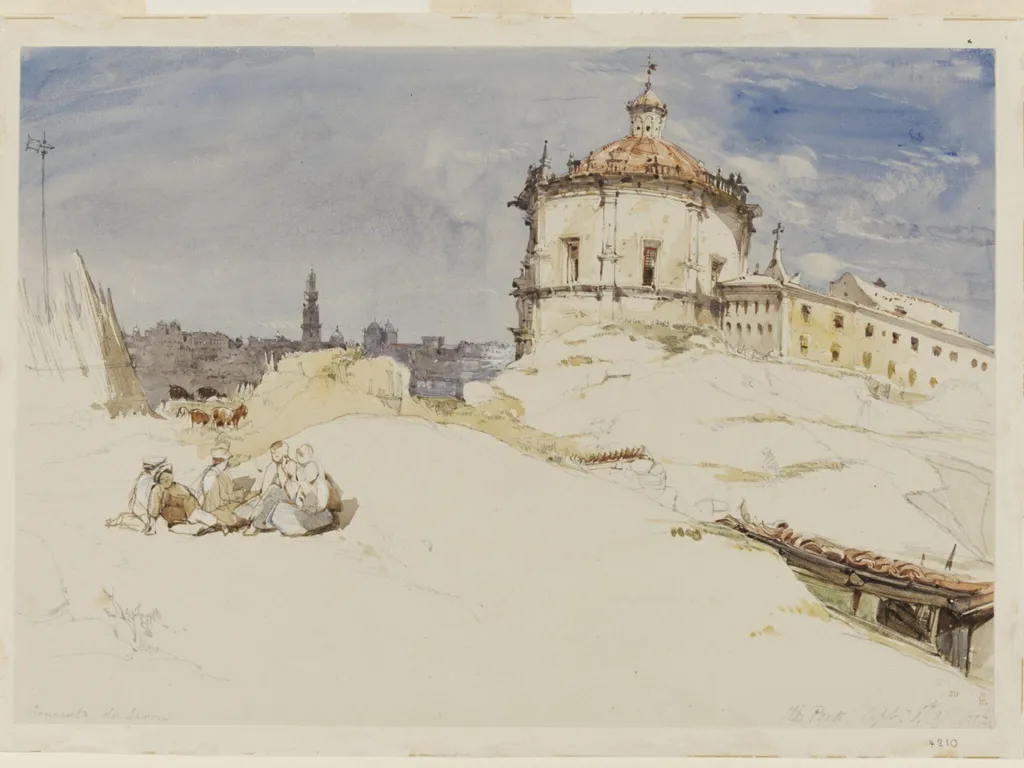
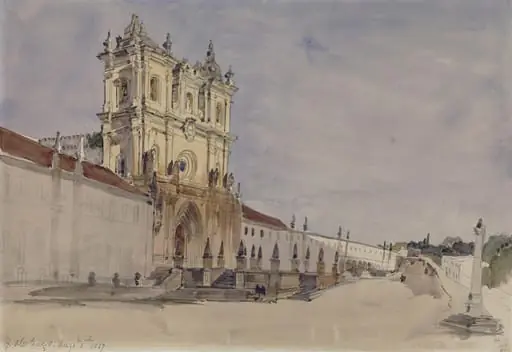
Convento da Serra is a watercolor work on paper by the British Romanticist artist James Holland. It dates from 1837 and is held in the collection of the Victoria and Albert Museum.
About this work
Overview
This watercolour by James Holland, signed and dated 1837, captures the Convento da Serra do Pilar in Portugal. Executed with a spontaneous, on-site approach, the work reflects the artist’s interest in architectural forms within natural landscapes. The composition emphasizes light and atmospheric conditions, suggesting a direct response to the environment rather than a studio reconstruction.
Subject & Meaning
The scene centers on the monastery’s distinctive dome rising above a sloping hillside, framed by quiet rural activity. Three figures rest near a small boat, while cattle graze in the distance, conveying a sense of daily life unobtrusively integrated with sacred architecture. The absence of dramatic narrative invites contemplation of place and stillness rather than religious symbolism.
Technique & Style
Holland employed loose, fluid washes to render the dome and walls in pale yellows and whites, using subtle shifts in tone to suggest volume and shadow. The sky, lightly glazed with blue and scattered cloud strokes, enhances the sense of air and openness. The sketchlike quality—unpolished edges, minimal detail—points to an outdoor execution, prioritizing immediacy over finish.
History & Provenance
Created during Holland’s travels in Portugal, the work is part of a series of watercolours documenting Iberian architecture and landscapes. Its survival and attribution to 1837 align with documented journeys he made in the region. The piece entered the Victoria and Albert Museum’s collection through later acquisitions, preserving its connection to 19th-century British topographical art.
Context
In the 1830s, British artists increasingly traveled across Europe to record historic sites, often for personal study or private collections. Holland’s work reflects this trend, blending topographical accuracy with a Romantic sensitivity to light and mood. His focus on monastic ruins and rural scenes aligned with broader interests in cultural heritage and the picturesque.
Legacy
Holland’s watercolours, including this one, contributed to a growing archive of European architectural studies by British artists. Though not widely exhibited in his lifetime, his sketches remain valuable for their observational honesty and technical restraint. They continue to inform studies of 19th-century travel art and the evolution of watercolour as a medium for direct observation.
Artist & collection

Artist
James Holland (18 October 1799 – 12 February 1870) was an English painter of flowers, landscapes, architecture, marine subjects, and a book illustrator.

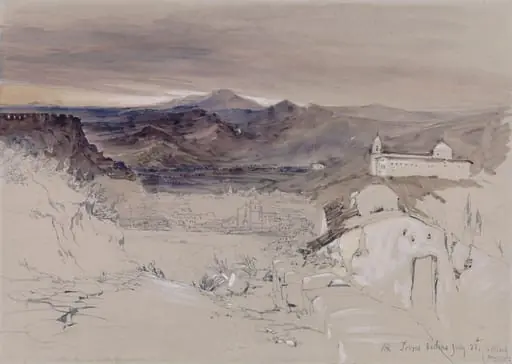
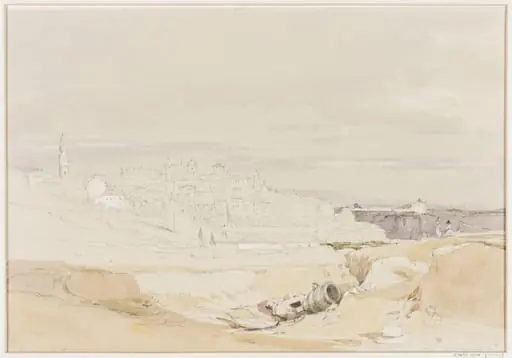 Sketch in Portugal
![Looking towards Leanders Tower and the Sultans New Palace [Dolmabahçe] From Scutari, by Michael Anthony Shrapnel Biddulph](https://artifactworldgallery.com/img/michael-anthony-shrapnel-biddulph--looking-towards-leanders-tower-and-the-sultans-new-palace-do--77513ba4e146ed32-w320.webp) Looking towards Leanders Tower and the Sultans New Palace [Dolmabahçe] From Scutari
Looking towards Leanders Tower and the Sultans New Palace [Dolmabahçe] From Scutari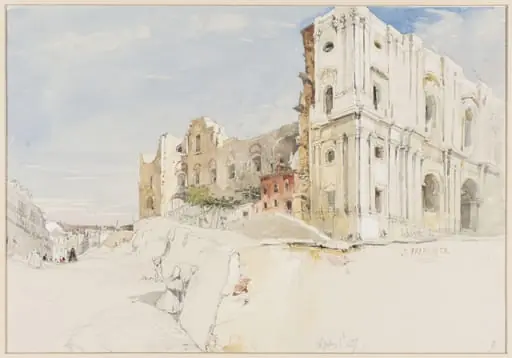 S. Francisco
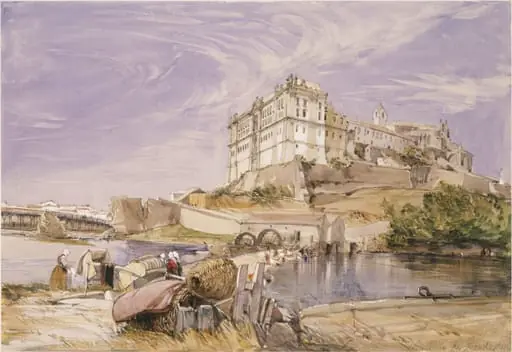 Villa do Conde, about eleven miles from Oporto
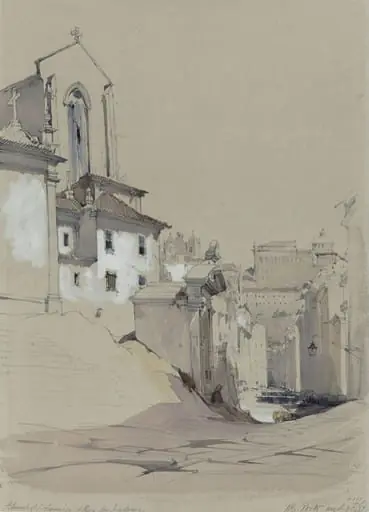 Church of San Francisco and Rua dos Ingleses, Oporto
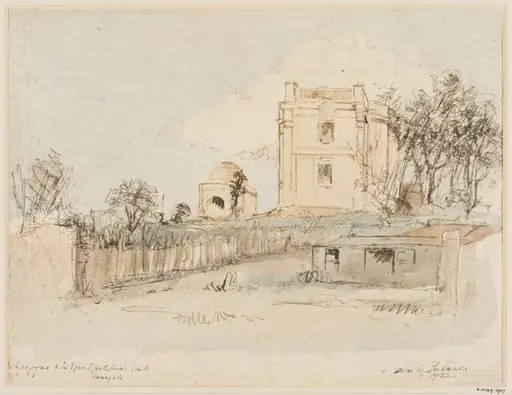 The Synagogue and Sir Moses Montefiore's Tomb, Ramsgate
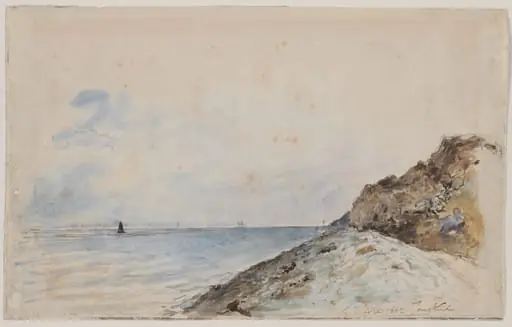 Le Havre
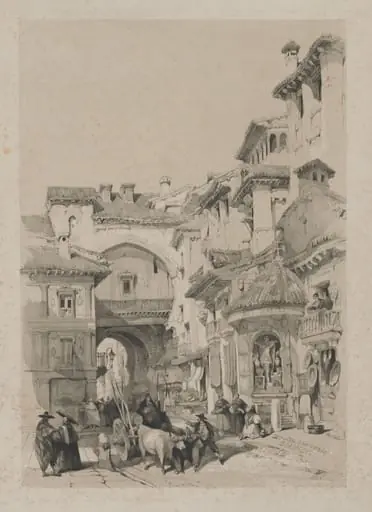 Picturesque Sketches in Spain: Gate of the Vivarrambla, Granada
 Florence
 Qasr al-Ayni, Cairo
 College of San José from the adjacent boat-village, Macao