Artwork
Cives Hollandica
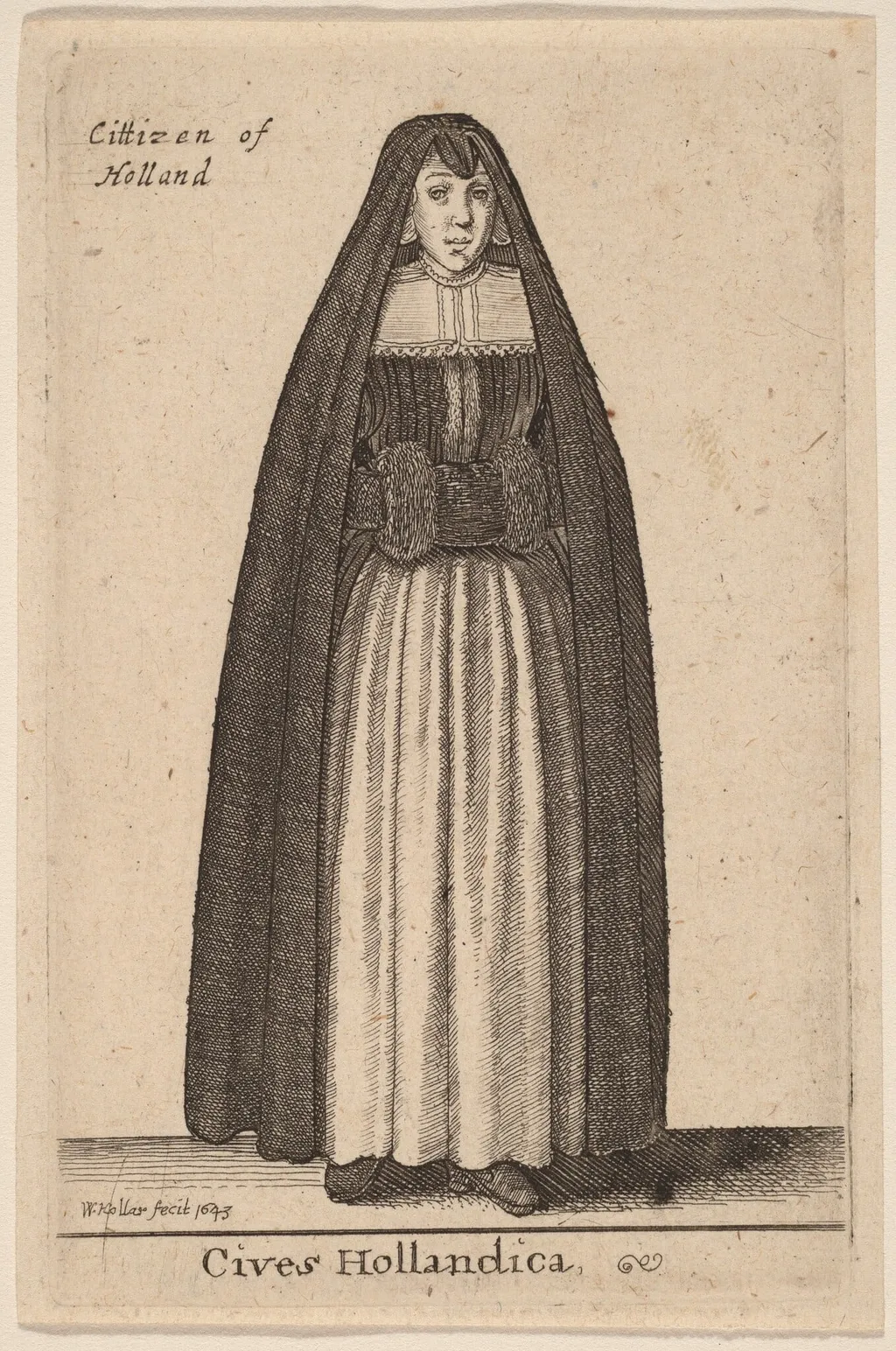
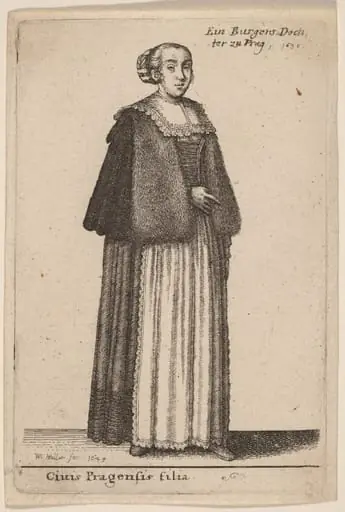
Cives Hollandica is an ink print by the Baroque artist Wenceslaus Hollar. It dates from 1643 and is held in the collection of the National Gallery of Art.
About this work
She wears a long skirt with vertical folds, a dark cloak draped over her head, and a white collar with lace trim.
This is a black-and-white drawing of a woman in old-fashioned clothes. She wears a long skirt with vertical folds, a dark cloak draped over her head, and a white collar with lace trim. Her face is plain but serious, with simple lines for eyes and a small mouth.
The words “Citizen of Holland” are written above her head, and “Cives Hollandica” is printed at the bottom. The artist’s name, W. Hollar, and the year 1643 appear near the edge.
If you like this style, look up etching next.
Overview
Created in 1643, *Cives Hollandica* is an etching by the Czech-born printmaker Wenceslaus Hollar, who spent the majority of his professional life in England. Executed in black ink on paper, the image presents a solitary figure dressed in period attire, accompanied by the Latin inscription identifying her as a "Citizen of Holland." The work exemplifies Hollar’s meticulous approach to rendering human figures within a broader topographical context.
Subject & Meaning
The central figure is a woman clad in a long, vertically folded skirt, a dark cloak covering her head, and a white, lace‑trimmed collar. Her expression is restrained, rendered with simple line work that conveys a sense of modest dignity. The accompanying Latin text, "Cives Hollandica," functions as both a title and a cultural identifier, linking the portrait to the Dutch civic identity of the era.
Technique & Style
Hollar employed the etching process, incising lines into a copper plate with acid to achieve fine detail and tonal variation. His handling of line demonstrates the precision for which he is renowned in his cityscape and architectural prints. The stark monochrome palette emphasizes texture and form, allowing the folds of fabric and the delicate lace to emerge through subtle gradations of line.
History & Provenance
The print was produced during a prolific period in Hollar’s career when he focused on topographical and documentary subjects. Although primarily known for his depictions of urban vistas, this work reflects his occasional forays into portraiture. Original impressions would have been distributed as part of Hollar’s broader output of prints circulated among collectors and scholars in mid‑17th‑century England.
Context
In the early 1640s, Europe was marked by political and religious upheaval, and the Dutch Republic was asserting its civic identity. Hollar’s choice to label the sitter as a Dutch citizen aligns with contemporary interest in national and municipal representation. The work thus serves both as a portrait and as a document of cultural affiliation during a period of burgeoning national consciousness.
Artist & collection
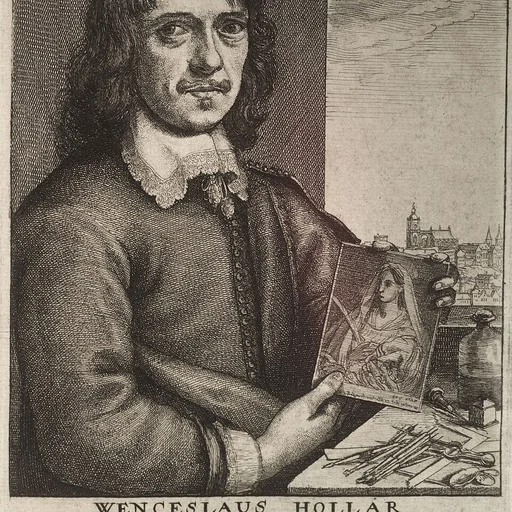
Artist
Wenceslaus Hollar (Czech: Václav Hollar (Czech pronunciation: ), German: Wenzel Hollar; 23 July 1607 – 25 March 1677) was a Czech engraver, etcher and painter.