Artwork
Spring
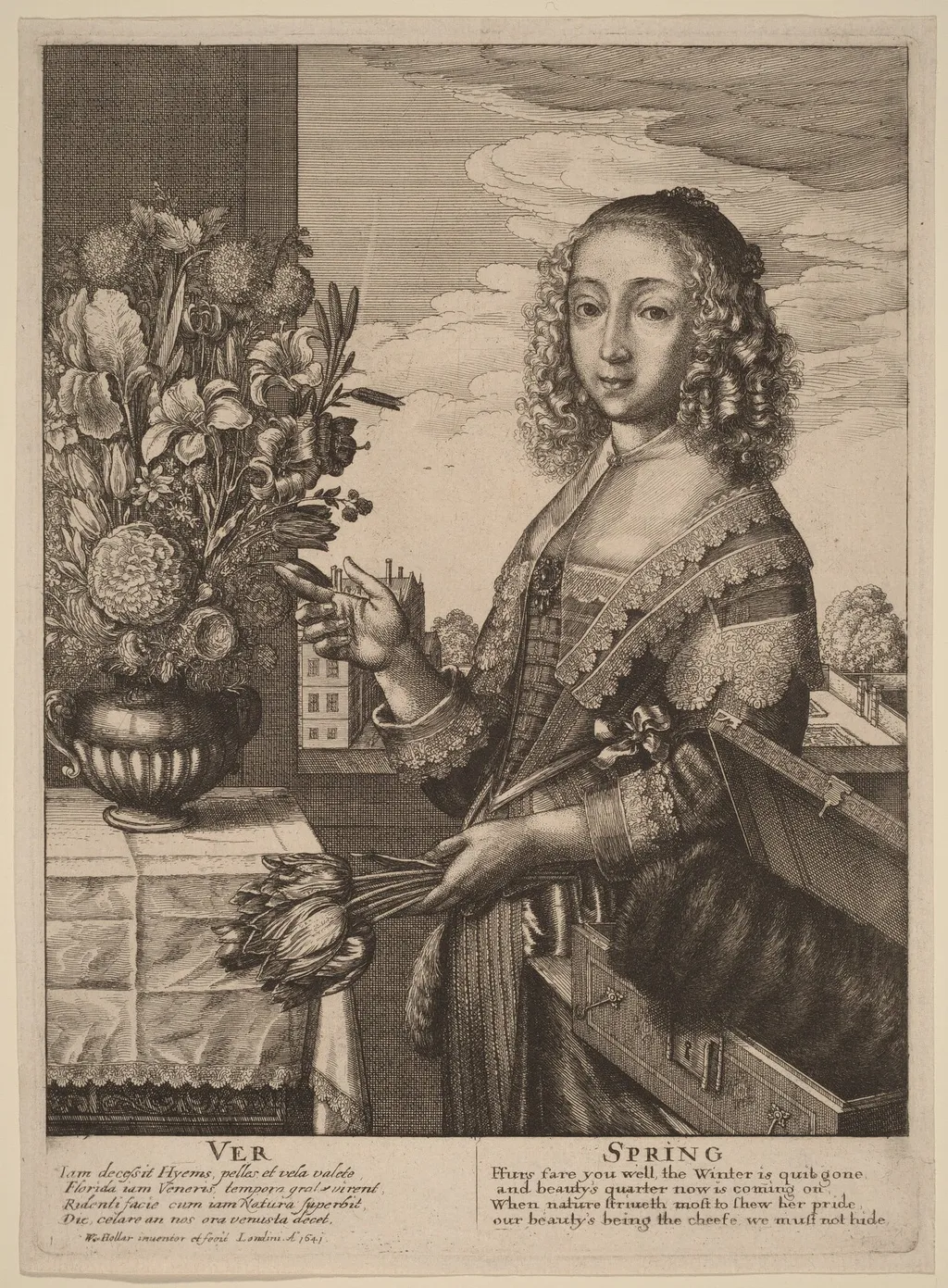
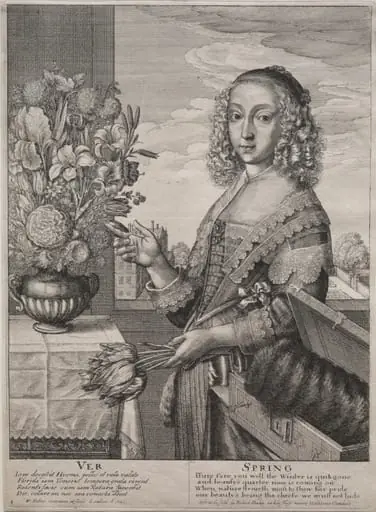
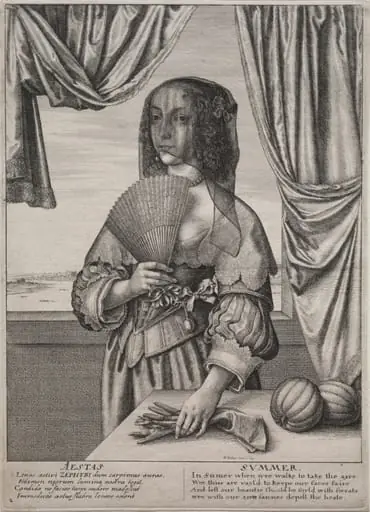
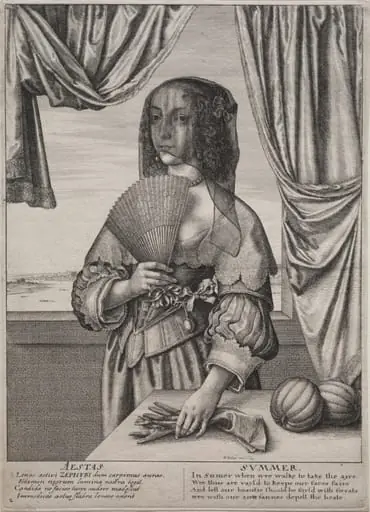
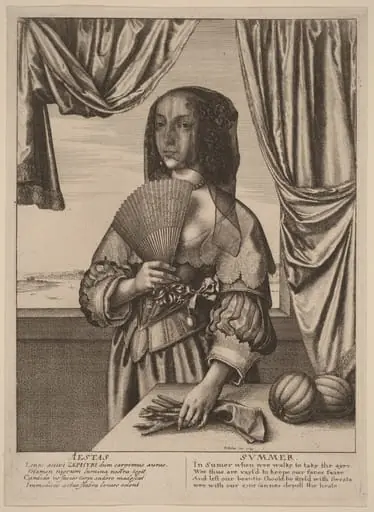
Spring is an ink print by the Baroque artist Wenceslaus Hollar. It dates from 1641 and is held in the collection of the National Gallery of Art.
About this work
Overview
Its precision reflects Hollar’s mastery of printmaking and his interest in documenting the everyday through meticulous detail.
Created in 1641 by Wenceslaus Hollar, *Spring* is an etching that captures a quiet interior scene tied to the season. Hollar, a Czech artist active in England, employed fine-line etching to render delicate textures and spatial depth. The work belongs to a series of seasonal prints, blending natural imagery with human presence to evoke temporal rhythms. Its precision reflects Hollar’s mastery of printmaking and his interest in documenting the everyday through meticulous detail.
Subject & Meaning
The image depicts a woman seated indoors, holding a violin, surrounded by blooming flowers in a tall vase. Roses, tulips, and foliage suggest the renewal of spring. Her musical instrument and the floral arrangement together imply harmony between human activity and seasonal change. Below the image, poetic verses reinforce this connection, framing music and botany as expressions of spring’s vitality. The scene is intimate, not ceremonial, emphasizing quiet contemplation over grandeur.
Technique & Style
Hollar used fine, controlled etching lines to model form and texture with remarkable subtlety. The lace on the woman’s dress, the petals of flowers, and the grain of the wooden window frame are rendered with precision. Shadows are built through cross-hatching and varying line density, creating a sense of volume without heavy contrast. The background window opens to a softly suggested landscape, enhancing depth while maintaining focus on the interior. The technique prioritizes clarity and refinement over dramatic effect.
History & Provenance
Hollar produced *Spring* during his years in London, following his move from Prague in the 1630s. The etching was likely part of a commercial series of seasonal prints, popular among collectors interested in natural cycles and refined domestic life. Though no early ownership records are widely documented, the work’s survival in institutional collections suggests it was valued in its time for its technical skill and thematic coherence.
Context
In mid-17th century England, etching was increasingly used for both artistic and documentary purposes. Hollar’s seasonal prints aligned with a broader European interest in the allegory of the year’s cycles, often linked to poetry and natural philosophy. His work reflects the influence of Dutch genre scenes and Flemish still-life traditions, adapted to English tastes. The fusion of visual art and verse was common in print culture, appealing to educated audiences seeking intellectual and aesthetic pleasure.
Legacy
Hollar’s *Spring* exemplifies the potential of etching to convey both observation and symbolism with subtlety. While not widely known outside specialist circles, his seasonal prints contributed to the development of print series as a coherent artistic form. His attention to detail influenced later topographical artists and printmakers, particularly those interested in combining natural history with domestic imagery. The work remains a quiet testament to the intersection of craft, seasonality, and quiet human presence.
Artist & collection
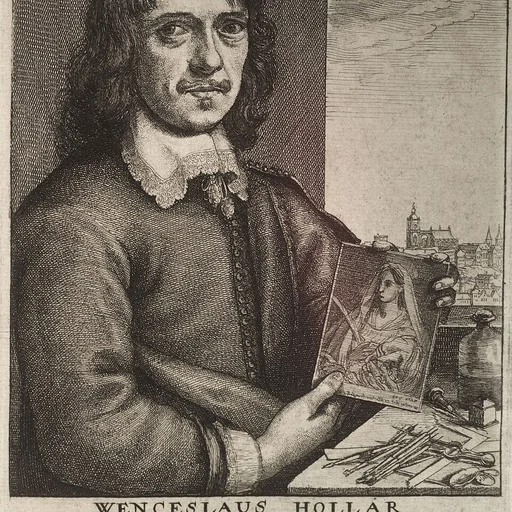
Artist
Wenceslaus Hollar (Czech: Václav Hollar (Czech pronunciation: ), German: Wenzel Hollar; 23 July 1607 – 25 March 1677) was a Czech engraver, etcher and painter.