Artwork
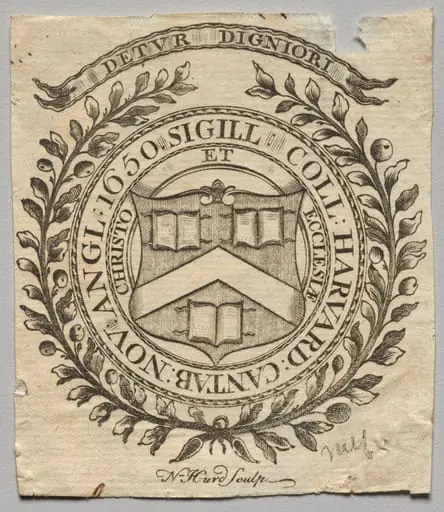
Harvard College Bookplate with the Christo et Ecclesiæ Seal
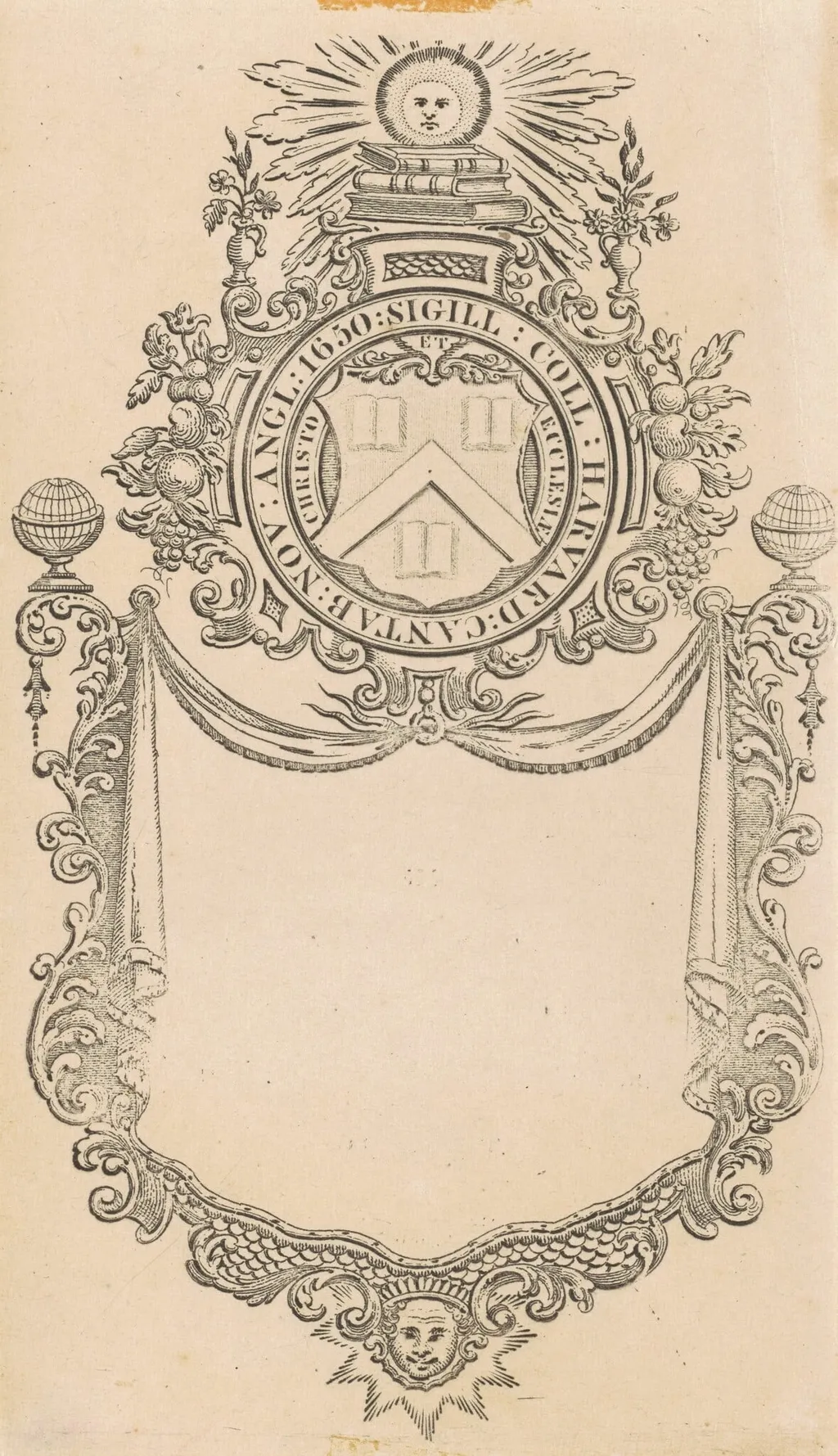
Harvard College Bookplate with the Christo et Ecclesiæ Seal is an ink print by the Romanticist artist Nathaniel Hurd. It dates from 1765 and is held in the collection of the National Gallery of Art.
About this work
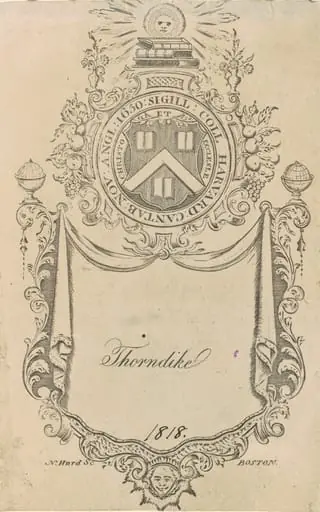
At the center is a triangle with an eye on top, surrounded by letters and a banner.
This engraving shows a fancy coat of arms with lots of swirling lines and shapes. At the center is a triangle with an eye on top, surrounded by letters and a banner. Above it, a sun face beams down, and below, a smaller face peeks out. The whole thing is framed by scrolls, globes, and ornate borders.
The triangle in the middle is called a "seal" for Harvard College, made in 1765. The extra details—like the sun and faces—were added to make it look grand.
Next, check out how this was made using engraving.
Overview
This 1765 engraving by Nathaniel Hurd serves as a bookplate for Harvard College, bearing the official Christo et Ecclesiæ seal. Executed in black ink on wove paper, it functions as a mark of institutional ownership. The design combines heraldic elements with symbolic imagery, reflecting the college’s identity through formal visual language rather than literal representation.
Subject & Meaning
At the center lies a triangular seal inscribed with Latin text, representing Harvard’s dedication to Christ and the Church. Above it, a radiant sun face signifies divine guidance; below, a smaller face may allude to wisdom or the human pursuit of knowledge. Surrounding scrolls, globes, and ornamental borders reinforce themes of learning, global reach, and scholarly tradition.
Technique & Style
The image was produced through fine-line engraving, a technique requiring precise incisions on a metal plate. Hurd employed intricate swirling lines, dense ornamentation, and layered textures to create depth and formality. The composition is symmetrical and tightly controlled, typical of 18th-century American heraldic prints, emphasizing craftsmanship over spontaneity.
History & Provenance
Commissioned in 1765, this plate was used to mark volumes in Harvard’s growing library collection. As one of the earliest institutional bookplates in colonial America, it reflects the college’s efforts to establish a formal identity. Its survival in multiple copies suggests widespread use among faculty and donors, anchoring its role in early academic culture.
Context
Created during a period when American institutions sought to emulate European academic traditions, the plate draws from British heraldic conventions. The inclusion of celestial and allegorical figures aligns with Enlightenment-era ideals linking knowledge with divine order. Such imagery was common in collegiate seals, reinforcing the moral and spiritual dimensions of education.
Legacy
The Christo et Ecclesiæ seal remained Harvard’s official emblem for over a century, influencing later institutional logos. Hurd’s engraving stands as a key example of early American print culture and the visual language of academia. Though replaced in the 19th century, its design continues to inform historical interpretations of Harvard’s founding ethos.
Artist & collection