Artwork
Sketch for “Konrad Wallenrod”
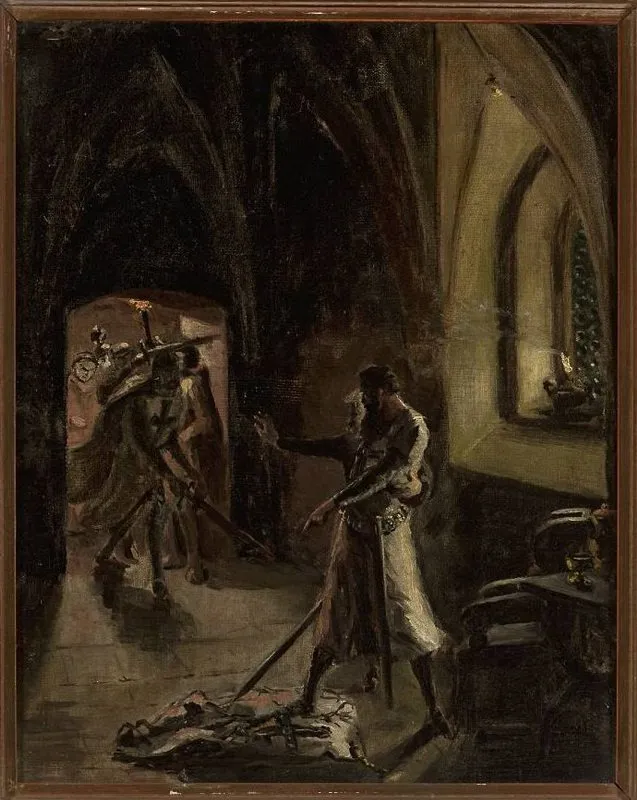
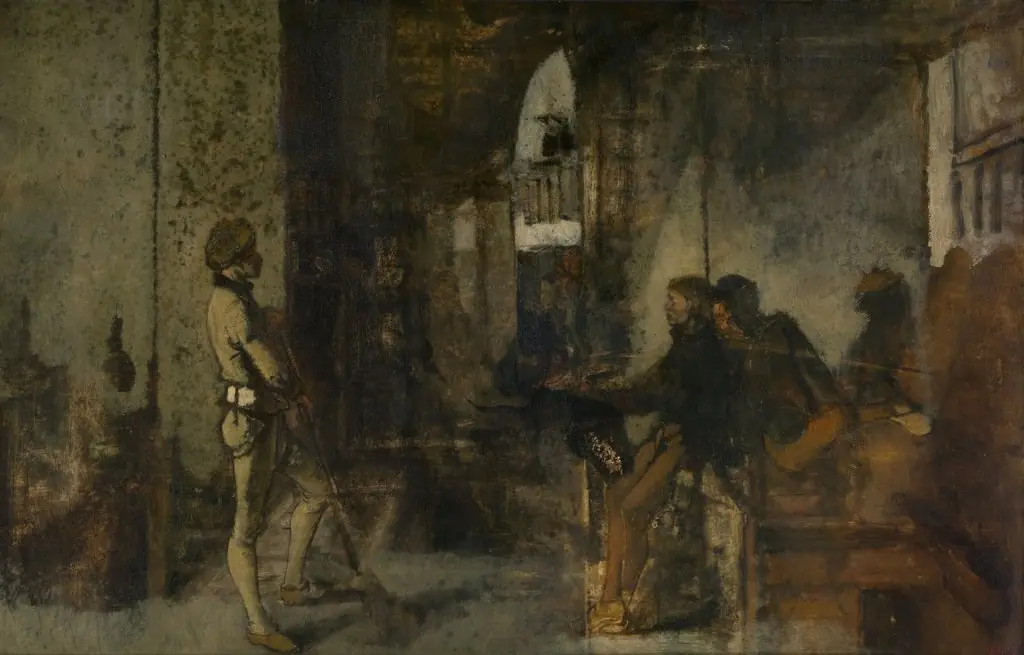
Sketch for “Konrad Wallenrod” is an unspecified painting by the Realist artist Ignacy Gierdziejewski. It dates from 1856 and is held in the collection of the National Museum in Warsaw.
About this work
Overview
It resides in the collection of the National Museum in Warsaw, where it is valued as a rare surviving example of Gierdziejewski’s narrative work.
Created in 1856 by Ignacy Gierdziejewski, this oil sketch serves as a preparatory study for a larger work inspired by Adam Mickiewicz’s epic poem 'Konrad Wallenrod.' Executed in muted tones with strong contrasts of light and shadow, the piece captures a moment of quiet tension within a confined interior. It resides in the collection of the National Museum in Warsaw, where it is valued as a rare surviving example of Gierdziejewski’s narrative work.
Subject & Meaning
The scene illustrates a moment from Mickiewicz’s poem in which the titular character, Konrad Wallenrod, performs a menial task while concealing his true identity and mission. The central figure, clad in white, sweeps the floor—an act of humility masking his role as a covert avenger. The two figures in dark clothing, one armed, suggest surveillance or impending confrontation, reinforcing the poem’s themes of sacrifice, deception, and national duty.
Technique & Style
Gierdziejewski employs chiaroscuro to isolate the central figure, using a single light source from the right to carve form from shadow. The brushwork is loose yet deliberate, typical of preparatory sketches, with thick impasto in the shadows and thinner layers in the illuminated areas. The composition directs focus downward toward the broom’s motion, while the arched doorway frames the background figures, enhancing spatial depth and psychological unease.
History & Provenance
The sketch was likely produced during Gierdziejewski’s engagement with Polish Romantic literary circles in the mid-1850s. It remained in the artist’s possession until after his death, eventually entering the National Museum in Warsaw’s collection through documented acquisition in the late 19th century. Its survival is notable, as many of his works were lost or destroyed during periods of political upheaval.
Context
Gierdziejewski worked during a time when Polish artists increasingly turned to literature for subject matter, seeking to preserve national identity under foreign partition. His sketch reflects a broader trend of visualizing Mickiewicz’s poetry, which functioned as cultural resistance. The choice of a domestic interior over a battlefield underscores the psychological weight of covert action, aligning with Romantic ideals of inner heroism.
Legacy
Though Gierdziejewski did not achieve widespread fame, this sketch endures as a significant link between Polish literature and visual art. It provides insight into how literary narratives were translated into visual form during the Romantic era. Scholars reference it when studying the interplay between text and image in 19th-century Polish culture, and it remains a quiet but potent artifact of national memory.
Artist & collection

 The Guard
 Pridvorul bisericii Colțea
 The Vote (Sketch)
 Essay on Stone with Brush and Scraper: Chase on the Winding Staircase
 Two Men Fighting
 Die Auffindung von Pyramus und Thisbe
 Scene from the Spanish Inquisition
 Etchings of Venice: Laundry
 Bishop Lubrański establishes the Ecclesiastical Academy in Poznań, sketch
 Interior of the cloister at the church of St. Catherine in Kraków
 Allegory of the foundation of the Society of Jesus.
 Godfrey of Bouillon