Artwork
Great Dismal Swamp, Virginia
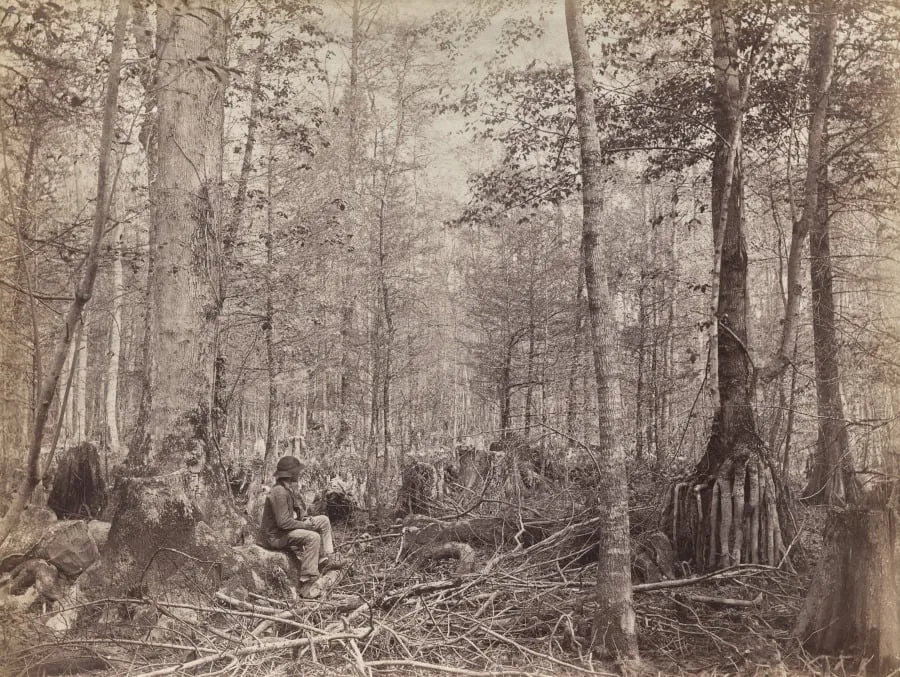
Great Dismal Swamp, Virginia is a photography by the Impressionist artist Israel Cook Russell. It dates from 1881 and is held in the collection of the Cleveland Museum of Art.
About this work
Overview
Taken by geologist Israel Cook Russell, this photograph captures the Great Dismal Swamp along the Virginia-North Carolina border. Unlike typical 19th-century landscape images, it merges scientific observation with aesthetic sensitivity. Russell’s approach treats the swamp not as a wilderness to be conquered, but as a dynamic system shaped by natural processes over time.
Subject & Meaning
The image presents a dense, waterlogged forest where gnarled cypress and tupelo roots emerge from still, dark pools. Mist clings to the ground, softening edges and deepening the sense of isolation. Rather than portraying emptiness, Russell conveys ecological complexity—life sustained in conditions that appear inhospitable, revealing the swamp as a resilient, evolving ecosystem.
Technique & Style
Russell employed careful composition and controlled exposure to render subtle tonal gradations in the mist and water. His framing emphasizes verticality—trunks rising from the shallows—and horizontal stillness, creating a quiet rhythm. The photograph avoids dramatic contrasts, favoring muted tones that reflect the swamp’s natural palette and reinforce its atmospheric stillness.
History & Provenance
Russell produced this image during fieldwork in the 1880s as part of U.S. geological surveys. His photographs were intended as scientific records, yet he consistently sought visual clarity and compositional balance. The image likely circulated among academic circles and government archives, contributing to early documentation of eastern wetland environments.
Context
In an era when American landscapes were often romanticized or exploited for economic potential, Russell’s work stood apart. His training as a geologist informed his focus on process—erosion, sedimentation, vegetation growth—rather than spectacle. This perspective aligned with emerging scientific approaches to natural history, distinguishing his images from purely picturesque traditions.
Legacy
Russell’s photographs of the Great Dismal Swamp contributed to a growing body of work that treated nature as a subject of study rather than mere backdrop. His integration of empirical observation with visual restraint influenced later environmental documentation, offering a model for how science and art could coexist in representing complex ecosystems.
Artist & collection

 Untitled (The Forest of Fontainebleau)
 Landscape
 Battlefield of New Hope Church, Georgia, No. 2
 Untitled (Woods in Snow)
 Shimla. Sir Hugh Rose's Bungalow at Mahasso
 Pathway in the Forest of Fontainebleau
 Untitled (Landscape)
 Lysning i Nordskoven ved Jægerspris
 Landscape with Seated Figure on Stream Bank
 A Path Through a Wood
 The Upper Himmalayahs. The Dodee Tal in Lake
 Forest, Ramsau, Germany