Artwork
An Elaborate Altar with the Resurrection of Christ and the Martyrdom of Saint Andrew
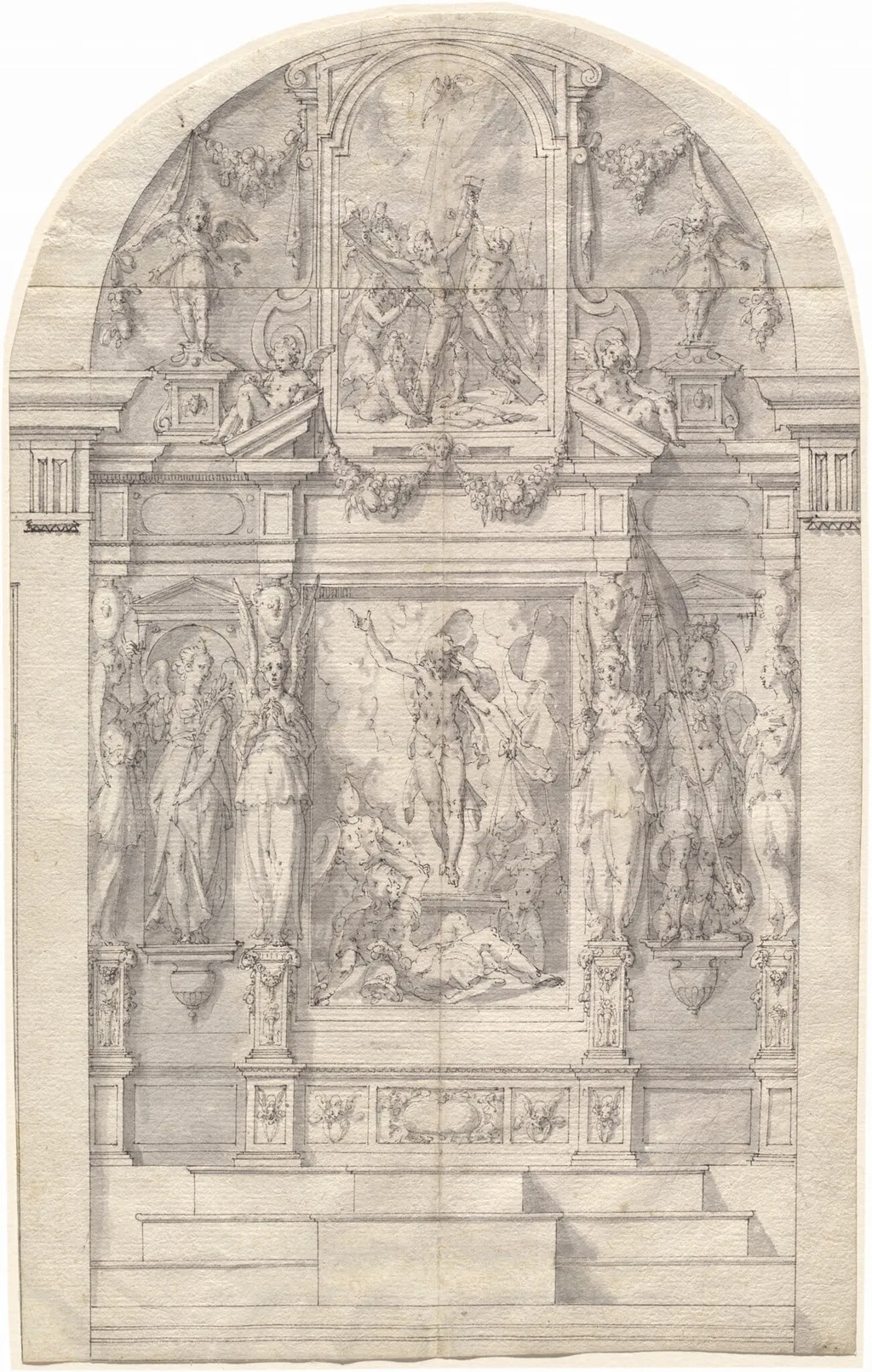
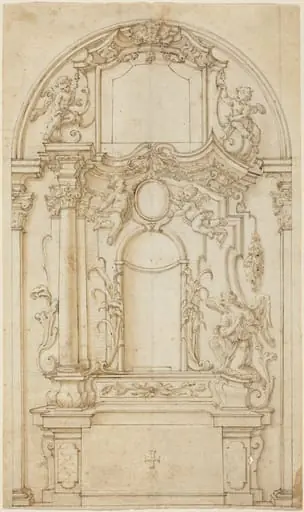
An Elaborate Altar with the Resurrection of Christ and the Martyrdom of Saint Andrew is an ink drawing by the Renaissance artist Friedrich Sustris. It dates from 1575 and is held in the collection of the National Gallery of Art.
About this work
Overview
Executed in pen and black ink with gray wash on two joined sheets of laid paper, it combines structural precision with narrative elements.
Created in 1575 by Friedrich Sustris, this drawing is a detailed architectural design for a religious altar. Executed in pen and black ink with gray wash on two joined sheets of laid paper, it combines structural precision with narrative elements. The composition is vertically oriented, presenting a layered altar scheme that integrates sacred scenes with ornamental framing, reflecting Sustris’s training in both Venetian and Florentine artistic circles.
Subject & Meaning
The drawing depicts the Resurrection of Christ at its center, shown with outstretched arms above a draped cloth held by two figures. Flanking scenes include the Martyrdom of Saint Andrew, while decorative elements like cloud-borne faces and niched saints reinforce a celestial hierarchy. The altar functions as a visual liturgy, aligning divine intervention with martyrdom to affirm theological themes of sacrifice and triumph within a Catholic devotional context.
Technique & Style
Sustris employed fine pen lines to define architectural details and figures, using gray wash to model volume and suggest shadow. Areas of untouched paper serve as highlights, enhancing the illusion of stone and fabric. Cross-hatching builds depth in drapery and relief, while simplified facial features convey emotion without naturalism. The precision of the lines and the clarity of spatial organization reflect a draftsperson’s discipline rooted in Renaissance design principles.
History & Provenance
Friedrich Sustris, son of painter Lambert Sustris, trained under Giorgio Vasari in Florence and later worked in Rome before settling in Bavaria. This drawing, dated 1575, likely served as a preparatory study for an altar commission, possibly for a church in Munich where he was active. Its survival suggests it was valued as a working document, though no record confirms its direct use in a built structure.
Context
Produced during the Counter-Reformation, the drawing responds to the Catholic Church’s emphasis on visual piety and doctrinal clarity. Sustris’s synthesis of Venetian color sensibility and Florentine draftsmanship aligns with the period’s demand for devotional imagery that was both theologically sound and visually compelling. The altar’s complexity mirrors contemporary liturgical reforms encouraging immersive sacred spaces.
Legacy
Though not widely exhibited, this drawing exemplifies the role of architectural sketches in Counter-Reformation religious art. Sustris’s ability to merge narrative, ornament, and structural logic influenced regional altar design in southern Germany. As a surviving example of a working drawing, it offers insight into the transition from concept to sacred object in late 16th-century ecclesiastical practice.
Artist & collection
Artist
Friedrich Sustris (c. 1540, in Padua – 1600, in Munich) was an Italian-Dutch painter, decorator and architect. He was a son of the artist Lambert Sustris, who worked in Italy. Sustris got his training from his father…

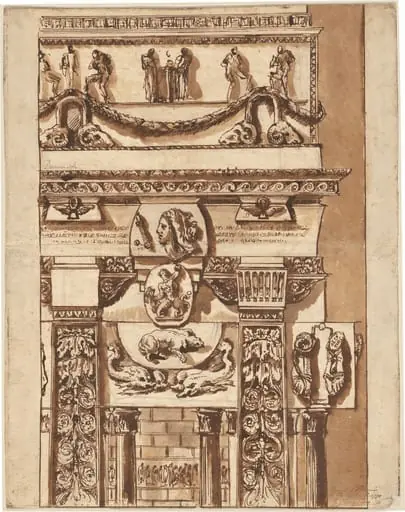 Fantasy of a Façade with Bizarre Ornaments
 Study for an Altar and a Reredos
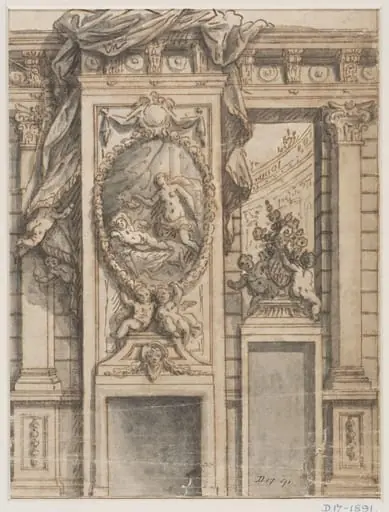 Design for wall decoration, possibly at Chatsworth, Derbyshire
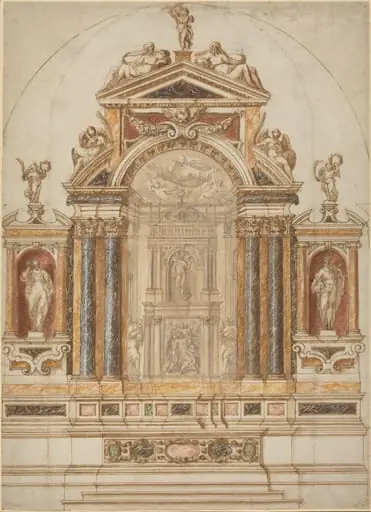 An Elaborate Altar of Colored Marble Ornamented with Sculptures
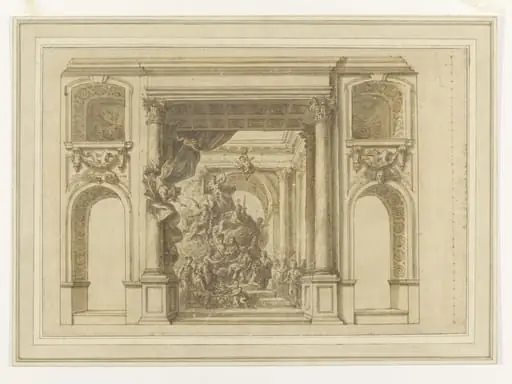 Design for the west wall of the Upper Hall at Greenwich
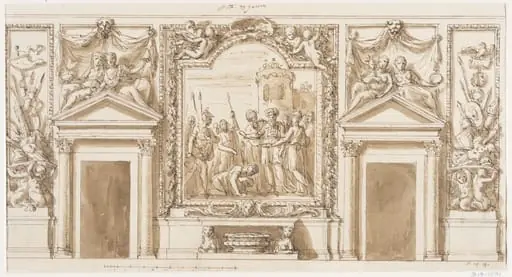 Design for the lower wall of the Great Hall at Moor Park, Hertfordshire
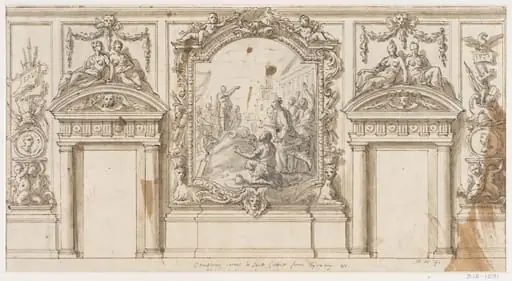 Early project design for the lower wall of the Great Hall at Moor Park, Hertfordshire
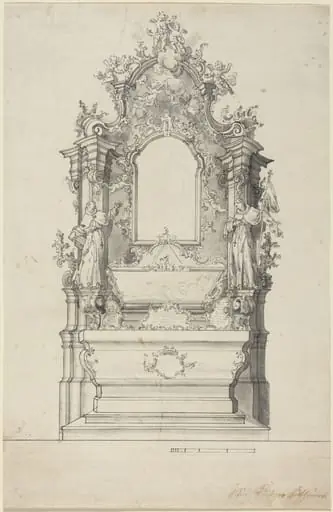 Rococo Altar with a Reliquary Tomb
 Untitled
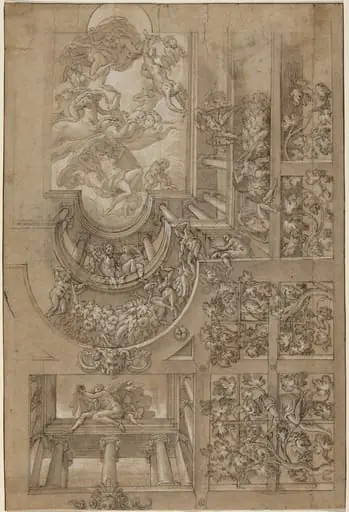 Illusionistic Ceiling with a Grape Arbor, Figures Poised on Galleries, and a Central Scene of Olympian Gods
 A Design for a Wall Decoration or Fountain
 Triumphal Altar with Stages in the Life of Christ